
4-5-1 Formation: Defensive Compactness with a Lone Striker
The 4-5-1 packs five midfielders behind a lone striker — a defensive formation used to absorb pressure and counter-attack. We break down the structure, when it works, and how it differs from 4-1-4-1.
 Tap to enlarge
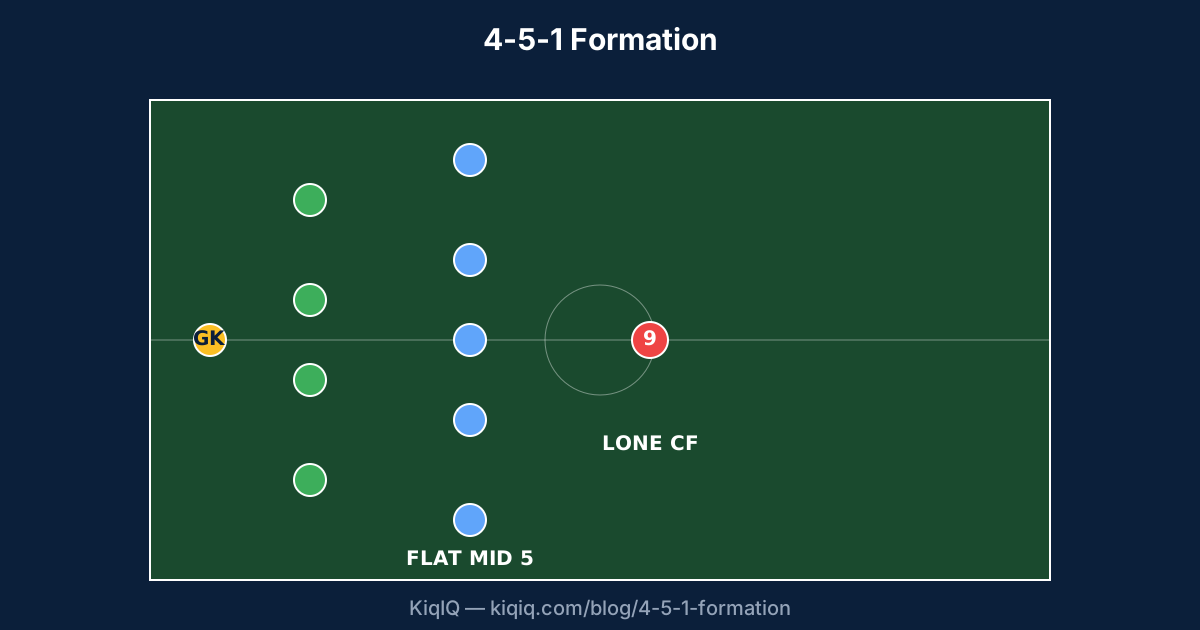
The 4-5-1 packs five midfielders behind a lone striker — a defensive formation designed to absorb pressure, deny central penetration, and counter-attack. It is a flatter shape than 4-1-4-1 (which has explicit depth between a single 6 and the midfield four) and is favoured by sides defending leads or playing against possession-heavy opposition.
The 4-5-1 structure
- Goalkeeper. Standard role.
- Back four. Conservative; full-backs hold position.
- Five-man midfield (flat). Two wide midfielders, two central midfielders, one slightly more attacking. No clear depth division (vs 4-1-4-1).
- Lone striker. Often a target striker or pressing forward who occupies CBs.
4-5-1 vs 4-1-4-1 vs 4-2-3-1: 4-5-1 has a flat 5; 4-1-4-1 has a single 6 + flat 4; 4-2-3-1 has a 2 + 3 split. All three are variants of the same family but with different depth structures.
Strengths of 4-5-1
- Numerical superiority in midfield. 5 midfielders vs typical opposition 3-4 in midfield zones.
- Compact defensive block. Easy to keep narrow with the wide-mids tucking in.
- Counter-attack outlet. Lone striker holds up the ball; midfielders surge forward in transition.
- Coaching simplicity. Defensive shape is intuitive at all levels.
Weaknesses
- Striker isolation. Most pronounced of any formation — the lone CF often runs out of options.
- Lack of depth structure. A flat 5 doesn't have the explicit screening that 4-1-4-1's single 6 provides.
- Width dependent on wide-mids and FBs. If neither attacks, the team has no flank threat.
When 4-5-1 works
- Defending a narrow lead. Final 20 minutes when 1-0 / 2-1 ahead.
- Vs technically superior opposition. Cup-tie second legs, knockout-stage tournament football.
- Counter-attacking sides with one elite lone striker. The CF must be comfortable holding the ball alone.
- Without a strong CDM. If the squad doesn't have a 4-1-4-1-quality holding midfielder, 4-5-1 is the alternative.
Famous 4-5-1 deployments
- Sven-Göran Eriksson's England. Frequently used 4-5-1 in tournament knockouts to defend leads.
- Greece at Euro 2004. Won the tournament with disciplined defensive 4-5-1 / 4-3-3 hybrid.
- Tony Pulis's Stoke (Premier League era). 4-5-1 with Crouch / Walters lone striker; absorbed pressure, counter-attacked.
- Various national teams in tournament football. Default defensive formation for sides expecting to be outnumbered in possession.
Frequently asked questions
- What is the 4-5-1 formation?
- The 4-5-1 is a football formation with 1 goalkeeper, 4 defenders, 5 midfielders (flat band), and 1 striker. It is a defensive formation designed to absorb pressure, deny central penetration, and counter-attack. Greece won Euro 2004 with a defensive 4-5-1 hybrid.
- How is 4-5-1 different from 4-1-4-1?
- 4-5-1 has a flat 5-man midfield with no explicit depth division. 4-1-4-1 has a single CDM at the base + flat midfield 4 in front. Tactically, 4-1-4-1 is more vertically compact and better suited to counter-attacking; 4-5-1 is more uniform but less aggressive in transition.
- When should a team use 4-5-1?
- Three scenarios: defending a narrow lead in the final 20 minutes; playing against technically superior opposition; tournament knockout football where conceding is costlier than scoring. Sven-Göran Eriksson's England regularly used 4-5-1 in this context.
- What is the main weakness of 4-5-1?
- Striker isolation. With a lone CF and no defined number 10 behind (vs 4-2-3-1), the striker often has limited options in attack. The team also lacks the explicit depth structure of 4-1-4-1.
References
- The Coaches' Voice — 4-5-1 Formation — Coaches' Voice
- BBC Sport — Tactics Glossary — BBC Sport
- IFAB Laws of the Game — IFAB
- Jobs in Football — 4-5-1 — Jobs in Football
Key terms in this article
Ask KiqIQ a follow-up
Get a live, data-driven answer powered by api-football + KiqIQ's Poisson model. Try one of these prompts or write your own.
Try the calculators
Apply the concepts from this article with KiqIQ's free calculators.
Part of pillar
Tactical Intelligence
See every article in this knowledge pillar →
Related
Reviewed by a KiqIQ editor before publication. Spotted an error? Email editor@kiqiq.com — we follow our Corrections Policy.