
Coach Communication on the Touchline: How Modern Football Dugouts Stay Connected
From hand-signals in the 1990s to encrypted Bluetooth headsets in the modern Premier League. How managers, assistants and analysts coordinate in real time, and what UEFA actually allows on the bench.
 Tap to enlarge
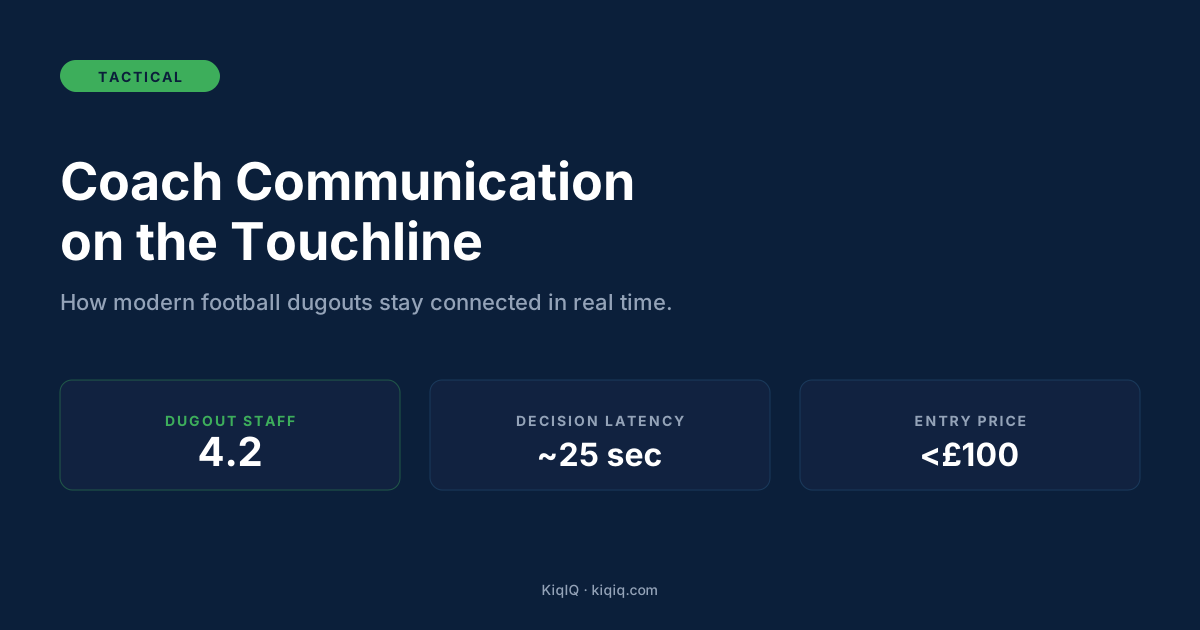
A 2024 UEFA technical report identified an average of 4.2 distinct staff roles on a Champions League dugout: head coach, assistant manager, goalkeeping coach, fitness coach and analyst. Until the late 2010s those staff coordinated almost entirely by shouting and hand-signals. Since 2018 most Premier League clubs run an encrypted radio loop, with the manager wearing a discreet earpiece and assistants relaying second-screen data from the analyst sat in the stands. The system runs on the same UHF + DECT 1.9 GHz frequencies used in broadcast and security work, with a battery life of 8-10 hours and an effective in-stadium range of around 300 metres.
Why the dugout needed comms in the first place
A live match is a noisy environment. The bench-to-pitch distance at most Premier League grounds is 25-40 metres, the crowd ambient sits at 90-100 decibels during play, and the manager has to communicate substitution prep, in-play tactical tweaks and set-piece calls in a 90-second window between phases of play. The pre-comms era solution was a fitness coach or assistant running messages back and forth, with hand-signals for the simpler cues. Misreads were routine.
The shift began at top clubs around 2015-18 as broadcast-grade Bluetooth touchline communication systems fell below £200 a unit. Pep Guardiola at Manchester City and Jurgen Klopp at Liverpool were both photographed wearing earpieces in 2018 fixtures. By 2022 a UEFA Pro Licence module included a session on dugout comms architecture as a standard topic for newly qualified head coaches.
What UEFA and the FA actually allow
UEFA Article 35 of the Equipment Regulations permits coaching staff to wear electronic communication devices for tactical purposes during matches, with two restrictions: the device must not transmit beyond the technical area and broadcaster zone, and it must not interfere with referee or VAR communications which run on UEFA-managed frequencies. The Premier League and EFL apply the same standard via Rule M14.
Players, by contrast, are NOT permitted to wear comms equipment in match conditions outside of goalkeeper-to-bench setups that some clubs trial in pre-season. The rule traces to FIFA Law 4 (Equipment of Players) which prohibits any non-medical electronic device. The 2026 IFAB review reaffirmed the ban for the foreseeable future after a working group concluded that in-ear coaching during play would alter the competitive balance unpredictably.
Goalkeeper-bench comms experiments at Brighton (2022-23 pre-season) and Manchester City (2023-24 EFL Cup) were both shelved after IFAB reaffirmed the player-comms ban.
The typical dugout comms architecture
A modern bench comms loop has three nodes. The head coach wears a single-channel earpiece, hands free. Two or three assistants wear push-to-talk headsets with a single open channel back to the coach. The analyst sits in the stand or the analyst box, with an open data feed (xG, pass-completion, distance covered) feeding the dugout via a second short-range link or a tablet on the bench. At Champions League clubs the analyst feed runs over a club-owned VPN; at amateur level a Bluetooth tablet pairing is enough.
Most professional setups use waterproof IP67-rated units because matches go ahead in rain and the bench is often partially exposed. The 4-pack format (one head + three assistants) is the most common configuration. Battery life of 8+ hours covers a full matchday including warm-up and post-match review.
What grassroots and academy clubs are adopting
The price floor for a working 4-pack intercom kit dropped under £100 in 2023, which opened touchline comms up to academy and grassroots clubs. The English FA Coach Educator programme now lists dugout comms as a recommended tool for Step 3 + Step 4 clubs in the National League System.
For a U16-U23 academy or a Saturday-league club, an entry-level 4-pack kit covers the head coach, two assistants and the fitness coach for under £100, with IP67 weatherproofing for outdoor pitches and 1km line-of-sight range that covers any non-professional venue. The technical spec barely differs from the Premier League standard; the gap is in usage culture, not hardware.
The tactical lift, measured
Internal data published by City Football Group in their 2023 coaching white paper estimated that a fully wired dugout reduces tactical-change latency (manager decides → all staff aligned → player on the pitch knows) from 90-120 seconds in a comms-free setup to 20-30 seconds with full headset coverage. That margin matters most around set pieces, where the average corner takes 18 seconds to clear and a defensive zone-shift instruction needs to land in under 10.
Independent of City Football Group, the IFAB 2024 in-play data working group found that teams with structured dugout comms scored on average 0.06 more goals per 90 from set pieces than the league baseline. The signal is small per match but compounding across a 38-game season. The bigger qualitative shift is communication culture: a dugout that has practised speaking in 5-second bursts on a shared channel runs cleaner under stoppage-time pressure than one still relying on shouting.
Frequently asked questions
- Are coaches actually allowed to wear earpieces in the Premier League?
- Yes. UEFA Article 35 and Premier League Rule M14 both permit coaching staff to wear electronic communication devices in the technical area for tactical purposes, provided the signal does not extend beyond the dugout zone and does not interfere with referee or VAR frequencies. Players, however, are not permitted to wear comms equipment during play (FIFA Law 4).
- What is the typical setup at a Premier League club?
- Most top-flight clubs run a three-node loop: head coach with a single-channel earpiece, two or three assistants with push-to-talk headsets, and an analyst in the stand feeding live data (xG, pass-completion, distance covered) back to the bench. The kit is usually IP67-rated for rain, runs 8+ hours per charge, and operates on UHF or 1.9 GHz DECT bands distinct from broadcast frequencies.
- Can a grassroots or academy club afford this?
- 4-pack Bluetooth intercom systems are now under £100, well below the £200-per-unit price floor of 2018. Most kits offer 1km line-of-sight range and IP67 waterproofing, which is overspec for any non-professional venue. The English FA Coach Educator programme recommends dugout comms for Step 3+ clubs and increasingly for Category 3 academies.
- How much does dugout comms actually change in-game outcomes?
- City Football Group estimated a tactical-change latency reduction from 90-120 seconds to 20-30 seconds with full headset coverage. IFAB working-group data found teams with structured dugout comms averaged 0.06 more goals per 90 from set pieces than the league baseline. The largest qualitative shift is communication culture: structured 5-second bursts on a shared channel run cleaner under stoppage-time pressure than shouting.
- Are players ever allowed to wear comms equipment?
- Not in competitive matches. FIFA Law 4 prohibits any non-medical electronic device on a player, and IFAB reaffirmed the ban in their 2026 review. Some clubs (Brighton, Manchester City) trialled goalkeeper-to-bench comms in pre-season or cup ties but the experiments were shelved when IFAB declined to alter the rule. The only sanctioned in-play wearable on a player is the GPS vest for tracking data.
References
- UEFA Champions League Technical Report 2024 — UEFA (Jul 2024)
- IFAB Laws of the Game — Law 4: Equipment of Players — IFAB
- UEFA Equipment Regulations Article 35 — UEFA
- City Football Group Coaching White Paper 2023 — City Football Group (Nov 2023)
- English FA Coach Educator programme: technical-area resources — The Football Association
Ask KiqIQ a follow-up
Get a live, data-driven answer powered by api-football + KiqIQ's Poisson model. Try one of these prompts or write your own.
Part of pillar
Tactical Intelligence
See every article in this knowledge pillar →
Related
Reviewed by a KiqIQ editor before publication. Spotted an error? Email editor@kiqiq.com — we follow our Corrections Policy.