
Ibrox Stadium: 126 Years at the Heart of Rangers FC
From the 1902 first-stand collapse to the 1971 Stairway 13 disaster to Archibald Leitch's rebuild, the story of one of British football's most architecturally distinct grounds.
 Tap to enlarge
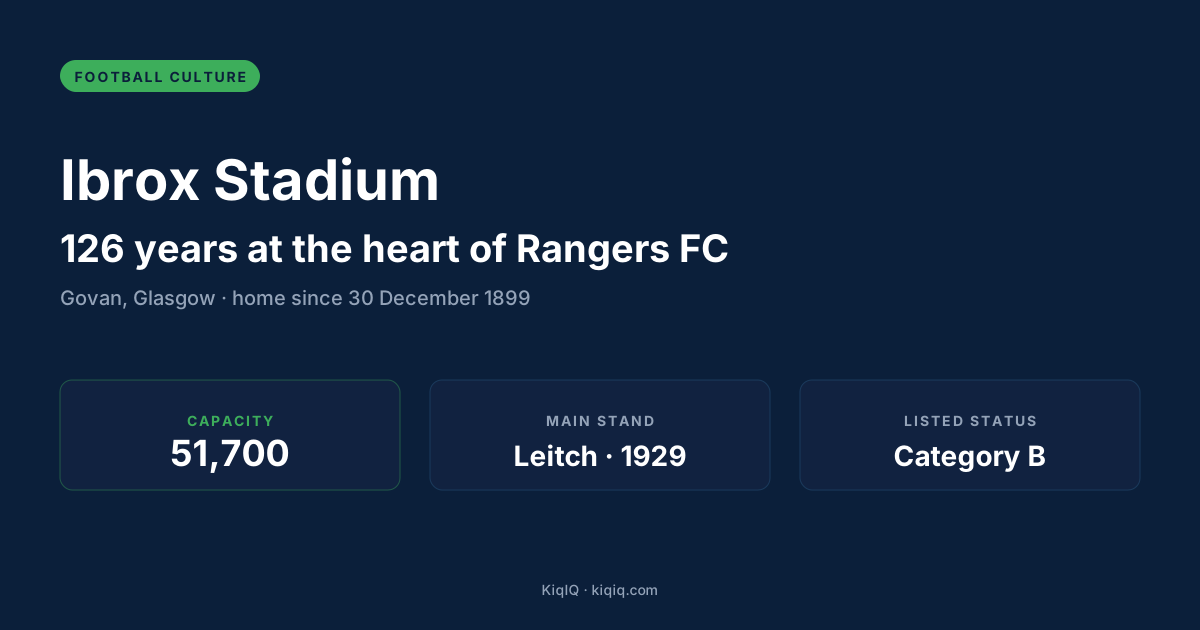
Ibrox has been Rangers Football Club's home since 30 December 1899, the third ground the club has used since its 1872 founding. The current 51,700-capacity stadium sits on the same Govan footprint as the original wooden-stand version, with three of its four stands rebuilt between 1978 and 1981 to a bowl configuration after the 1971 Stairway 13 disaster killed 66 supporters. The fourth, Archibald Leitch's 1929 Main Stand, is a Category B listed structure with the only surviving Leitch facade still in match use at a top-flight British football ground.
The 1899 move and the 1902 first disaster
Rangers moved to the current Ibrox stadium site on 30 December 1899, opening the ground with a 3-1 Scottish Football League win over Hearts in front of 12,000 supporters. The original stadium had two wooden grandstands and earth-bank terracing. Capacity sat at around 75,000 by 1902, which made it one of the largest football venues in Britain.
On 5 April 1902, during a Scotland vs England international match at Ibrox, the western terracing collapsed under the weight of an estimated 30,000 spectators. 25 people died and over 500 were injured. The disaster prompted a complete redesign of British football terracing, with packed-earth banks replacing wooden under-structures across most major grounds over the following decade. The Rangers board commissioned Archibald Leitch, a Glasgow engineer who would go on to design Goodison Park, Anfield, Old Trafford and Stamford Bridge, to rebuild Ibrox in stone and concrete.
The Bill Struth Main Stand and the Leitch facade
Leitch's Ibrox Main Stand opened on 1 January 1929, with a 9-0 win over Celtic. The two-tier red-brick frontage with its central pediment and gable-end staircases became the architectural template for British football stands for the next four decades. The stand was renamed the Bill Struth Main Stand in 2006 in honour of the manager who served from 1920-54 and won 18 league titles. The facade was Category B listed by Historic Environment Scotland in 1980, the only British football stand carrying that designation while still in active match use.
The 10,300-seat capacity of the Main Stand is now the smallest of Ibrox's four stands, but it remains the spiritual centre of the ground: the dressing rooms, the trophy room and the press facilities all sit behind the Leitch facade. The home dressing room contains the original Bill Struth-era furniture, preserved by the club as a heritage feature visible on stadium tours.
The 1971 Stairway 13 disaster and the rebuild
On 2 January 1971, at the end of an Old Firm derby against Celtic, a crush developed on Stairway 13 of the Copland Road exit as supporters tried to leave the ground. 66 people died, the deadliest disaster in British football history at that time. The Wheatley Report which followed led to the Safety of Sports Grounds Act 1975, which mandated stadium safety certificates and capped capacities based on egress capability across all British football venues.
Rangers chose to rebuild rather than refurbish. Between 1978 and 1981 the three non-Leitch stands were demolished and replaced with the modern Copland Road, Broomloan Road and Govan stands, all to a uniform 8,000-9,000 seat capacity, all all-seater from completion (anticipating the all-seater requirement that would follow Hillsborough in 1989). The bowl configuration that resulted gives Ibrox its current capacity of 51,700 and its acoustic character: the steep tiers concentrate crowd noise downward onto the pitch in a way the original terracing could not.
Ibrox was the first British football ground to complete a full all-seater conversion (1981), eight years before the Taylor Report made it a national requirement following Hillsborough.
Ibrox today: an architectural and cultural landmark
The current 51,700 capacity is the third-largest in Scotland after Celtic Park and Murrayfield, and Ibrox typically averages 47,000-48,500 in Scottish Premiership matches, giving Rangers one of the highest utilisation rates in European top-flight football. The bowl has hosted Champions League group-stage football, Europa League knockout ties, Scottish Cup finals when Hampden Park is unavailable, and international fixtures for Scotland.
The Bill Struth Main Stand's red-brick frontage has been featured in Royal Mail commemorative stamps (1999), and Historic Environment Scotland identified it in 2020 as one of the 100 most architecturally significant buildings in Glasgow. For Rangers supporters and football historians alike, the Main Stand is the structural link between the club's pre-WW2 dominance under Struth and the modern Champions League era.
The five biggest matches at Ibrox
Rangers 4-1 Hearts (30 December 1899, opening match), Scotland 1-2 England (5 April 1902, the disaster match), Rangers 9-0 Celtic (1 January 1929, opening of the Leitch stand), Rangers 1-1 Dynamo Moscow (8 December 1962, the first European tie at the ground), and Rangers 3-2 Borussia Dortmund (16 March 2022, the Europa League knockout that took Rangers to the final in Seville). Each match marks a structural or cultural inflection point for the venue.
The Old Firm derby remains Ibrox's defining recurring fixture. Across the post-WW2 era Rangers and Celtic have met more than 400 times at the ground, with the 2/3 January slot specifically a Scottish football institution: the New Year derby has been an Ibrox tradition since the 1888 founding of the rivalry.
Frequently asked questions
- When did Rangers move to the current Ibrox site?
- On 30 December 1899. The club opened the ground with a 3-1 Scottish League win over Hearts in front of 12,000 supporters. It was Rangers' third ground since the 1872 founding, after the original Flesher's Haugh and Kinning Park.
- What was the 1902 Ibrox disaster?
- During a Scotland vs England international on 5 April 1902, the western wooden terracing collapsed under the weight of an estimated 30,000 spectators. 25 people died and over 500 were injured. The disaster prompted Rangers to commission Archibald Leitch to rebuild Ibrox in concrete and stone, and reshaped British football terracing standards.
- What happened on Stairway 13 in 1971?
- On 2 January 1971, at the end of an Old Firm derby, a crush developed on Stairway 13 of the Copland Road exit as supporters tried to leave. 66 people died, the deadliest disaster in British football history at that time. The Wheatley Report which followed led to the Safety of Sports Grounds Act 1975 and Rangers' decision to demolish and rebuild three of Ibrox's four stands between 1978-81.
- What is the current capacity of Ibrox?
- 51,700 all-seater. The Bill Struth Main Stand holds approximately 10,300, with the Copland Road, Broomloan Road and Govan stands each at 8,000-9,000 plus corporate and disabled-access areas. The figure makes Ibrox the third-largest stadium in Scotland after Celtic Park (60,000+) and Murrayfield (67,144).
- Is the Main Stand a listed building?
- Yes. Historic Environment Scotland Category B listed the Bill Struth Main Stand facade in 1980, recognising its 1929 Archibald Leitch design. It is the only Leitch facade still in active match use at a top-flight British football ground after the demolitions at Old Trafford (1995) and Highbury (2006).
References
- Ibrox Stadium: official history — Rangers FC
- Engineering a Football Stadium: Archibald Leitch and the Modern Game — English Heritage Press (Jun 2018)
- The Wheatley Report on Crowd Safety at Sports Grounds (1972) — HMSO (May 1972)
- Bill Struth: The Boss — Rangers FC
- Listed Building Record: Bill Struth Main Stand, Ibrox — Historic Environment Scotland
Key terms in this article
Ask KiqIQ a follow-up
Get a live, data-driven answer powered by api-football + KiqIQ's Poisson model. Try one of these prompts or write your own.
Part of pillar
Football Culture
See every article in this knowledge pillar →
Related
Reviewed by a KiqIQ editor before publication. Spotted an error? Email editor@kiqiq.com — we follow our Corrections Policy.