
St James' Park: Newcastle United's Home in the Heart of Tyneside
From the 1880s athletics ground to the Cathedral on the Hill, the story of a stadium constrained by Leazes Park, a railway and a public road, and the renovation that may finally lift its capacity.
 Tap to enlarge
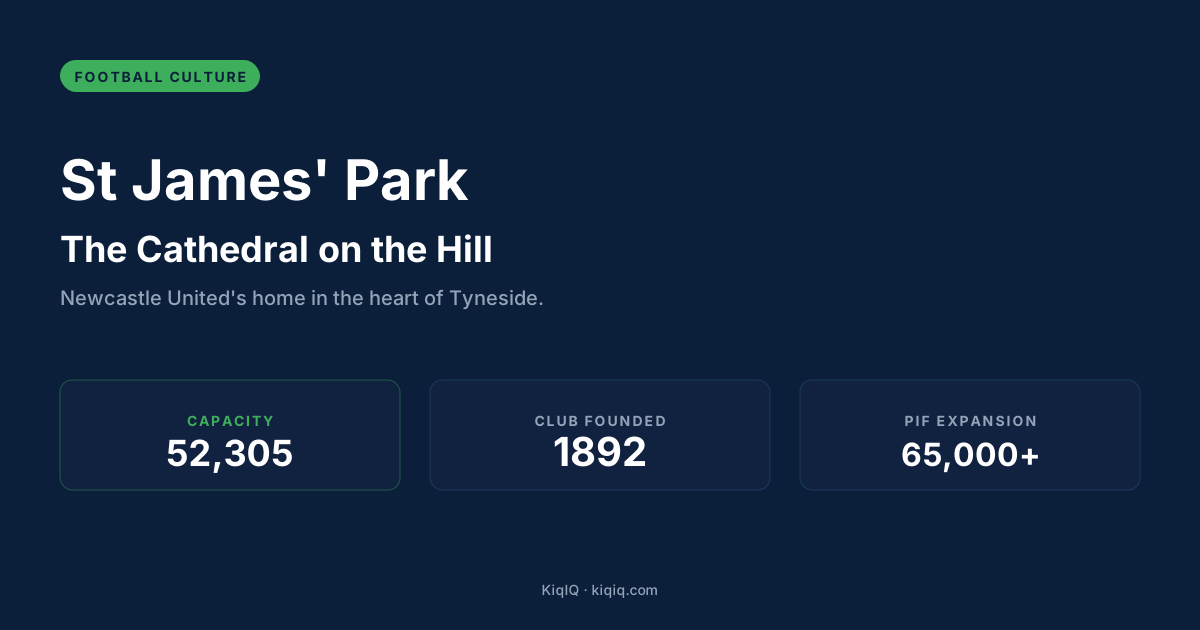
St James' Park has been Newcastle United's home since the club's formation in December 1892. The site has hosted football since the 1880s, originally as the home of Newcastle West End and Newcastle East End, the two clubs that merged to create Newcastle United. The ground's defining architectural feature is its asymmetry: the western Milburn Stand and northern Leazes End were rebuilt in 1998-2000 as 51-metre tall cantilever structures, while the southern Sir Bobby Robson Stand and eastern Gallowgate End remained at the older 30-metre profile. Total capacity sits at 52,305, the seventh-largest club ground in England. A PIF-funded expansion to 65,000+ seats is in early planning as of 2026.
The 1880s athletics ground and the 1892 merger
The St James' Park site, on the southern edge of Leazes Park in central Newcastle, hosted athletics, cricket and informal football matches from the early 1880s. Newcastle West End FC played at the ground from 1886, in modest wooden-stand-and-terrace facilities. The club was financially distressed by 1892 and merged in December that year with their crosstown rivals Newcastle East End to form Newcastle United, with the new combined club taking over the West End's lease at St James' Park.
The first competitive Newcastle United match at St James' Park was a 2-2 draw with Glasgow Celtic in a friendly on 3 September 1892. League fixtures followed when Newcastle entered the Football League Second Division in 1893. The club purchased the freehold of the ground in 1925 for £20,000, securing the long-term occupation, but the geographical constraints — Leazes Park to the north, Strawberry Place to the east, residential streets to the south, the West Road to the west — meant that any expansion would always require building upward rather than outward.
Archibald Leitch and the 1905-30 modernisation
Newcastle commissioned Archibald Leitch in 1905 to design a new Main Stand for the western side of the ground, ahead of the 1905-06 season in which Newcastle would win their first league title. Leitch's Newcastle commission was contemporaneous with his Stamford Bridge and Glasgow Rangers work; his Main Stand at St James' was a pitched-roof brick structure with the central-pediment styling that became his recognisable signature.
The Leitch Main Stand stood until 1986, when it was demolished as part of the Sir John Hall era expansion. Hall, the property developer who became Newcastle chairman in 1992 and floated the club on the London Stock Exchange in 1997, funded the Milburn Stand rebuild (1986-88) and then the dramatic 1998-2000 expansion that gave the ground its current asymmetric silhouette. The original Leitch facade was the visual reference for the modern Milburn Stand's brick lower tier, though the steel-and-glass upper tiers depart entirely from Leitch's 1905 design.
St James' Park hosted matches for both Newcastle West End and Newcastle East End in the 1880s. The two clubs merged in December 1892 to form Newcastle United, with the new club taking over the West End's lease at the ground.
The asymmetric 1998-2000 expansion
The Taylor Report (1990) required all-seater conversion across the top two English divisions. Newcastle's response under Sir John Hall was a phased rebuild that fundamentally changed the ground's silhouette. Between 1993 and 1995 the Milburn Stand was rebuilt to a 12,500-seat capacity, the Gallowgate End was converted to seating, and the Sir Bobby Robson Stand (then the East Stand) was rebuilt. The total capacity sat at around 36,500 by 1995, which proved inadequate for Newcastle's Premier League ambitions under Kevin Keegan.
The dramatic 1998-2000 expansion added a third tier to both the Milburn Stand (final capacity 14,200) and the Leazes End (final capacity 11,400), creating the towering 51-metre asymmetric profile that defines the ground today. The Sir Bobby Robson Stand and Gallowgate End remained at the lower 30-metre profile because the geography — Strawberry Place to the east, the railway viaduct to the south — prevented adding equivalent third tiers on those sides. Total capacity rose to 52,305 and has held at that figure since the 2000 completion.
The Bobby Robson era and the cultural place of St James' Park
Sir Bobby Robson managed Newcastle 1999-2004, returning the club to Champions League football in 2002-03 and 2003-04. The Sir Bobby Robson Stand (formerly the East Stand) was renamed in November 2009 following Robson's death from cancer that summer. A nine-foot statue of Robson stands outside the Milburn Stand entrance, sculpted by Tom Maley and unveiled by Robson's widow Lady Elsie in May 2012.
St James' Park's cultural place in Newcastle is unusually central for a Premier League ground. The stadium sits 600 metres from Central Station and 400 metres from the city's commercial centre, making it the most central club ground in the Premier League (Manchester City's Etihad Campus and Chelsea's Stamford Bridge are both further from their city centres). Local Tyneside writing refers to the ground as "the Cathedral on the Hill" — the comparison to Newcastle Cathedral 800 metres south on Mosley Street is a deliberate marker of the stadium's civic importance.
The PIF-era expansion and the brick-set market
Following the October 2021 takeover by the Saudi Public Investment Fund, Newcastle United announced in 2023 a planning study for a 65,000+ seat expansion of St James' Park. The proposed redesign, by architects Heatherwick Studio in association with Foster + Partners, would rebuild the Sir Bobby Robson Stand and Gallowgate End to match the higher Milburn and Leazes profiles, eliminating the asymmetric silhouette and creating a uniform 65,000+ bowl. The plan also includes leasehold acquisition of the Strawberry Place car park to allow the eastern expansion.
Planning permission has not yet been submitted as of 2026 — Newcastle City Council is reviewing the proposal as part of the wider Leazes Park heritage area planning framework. The Cathedral on the Hill silhouette may therefore be on borrowed time. Officially licensed brick-built kits preserve the asymmetric four-stand layout as it stands today, becoming historical artefacts once the planned PIF-era rebuild begins.
Frequently asked questions
- When did Newcastle United move to St James' Park?
- Newcastle United did not exist before St James' Park. The site hosted Newcastle West End from 1886, and the new club was formed in December 1892 through the merger of Newcastle West End and Newcastle East End. The first competitive Newcastle United match at St James' Park was a 2-2 draw with Glasgow Celtic in a friendly on 3 September 1892. The club purchased the ground's freehold in 1925 for £20,000.
- Why is St James' Park asymmetric?
- Geography. The Milburn Stand (west) and Leazes End (north) were rebuilt to a 51-metre, three-tier, 14,200-seat profile in the 1998-2000 expansion under Sir John Hall. The Sir Bobby Robson Stand (east, formerly East Stand) and Gallowgate End (south) could not be raised to the same height because Strawberry Place to the east and the railway viaduct to the south block adjacent expansion. Total capacity sits at 52,305.
- Who is the Sir Bobby Robson Stand named after?
- Sir Bobby Robson, who managed Newcastle 1999-2004 and returned the club to Champions League football. Robson died from cancer in 2009; the East Stand was renamed in his honour in November 2009. A nine-foot statue of Robson by sculptor Tom Maley stands outside the Milburn Stand entrance, unveiled by Lady Elsie Robson in May 2012.
- Will St James' Park be expanded?
- Yes — a 65,000+ seat expansion has been announced by the PIF-owned Newcastle United, designed by Heatherwick Studio with Foster + Partners. The plan would rebuild the Sir Bobby Robson Stand and Gallowgate End to match the higher Milburn and Leazes profiles, eliminating the current asymmetric silhouette. Planning permission has not been submitted as of 2026; Newcastle City Council is reviewing the proposal within the Leazes Park heritage framework.
- Why is St James' Park called the Cathedral on the Hill?
- A Tyneside cultural reference. The stadium sits on raised ground 600 metres north of Newcastle Central Station and 800 metres north of Newcastle Cathedral itself, making it the visual peak of the city centre skyline from the south. The comparison to a cathedral marks the ground's civic importance and central location — St James' Park is the most central club ground in the Premier League, unmatched by any other top-flight venue.
References
- Newcastle United: official history of St James' Park — Newcastle United FC
- Engineering a Football Stadium: Archibald Leitch and the Modern Game — English Heritage Press (Jun 2018)
- Sir Bobby Robson Foundation: stand naming and legacy — Sir Bobby Robson Foundation
- Newcastle City Council: Leazes Park planning framework — Newcastle City Council
- Heatherwick Studio: stadium architecture portfolio — Heatherwick Studio
Ask KiqIQ a follow-up
Get a live, data-driven answer powered by api-football + KiqIQ's Poisson model. Try one of these prompts or write your own.
Part of pillar
Football Culture
See every article in this knowledge pillar →
Related
Reviewed by a KiqIQ editor before publication. Spotted an error? Email editor@kiqiq.com — we follow our Corrections Policy.