
The 2-5-3 looks like an experiment on a tactics board. On the pitch, it is one of the most positionally demanding systems a coaching team can build, relying on midfield discipline and collective transition defence that most squads cannot sustain without structural preparation and deliberate squad selection.
By David Findlay, Founder of KiqIQ.
Quick Answer: The 2-5-3 football formation arranges two defenders, five midfielders, and three forwards, concentrating numerical advantage in central midfield and the final third. Its viability depends on the midfield five maintaining collective defensive shape during transitions, as the two-man backline cannot cover the full width of the pitch without significant exposure to wide and diagonal attacks.
Definition: The 2-5-3 football formation is a tactical structure that positions two centre-backs as the sole defensive line, five midfielders operating across central and wide corridors, and three forwards in the attacking third. The formation prioritises numerical superiority in midfield and attack over defensive security, placing the full burden of press recovery and transition defence on the midfield band.
Key point: The 2-5-3 formation functions as an attack-first system. Its defensive integrity rests entirely on how quickly and collectively the midfield five can compress space after possession is lost.
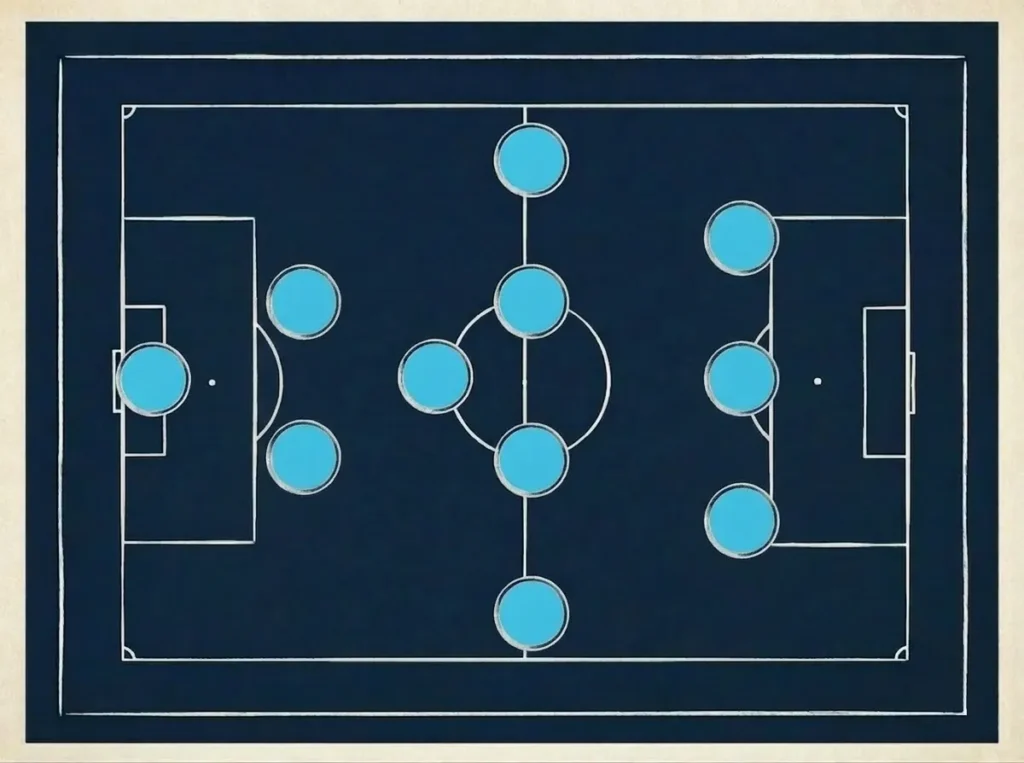
Formation Structure: What the 2-5-3 Actually Looks Like
While the definition is clear, the transitional discipline required from the midfield five is where most attempts to deploy the 2-5-3 break down at sustained intensity.
The 2-5-3 splits the pitch into three distinct bands. At the back, two centre-backs operate without full-back cover on either side. In midfield, five players typically divide into a defensive-leaning pair and three attacking midfielders, though the configuration adjusts depending on the game model. Three forwards occupy the attacking third, usually operating as a central striker and two wide forwards.
The shape is best understood as a high-density central block. Width is generated by the widest midfield players rather than traditional full-backs. This demands that those wide midfielders contribute defensively by tracking opposition runners into the channels that would normally fall to a full-back’s responsibility.
In most implementations the midfield five operates in one of two sub-shapes:
- A 2-3 split: Two deeper midfielders protect the centre-backs, while three attacking midfielders link play between the base and the front three.
- A flat five: All five midfielders operate at a similar line of confrontation, requiring synchronised movement to shift between attacking and defensive shape in real time.
Neither configuration eliminates the defensive exposure at the back. Both demand high positional intelligence from every outfield player outside the front three.
| Position | Number | Primary Role | Key Defensive Requirement |
|---|---|---|---|
| Centre-back | 2 | Last line of defence covering the central defensive zone | Defend 1v1 and in channels without full-back support on either flank |
| Defensive Midfielder | 2 | Shield the centre-backs and recycle possession under pressure | Step out to support the press without leaving unprotected space behind |
| Attacking Midfielder | 3 | Link midfield to attack and create combinations with the front three | Activate press triggers collectively and recover immediately after losing possession in advanced zones |
| Wide Midfielder | 2 (part of the five) | Provide width in attack and support wide transitions | Track opposition runners into the flanks vacated by the absence of traditional full-backs |
| Centre-forward | 1 | Focal point for hold-up play and runs in behind the defensive line | Lead the press structure from the front to reduce the opposition's time on the ball |
| Wide Forward | 2 | Stretch the defensive line horizontally and create wide overloads | Track opposition defenders in transition and cover wide areas when the midfield press is breached |
Historical Context: The Pyramid and Its Structural Legacy
Early association football was built around attacking numerical advantage rather than defensive organisation. The 2-3-5 formation, known as the Pyramid, dominated the game from the late nineteenth century into the early twentieth century. It placed five forwards ahead of three midfielders and two defenders, treating goal creation as the primary structural objective.
The 2-5-3 reverses the midfield-to-forward ratio of the Pyramid, redistributing two of the Pyramid’s forwards into a deeper midfield role. The structural logic is related: dominate central areas, overload the opposition’s middle third, and rely on the remaining forwards to convert the chances that a numerically superior midfield generates.
Herbert Chapman’s development of the WM formation in the 1920s shifted English football away from attack-first structures. The WM addressed the defensive exposure of the Pyramid by repositioning the centre-half as a third central defender, creating a more balanced shape across both phases. The 2-5-3 can be understood as a deliberate return to that attack-first structural logic, applied to a modern positional context where midfielders carry both offensive and defensive phase responsibilities.
The Midfield Five: Roles, Positioning, and Phase Demands
The success or failure of the 2-5-3 is decided in the midfield band. Five players must perform attacking and defensive functions across the full width of the pitch within the same tactical structure. Each role carries distinct positional demands.
The two deeper midfielders are the formation’s primary defensive anchor. Their positioning directly protects the centre-backs. When the team presses high, these two players must manage the transition space between the pressing line and the defensive pair. If one commits too high without the other covering, the gap behind is exposed immediately.
The three attacking midfielders serve as the connective tissue between the midfield base and the front three. They carry responsibility for press activation in the opposition half, support play in transitions, and must recover quickly when the team loses the ball in advanced zones.
The widest midfielders perform a function closer to modern wing-backs than traditional wide midfielders. They must provide width in attack and track back to cover the space outside the centre-backs when possession is conceded, a dual demand that requires significant physical output across ninety minutes.
The Defensive Trade-off: Two Defenders and a Structural Gamble
No honest analysis of the 2-5-3 avoids the central risk. Two defenders covering a full-width pitch against a counter-attacking side is a structural gamble that has to be managed through collective midfield discipline, not compensated for at the back.
The two-man defensive line can operate effectively under two conditions. First, when the team maintains high-press intensity and prevents the opposition from building with any regularity from the back. Second, when the midfield five holds its defensive shape and compresses the space in front of the defenders before the opposition can play through the central channel.
If either condition breaks down, the two centre-backs face a three-versus-two situation or worse. Long diagonal balls over the midfield press, quick transitions through the central corridor, or wide runners exploiting the absent full-back position expose the formation immediately and consistently.
Coaches who deploy the 2-5-3 must be confident that the squad’s press recovery rate is high enough to prevent the two defenders from facing repeated isolation. This is not a formation for teams that press without collective tracking discipline across all five midfielders.
Build-up and Attacking Principles in the 2-5-3
In possession, the 2-5-3 creates significant numerical advantages in central zones. The midfield five can overload the opposition’s middle third, with the two deeper players recycling possession and the three attacking midfielders creating combinations with the front three at the point of attack.
The three forwards typically divide into a central striker and two wide forwards. The wide forwards stretch the opposition’s defensive line horizontally, creating space for the central striker to receive between the lines or in behind. Alternatively, the attacking midfielders can make late runs beyond the front three’s initial positions, arriving into the box with the advantage of not being tracked from deeper defensive positions.
Width is a critical consideration throughout. Without full-backs, the team relies on the wide midfielders and wide forwards to stretch play. If both wide positions are occupied by players who drift naturally inside, the formation becomes too narrow and the opposition’s central defenders can compress without conceding space in behind.
Press-Break Rate: The Primary Metric for Evaluating the 2-5-3
For coaches and analysts assessing whether the 2-5-3 is functioning, press-break rate is the primary indicator. A team running this formation should be pressing high and winning the ball early. If the opposition is breaking the press with regularity, the defensive exposure at the back becomes structurally untenable.
A high press-break rate against a 2-5-3 signals one of three problems: pressing triggers are not coordinated across the midfield five, the two deeper midfielders are not stepping out aggressively enough to support the press in transition, or the three forwards are pressing without a connected structure behind them. Each problem creates a different type of exposure in front of the defensive line.
Tracking press-break rate alongside progressive passes conceded in the defensive third gives analysts a clearer picture of where the 2-5-3 is breaking down in specific match contexts, rather than attributing every defensive problem to the raw two-defender structure.
When the 2-5-3 Can Work
The 2-5-3 is most viable in specific match contexts rather than as a full-season base system. The scenarios where it offers genuine tactical value include the following.
- When chasing a result: The 2-5-3 offers attacking overloads and midfield numerical superiority that can create chances against a defensive block. It is a high-risk option with a corresponding return in creative volume and goalscoring opportunity.
- Against opposition with limited wide threat: If the opposing team lacks pace in transition or carries minimal wide attacking output, the two-defender structure is less exposed and the midfield five can operate with greater positional freedom.
- As a game-state rotation: Starting from a more balanced shape and transitioning into a 2-5-3 in the final twenty minutes can disorient a defending team that has organised against a different structure throughout the match.
Using the 2-5-3 as a permanent base formation requires a squad built specifically for its demands, with high defensive work rates across midfield, physical capacity for repeated transition cycles, and two centre-backs comfortable operating with large amounts of space behind a high defensive line.
Frequently Asked Questions
What is the 2-5-3 football formation?
The 2-5-3 football formation is a tactical shape using two defenders, five midfielders, and three forwards. It prioritises attacking numerical advantage and midfield control but requires strong collective defensive behaviour from the midfield five to protect the exposed two-man backline during transitions and counter-attacks.
The 2-5-3 shares structural logic with the 2-3-5 Pyramid used in early football. The Pyramid placed five forwards in advanced positions, while the 2-5-3 redistributes two of those forward positions into a deeper midfield role, retaining the attack-first principle while adding central midfield control.
What are the main risks of the 2-5-3 formation?
The primary risk is the two-man defensive line. Without full-backs, the centre-backs are exposed to wide attacks and diagonal balls played into the channels. The formation is vulnerable to teams that break the press quickly and transition with pace through central or wide positions before the midfield five can recover its shape.
Which teams have used the 2-5-3 formation at professional level?
The 2-5-3 is not a standard professional base formation. It is discussed primarily as a variant system for specific match scenarios and within tactical theory contexts. Related historical formations such as the 2-3-5 Pyramid were widely used across professional football before the 1920s but represent a different distribution of the attacking weight across the three bands.
What does the midfield five do in a 2-5-3 system?
In the 2-5-3, the midfield five divides into two deeper defensive midfielders protecting the centre-backs and three attacking midfielders linking play with the front three. The widest members of the five also perform defensive tracking roles to cover the flank zones that traditional full-backs would occupy in most other formations.