
The 3-5-2 Formation Explained: Roles, Strengths, and Weaknesses
The 3-5-2 formation uses three centre-backs, two wing-backs, and three central midfielders behind a front two. We explain each role and when the system works.
 Tap to enlarge
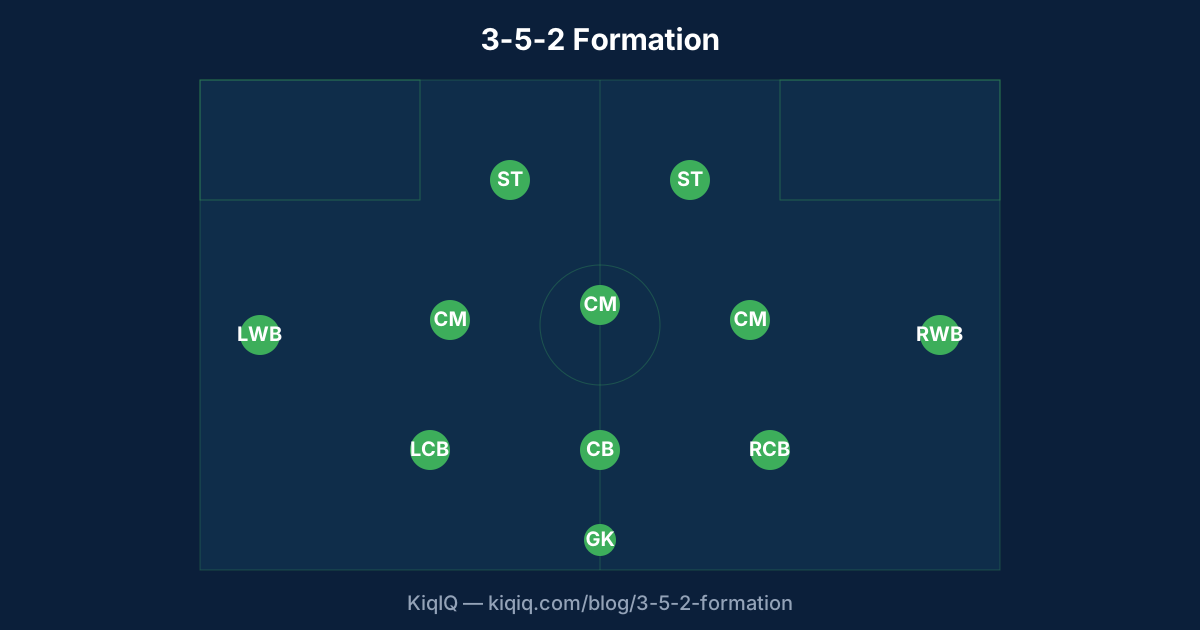
The 3-5-2 is a back-three system with two wing-backs providing all the width, three central midfielders forming a triangle, and two strikers up front. It offers central numerical superiority in midfield and wide thrust through the wing-backs, but lives or dies on those wing-backs' fitness and tactical discipline.
How the 3-5-2 lines up
The defensive base is three centre-backs — typically a left-sided CB, a sweeper-type central CB, and a right-sided CB. The flanks are owned by two wing-backs who push high in possession and tuck back into a back five out of possession.
Midfield is a three: usually a holding midfielder (#6), a box-to-box midfielder (#8), and a more advanced midfielder (#10 or attacking #8). The front line is two strikers — often a target-man + runner pairing (e.g. Lukaku + Dybala at Inter) or two mobile strikers (e.g. Saka shifted to wing-back roles in some Arsenal setups).
The defining feature is the wing-back position. They are not full-backs and they are not wingers — they are both, at different moments, in the same shirt.
Try it
The 3-5-2 on the pitch
Tap a player to read the role. Toggle to 3-4-3 to see what happens when a midfielder is traded for a third forward.
Tap a player to read the role. Currently showing 3-5-2, attacking upwards.
Everything in the 3-5-2 hangs on the wing-backs. If they cannot cover the full length of the pitch for ninety minutes, the shape becomes a 5-3-2 that never gets out.
Strengths of the 3-5-2
Three structural advantages stand out:
- Midfield numbers. Five players occupy the central zone (three midfielders + two strikers dropping). Against a 4-3-3 the 3-5-2 has a 5v3 in the centre.
- Width without sacrificing centre. Width is provided by wing-backs, freeing midfielders to play centrally. The opposite of a 4-3-3 where a wide forward must hug the touchline.
- Defensive solidity in transition. Three centre-backs cover the central channel. If one steps to engage, two cover. This is the structure that produced Italian catenaccio and Conte's scudetto teams.
A 3-5-2 trades wide attacking variety for central density. It is a format for sides that want to control midfield first.
Weaknesses and pressure points
Three known problems. First, wing-back fatigue — the wing-backs cover the entire flank both in attack and defence. They run more than any other position on the pitch, often 11+ km per match. A 3-5-2 with tired wing-backs becomes a 5-3-2 stuck deep.
Second, vulnerability to wide overloads — if the opposition floods one flank with two players against the lone wing-back, the back-three side has to either get a wide centre-back to step up (creating a centre-back gap) or get a midfielder to drop wide (pulling a midfielder out of the centre).
Third, the system needs three good centre-backs. Many sides default to a back four because they only have two reliable centre-backs. A 3-5-2 with one weak link in the back three is a 3-5-2 that loses every wide combination.
Famous 3-5-2 sides
Antonio Conte's Juventus (2011–14, three Serie A titles) — the modern revival of the 3-5-2 with Bonucci, Barzagli, and Chiellini behind Pirlo, Vidal, and Pogba. Conte's Chelsea (2016–17, Premier League title) — converted to 3-4-3 mid-season but originated in 3-5-2 thinking. Conte's Inter (2020–21, Serie A title) — Lukaku and Lautaro as the front two with Hakimi flying down the right.
Argentina at the 2022 World Cup — Lionel Scaloni used a 3-5-2 in knockout matches with Cristian Romero, Lisandro Martínez, and Nicolás Otamendi behind a midfield of De Paul, Mac Allister, and Enzo Fernández. They won the tournament.
When to play a 3-5-2
Three scenarios where the 3-5-2 makes most sense:
- You have two strikers worth pairing — Conte built his sides around Vučinić-Tévez, Costa-Hazard, Lukaku-Lautaro, etc.
- You have two world-class wing-backs (or two players willing to learn the role). Hakimi and Perišić at Inter were essential to that title.
- You want to dominate central midfield against possession-heavy 4-3-3 / 4-2-3-1 opponents — the 5v3 numerical advantage is the structural justification.
Variations: 3-4-3, 3-4-1-2, 3-5-1-1
The 3-5-2 has many close cousins. The 3-4-3 trades a midfielder for an extra forward (Tuchel's Chelsea, Conte's Chelsea after January 2017). The 3-4-1-2 puts a #10 between midfield and the front two (Argentina 2022). The 3-5-1-1 features a single striker with an attacking midfielder behind (used by Spalletti's Roma).
In practice, modern sides flex between these shapes within a single match — pushing wing-backs higher in possession (3-2-5) and dropping them back out of possession (5-3-2). The numbers on the team-sheet are a starting point, not a snapshot.
Frequently asked questions
- What are the 11 positions in a 3-5-2?
- Goalkeeper; three centre-backs (left CB, central CB, right CB); two wing-backs (LWB, RWB); three central midfielders (typically a defensive midfielder + box-to-box + advanced midfielder); two strikers up front. Wing-backs are the defining role — they cover the entire flank.
- What are the strengths of the 3-5-2?
- Numerical superiority in central midfield (5v3 against a 4-3-3), width via wing-backs without weakening the centre, and defensive solidity in transition because three centre-backs cover the central channel. It is a format for sides that prioritise central control.
- What are the weaknesses of the 3-5-2?
- Wing-back fatigue (they run 11+ km per match), vulnerability to opposition wide overloads (2v1 on the flank), and a requirement for three reliable centre-backs. A 3-5-2 with tired wing-backs collapses into a deep 5-3-2 unable to attack.
- Is the 3-5-2 still used in modern football?
- Yes. Conte revived it across Juventus, Chelsea, and Inter, winning league titles at all three. Argentina won the 2022 World Cup using a 3-5-2 in knockout rounds. Many sides flex into it from a back-four base, especially when chasing or protecting a lead.
References
- Antonio Conte's 3-5-2 Tactical Profile · The Analyst
- Argentina's 3-5-2 at the 2022 World Cup · FIFA Technical Study
- Wing-Back Workload Analysis · StatsBomb
- Catenaccio: A Brief History · The Athletic
Key terms in this article
Ask KiqIQ a follow-up
Get a live, data-driven answer powered by our live data feeds + KiqIQ's Poisson model. Try one of these prompts or write your own.
Try the calculators
Apply the concepts from this article with KiqIQ's free calculators.
Part of pillar
Tactical Intelligence
See every article in this knowledge pillar →
Related
Reviewed by a KiqIQ editor before publication. Spotted an error? Email editor@kiqiq.com. We follow our Corrections Policy.