
Pressing Schemes Explained: Mid-Block, High Press, Counter-Press and Pressing Traps
A comparison of the four canonical pressing approaches in modern football: when each is used, how to recognise them on screen, and how pressing traps engineer ball-side overloads.
 Tap to enlarge
Pressing in modern football is not a single tactic. It is a family of four approaches, each defined by where on the pitch the press is engaged and what the team does when possession changes hands. Mid-block, high press, counter-press and the pressing trap sit on the same spectrum but solve different problems. Read the four against each other and the choices of Klopp, Guardiola, Simeone and Bielsa stop looking like personality differences and start looking like rational responses to player profiles, opposition build-up patterns, and the energy budget available across a 90-minute fixture.
The four canonical schemes: what each one does
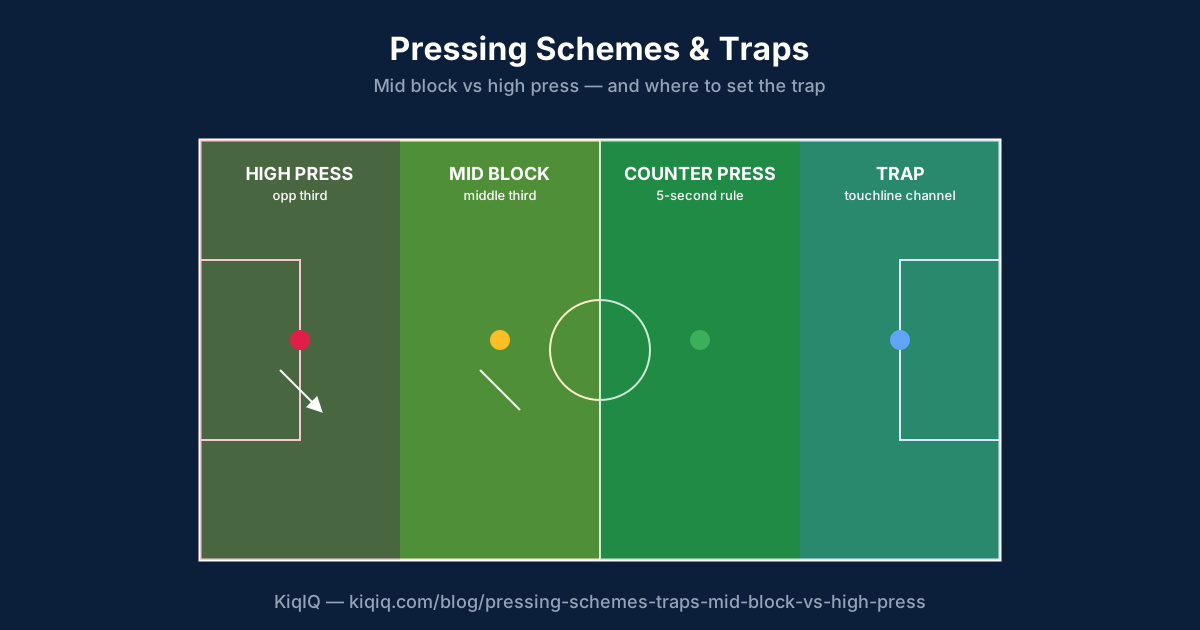
Pressing approaches are defined by two variables: how high up the pitch the engagement line sits, and whether the press is launched proactively (during an opposition build-up phase) or reactively (the instant possession is lost). A mid-block sits around the halfway line and presses proactively once the opposition crosses into the middle third. A high press sits in the opposition half and engages proactively from goal kicks and back-passes. A counter-press fires reactively the moment possession is lost, regardless of pitch position. A pressing trap is a structural variant that uses positional cues to herd the ball into a pre-prepared overload.
The four are not mutually exclusive. Elite sides combine a high press on opposition restarts with a counter-press on every turnover, and may shift into a mid-block when leading late or when the high press has been bypassed twice in succession. Spielverlagerung's tactical writing has been the most consistent public source for treating these schemes as a spectrum rather than as competing doctrines (Spielverlagerung tactical archive).
High press = proactive, high engagement line. Mid-block = proactive, mid engagement line. Counter-press = reactive on turnover. Pressing trap = a structural cue that engineers the engagement, not a separate height.
Mid-block: the energy-efficient default
A mid-block engages around the halfway line, with the defensive line pushing up to roughly 35-40 metres from the goalkeeper and the front line dropping back to meet the midfield. The shape is typically a 4-4-2 or a 4-5-1, with both banks compact and the gap between lines kept under 15 metres. The team allows the opposition to build out of the back unopposed, then engages when the ball reaches the middle third.
Diego Simeone's Atlético Madrid has been the most studied mid-block of the modern era. The shape concedes possession share and accepts opposition territorial dominance in the first phase, then forces play into pre-prepared compression zones in the middle third where the press fires (The Athletic tactics coverage, 2024). The mid-block's strengths are energy preservation, structural integrity against possession-heavy opponents, and the ability to spring counter-attacks from the middle third where the opposition defence is least set. Its weaknesses are the loss of high-turnover opportunities in the opposition third and a vulnerability to long, direct balls into the channel behind the defensive line when the press fires too aggressively from the front.
Try it
Mid-block against high press
Two schemes from the same family, separated by where the team decides to engage.
Engage around the halfway line
The side concedes the opposition's own third and defends the middle of the pitch, where the compactness costs least to maintain.
- Far lower energy cost, so it holds for ninety minutes.
- Space in behind is short, because the defensive line is deeper.
- Concedes territory and possession by design.
Neither is a philosophy. Most elite sides run both inside a single match, and the interesting question is what makes them switch.
High press: Klopp, Pep, and the cost of conceding behind
A high press engages in the opposition half, typically triggered by a back-pass, a centre-back receiving on his weaker foot, or a goalkeeper distribution. The front line presses the ball-carrier with two forwards, the wide forwards screen the full-backs, the midfield steps up to compress the central pass options, and the defensive line steps up to within 35-40 metres of the opposition goal. The intent is to force a turnover high up the pitch, where the opposition defence is least set and the route to goal is shortest.
Klopp's Liverpool of 2018-2020 is the canonical reference. The team averaged 18-22 pressing actions per match, ran ball-recovery times in the 5-7 second range, and generated meaningful xG from open-play turnovers in the opposition third (StatsBomb pressing analysis). Pep Guardiola's Manchester City use a more selective high press, with the engagement triggered by positional cues (a centre-back stepping up unmarked, a goalkeeper distributing under pressure) rather than every back-pass. The two share a common cost: when the press is bypassed, the defensive line is high and the gap behind is large. The 2020-21 Liverpool collapse after the van Dijk, Gomez and Matip injuries demonstrated what happens when the high press loses the rapid-recovery centre-backs that hold the line.
Counter-press: the five-second window after losing the ball
A counter-press, Gegenpressing in the German original, is a reactive scheme triggered the instant possession is lost. Instead of retreating into defensive shape, the nearest 4-5 players collapse on the new ball-carrier from multiple angles within roughly five seconds. The intent is to win the ball back before the opposition can set its attacking shape, exploiting the disorganised state of the team that just won possession.
The five-second window is structural, not arbitrary. The moment a team wins the ball, its attackers are scattered, its midfielders are not yet in defensive shape, and the ball-carrier is rarely the most ball-secure player on the team. Klopp called the counter-press "the best playmaker" because a regain in the opposition half eliminates the need to build attacks from deep (Coaches' Voice, Klopp profile). The data signature is a ball-recovery time of 5-7 seconds for elite sides, against a mid-table baseline of 9-11 seconds, and a press-regain rate above 35% within the five-second window (StatsBomb).
The risks are obvious. Counter-pressing commits players forward at the moment the team is most exposed. Without a screening midfielder who does not commit forward (Rodri at City, Fabinho at Liverpool in his prime), a rapid-recovery centre-back pairing, and a goalkeeper comfortable acting as the eleventh defender (Alisson, Neuer), the scheme produces transitions against the press at exactly the moments it fails.
Pressing traps: engineering the overload
A pressing trap is a structural variant that invites the opposition to play into a pre-prepared zone where the pressing team has a numerical advantage. The classic implementation is the touchline trap: the team shows the ball-carrier a passing lane into a wide receiver near the touchline, then collapses the ball-side full-back, near-side midfielder and near-side forward on that receiver the instant the pass is made. The touchline acts as a defender, reducing the trapped player's pass options by roughly half.
Marcelo Bielsa's sides at Leeds and Argentina ran the most aggressive man-orientation variant: every outfield press is matched to a specific opponent, with the trap created by deliberately leaving a single pass option open and overloading that option the instant the ball is played. The mechanic relies on accepting that the ball will be played there, with the press launched on the moment of pass release rather than on the ball arrival.
The mechanic on the defensive side is that the team baits a pass into the trap by deliberately under-pressuring one passing lane while overloading the others. The opposition takes the open lane, the press fires, and the ball-carrier in the trap has no good options. The cost is that the trap fails immediately if the ball-carrier executes a long switch out of the trap before the press closes, which is why teams playing against trap-heavy sides rehearse rapid switches of play and long diagonals into the unloaded side.
- Mid-block. Engages mid-third, energy-efficient, concedes possession in build-up.
- High press. Engages opposition half, high turnover yield, high exposure if bypassed.
- Counter-press. Fires on every loss within five seconds, regardless of pitch position.
- Pressing trap. Structural cue that engineers ball-side overloads, often using touchline as defender.
How to recognise each scheme on screen
The single fastest visual cue is the defensive-line height during opposition build-up. A defensive line on the halfway line during a goal kick is a high press; a defensive line at the centre circle is a mid-block; a defensive line inside the team's own half during build-up is a low block. The front-line behaviour is the second cue: forwards actively closing down the opposition centre-backs indicates a high press; forwards holding shape and waiting for the ball to reach the middle third indicates a mid-block.
For counter-pressing, watch what happens in the two seconds after a turnover. A team that immediately collapses 3-5 players around the new ball-carrier is counter-pressing. A team that retreats into defensive shape after a turnover is not. For pressing traps, the cue is a deliberately open passing lane combined with multiple ball-side players in close proximity to the likely receiver. The press fires the instant the pass is made, not before.
Frequently asked questions
- What is the difference between a high press and a counter-press?
- A high press is a proactive scheme applied during opposition build-up, typically triggered by goal kicks, back-passes or centre-backs receiving under pressure. A counter-press is a reactive scheme triggered the instant possession is lost, regardless of pitch position. Most elite sides run both: a high press during opposition restarts and a counter-press on every turnover.
- What is a pressing trap?
- A pressing trap is a structural variant that invites the opposition to play into a pre-prepared zone where the pressing team has a numerical advantage. The most common implementation uses the touchline as a defender, baiting the ball-carrier into a wide pass then overloading the receiver with the ball-side full-back, midfielder and forward simultaneously.
- Why does Atlético Madrid use a mid-block rather than a high press?
- A mid-block is energy-efficient over 90 minutes, structurally robust against possession-heavy opponents, and pairs well with rapid counter-attacks from the middle third. Diego Simeone built his sides around defenders and midfielders suited to a compact 4-4-2 with quick wide outlets, which is the structural fit for a mid-block rather than the rapid-recovery centre-backs required for a high press.
- What is the five-second rule in counter-pressing?
- The five-second window is the period immediately after a turnover when the team that just won possession is at its most disorganised: attackers scattered forward, midfielders not yet in defensive shape, ball-carrier rarely the most ball-secure player. A coordinated press in those five seconds wins the ball back at high frequency, which is why Klopp called counter-pressing "the best playmaker".
- How do teams beat a high press?
- Three repeated patterns: rapid switches of play to the unloaded side, long diagonals into the channel behind the high defensive line, and third-man combinations that bypass the front pressing line with a single bounced pass. Sides that beat the press consistently combine technical centre-backs comfortable receiving under pressure with a goalkeeper capable of mid-range distribution.
References
- Spielverlagerung: pressing theory archive · Spielverlagerung
- StatsBomb: Defining the Press, Block Heights · StatsBomb
- The Athletic: tactical coverage · The Athletic
- Coaches' Voice: Klopp on counter-pressing · The Coaches' Voice
- Marcelo Bielsa: man-orientation pressing · The Analyst
Key terms in this article
Ask KiqIQ a follow-up
Get a live, data-driven answer powered by our live data feeds + KiqIQ's Poisson model. Try one of these prompts or write your own.
Part of pillar
Tactical Intelligence
See every article in this knowledge pillar →
Related
Reviewed by a KiqIQ editor before publication. Spotted an error? Email editor@kiqiq.com. We follow our Corrections Policy.