
What Is Tiki-Taka Football? Barcelona, Pep and the Style
Tiki-taka is the short-passing, possession-dominant style that defined Barcelona and Spain between 2008 and 2012. We explain how it worked, why it stopped winning, and what survived in modern positional play.
 Tap to enlarge
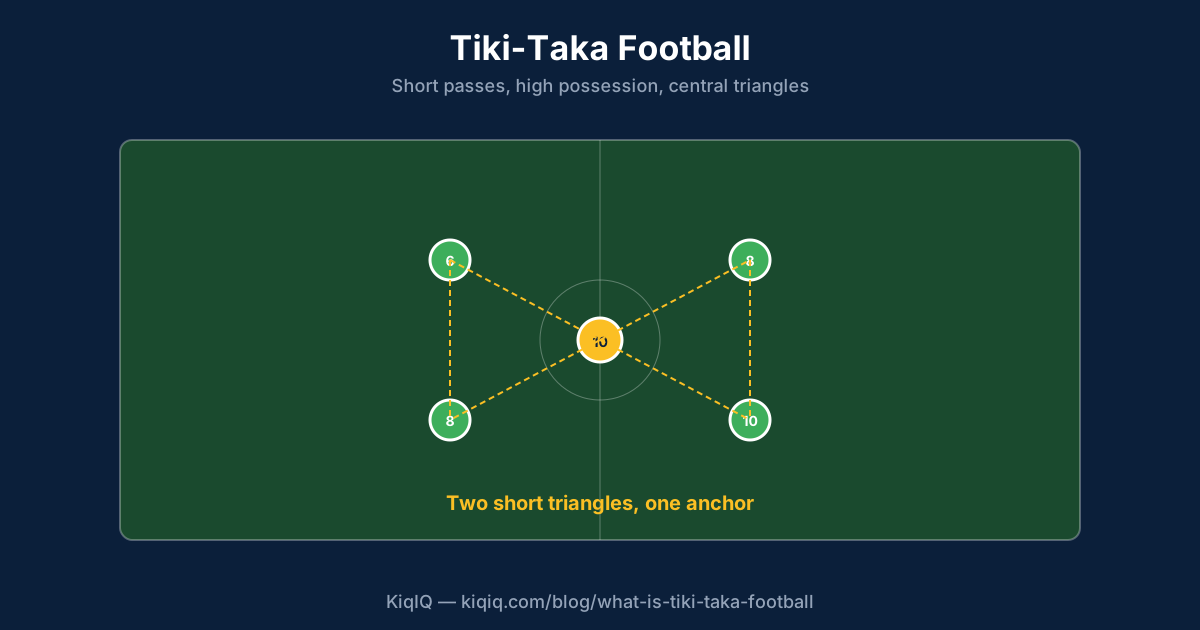
Tiki-taka is the short-passing, possession-dominant style that won Pep Guardiola's Barcelona two Champions Leagues and carried Spain to a 2008-2010-2012 international treble. It rests on three principles: pass distances under 15 metres, constant rotational triangles, and using the ball itself as the primary defensive tool. By the mid-2010s the style had been overrun by the counter-press, by vertical transitions, and by sides that refused to chase possession. Understanding what tiki-taka actually was, and what killed it, is the cleanest way into modern positional play, which inherited the structural ideas while abandoning the surface mannerisms.
Where the name came from and what it actually means
The label "tiki-taka" was popularised by Spanish broadcaster Andrés Montes during the 2006 World Cup, an onomatopoeic phrase for the rapid one-touch passing he was watching from Luis Aragonés's Spain. The phrase stuck, but Guardiola himself spent years rejecting it as a caricature. What the dressing room actually talked about was juego de posición, positional play, the structural framework underneath the short passes that the press eventually shortened to tiki-taka.
The principles, as set out by Juanma Lillo (Guardiola's mentor and later Manchester City assistant) and codified at Barcelona's La Masia academy, were specific. Occupy the five vertical channels of the pitch. Stagger heights so no two players sit on the same horizontal line. Maintain a minimum of three triangles around the ball-carrier at all times. Pass progressively, never sideways unless to bait a press. Receive on the half-turn. The short-passing was a symptom of those structural rules, not the rule itself (Coaches' Voice, Lillo and Guardiola interviews).
Tiki-taka is what tiki-taka looked like from the stands. Juego de posición is what the coaches were actually drilling. The first is the surface, the second is the engine.
Try it
The rondo clock
Tiki-taka lived on passes under 15 metres played before the press arrived. Tap for eight seconds to feel how many touches that actually is.
The style rested on three things: passes under 15 metres, constant rotational triangles, and the ball itself as the main defensive tool. Lose any one and it becomes possession for its own sake.
Quick question
What was tiki-taka's primary defensive tool?
How the Barcelona side of 2008-2012 actually played
Guardiola's Barcelona ran nominally as a 4-3-3 but functioned in possession as a 3-1-4-2 or a 3-4-3 with Sergio Busquets dropping between the centre-backs, Dani Alves stepping up as an inverted full-back, and Lionel Messi drifting in as a false 9. The team averaged 65-72% possession across La Liga seasons, completed roughly 700-800 passes per match against mid-table opposition, and recorded sequences of 25+ consecutive passes at a rate that no European side has matched before or since (Opta, Barcelona 2009-2012 archive).
The defensive mechanic was the part the casual viewer missed. The team did not defend with a low block when it lost the ball. It counter-pressed instantly, with the front three and the central midfielders collapsing on the new ball-carrier within five to six seconds. Pep called this the "six-second rule". Possession itself was the first phase of defence: if the opposition does not have the ball, the opposition cannot score, and a turnover in the opposition half is recovered before the receiving team can set its shape. The Spain side that won Euro 2008, the 2010 World Cup and Euro 2012 ran the same mechanic, with Xavi, Iniesta and Busquets reproducing the Barcelona midfield triangle in national colours.
Why it stopped winning, roughly 2013 onwards
The first crack was the 4-0 aggregate semi-final defeat to Bayern Munich in 2012-13, with Jupp Heynckes's side using a higher engagement line, more physical midfield duels, and direct verticality to bypass the Barcelona press. The second was Chile's 2-0 win over Spain at the 2014 World Cup, where Jorge Sampaoli's side man-marked the Spanish midfielders, refused to chase possession, and turned every Spanish turnover into a counter-attack. By the time Klopp's Dortmund and Liverpool sides had codified gegenpressing into a repeatable system, tiki-taka was being beaten by a simple counter: deny the central rotations, accept the lower possession share, and counter-attack the moment the ball-carrier overcommits.
The deeper problem was that tiki-taka assumed the opposition would engage. When opponents dropped into a low block, refused to press, and waited for Spain or Barcelona to make a mistake, the style lost its primary defensive mechanism. Without high turnovers in the opposition half, the team needed to break the block from possession, and the patient passing that worked against an engaged opponent became an end in itself. Spain's 5-1 defeat to the Netherlands at the 2014 World Cup, with the Dutch sitting deep and countering through Arjen Robben and Robin van Persie, is the moment most analysts mark as the public death of the style.
What survived: positional play in 2026
Guardiola's subsequent careers at Bayern and Manchester City have made clear what the coach himself kept and what he discarded. The positional principles, the five-channel occupation, the staggered heights, the rotational triangles, are all still there. What changed is the willingness to play vertically. Modern City under Guardiola play long diagonal switches, attack with five or six players in the box from cut-backs, and exploit width through inverted full-backs stepping into central midfield rather than chasing wide overloads.
The contemporary descendants of tiki-taka are not really tiki-taka any more. Mikel Arteta's Arsenal, Roberto De Zerbi's Brighton and now Marseille, and Xabi Alonso's Bayer Leverkusen all run positional structures with short-passing build-up patterns, but each is willing to go long when the press comes, each accepts that possession share is a means rather than an end, and each pairs the build-up with a counter-press that is closer to Klopp than to 2010 Barcelona. The label tiki-taka has effectively become a historical marker, while the structural ideas have spread quietly into the mainstream.
- What it was. Short-passing, possession-dominant, counter-pressing positional play built around La Masia midfielders.
- Peak. Barcelona 2008-2012, Spain 2008-2012.
- What killed it. Counter-pressing rivals, low-block opponents who refused to engage, and the vertical revival under Klopp and Conte.
- What survives. Positional principles, five-channel occupation, false 9 and inverted full-back ideas, now married to verticality and counter-pressing rather than pure ball-retention.
How to recognise tiki-taka on screen when sides still use it
The clearest visual cue is the pass length distribution. A tiki-taka side will complete 70-80% of its passes under 15 metres, with the long-pass share below 8% (Opta pass-length archives). The second cue is the build-up shape: a back three formed by a holding midfielder dropping in, with both full-backs stepping up to create a 3-2-5 in the opposition half. The third cue is what happens at turnover: a tiki-taka side will collapse on the ball-carrier within five seconds, not retreat into shape.
The honest version of the answer for 2026 is that no top-flight side plays pure tiki-taka any more. The closest thing in the men's game is De Zerbi's Marseille, which still builds out of the back from goal-kicks against pressing forwards, and Tite-era Brazil drawing on Spanish positional ideas. The Spain national team under Luis de la Fuente has moved towards a more direct, transition-based style, while Barcelona under Hansi Flick has explicitly broken with the Cruyff-Guardiola-Setién lineage in favour of a higher defensive line and faster verticality.
Frequently asked questions
- What is tiki-taka football in simple terms?
- Tiki-taka is a possession-dominant style based on short passes, constant triangles around the ball-carrier, and using the ball as the primary defensive tool. It was perfected by Pep Guardiola's Barcelona between 2008 and 2012, and by the Spain national team that won Euro 2008, the 2010 World Cup and Euro 2012.
- Who invented tiki-taka?
- The tactical principles came from Johan Cruyff at Barcelona in the late 1980s, refined by Louis van Gaal in the 1990s, and crystallised by Pep Guardiola in 2008-2012. The label itself was coined by Spanish commentator Andrés Montes during the 2006 World Cup. Juanma Lillo is credited as the modern theoretical voice behind the underlying positional play framework.
- Why did tiki-taka stop working?
- Three reasons combined. Counter-pressing sides like Klopp's Dortmund and Liverpool collapsed on tiki-taka turnovers before the triangle could reset. Low-block sides refused to engage, eliminating the high-turnover defensive mechanism. And vertical, transition-based teams turned every overcommitted forward into a counter-attack against an exposed defensive line.
- Is tiki-taka the same as positional play?
- No, but they overlap. Positional play (juego de posición) is the structural framework: five vertical channels, staggered heights, rotational triangles. Tiki-taka is what positional play looked like at Barcelona between 2008 and 2012, when the side married those principles to extremely short passing and a six-second counter-press. Modern positional sides keep the structure but pass more vertically.
- Does Pep Guardiola still play tiki-taka at Manchester City?
- Not in the 2008-2012 sense. City still play positional football with short-pass build-up and inverted full-backs, but the team also plays long diagonal switches, attacks with five-plus players in the box, and accepts lower possession share against deep blocks. The structural ideas survive, but the surface mannerisms of constant ball retention do not.
References
- Coaches' Voice: Pep Guardiola and the principles of positional play · The Coaches' Voice
- The Athletic: How tiki-taka fell and what came next · The Athletic
- Opta: Barcelona possession and passing archives 2008-2012 · The Analyst (Opta)
- Spielverlagerung: tactical analysis of Guardiola's Barcelona · Spielverlagerung
- UEFA technical reports, Spain at Euro 2008, 2012 and World Cup 2010 · UEFA
Key terms in this article
Ask KiqIQ a follow-up
Get a live, data-driven answer powered by our live data feeds + KiqIQ's Poisson model. Try one of these prompts or write your own.
Part of pillar
Tactical Intelligence
See every article in this knowledge pillar →
Related
Reviewed by a KiqIQ editor before publication. Spotted an error? Email editor@kiqiq.com. We follow our Corrections Policy.