
Walking football has grown from a local community trial into one of the UK’s fastest-expanding participation formats, and it is changing who gets to play the game.
By David Findlay, Founder of KiqIQ.
Quick Answer: Walking football is an adapted version of association football in which running is banned at all times. It is designed for players aged 50 and over and for adults with physical limitations, offering structured, competitive play at a lower physical intensity on small-sided pitches.
Definition: Walking football is a modified version of association football in which all players must walk throughout play. Running or jogging at any point results in a free kick to the opposing team. Developed in the UK to widen access for older adults and those with limited mobility, the format operates under its own governing rules, competition structures, and county FA frameworks.
Key point: Walking football is a standalone participation format with official rules, governed competitions, and dedicated county FA programmes, not a casual variation of the standard game.
 Origins and Growth of Walking Football in the UK
 Origins and Growth of Walking Football in the UK
Walking football was created in 2011 by Chesterfield FC Community Trust as part of a programme to bring older men back into regular physical activity through football. The format received national exposure after a 2014 television campaign placed it in front of a mainstream audience for the first time.
Since that point, England Football has embedded walking football into its national participation strategy. Thousands of weekly sessions now operate across affiliated county football associations, community clubs, and leisure facilities throughout England.
The format has expanded into Wales, Scotland, and Northern Ireland, with each home nation’s football association running dedicated programmes for older and recreational players.
The Core Rules of Walking Football
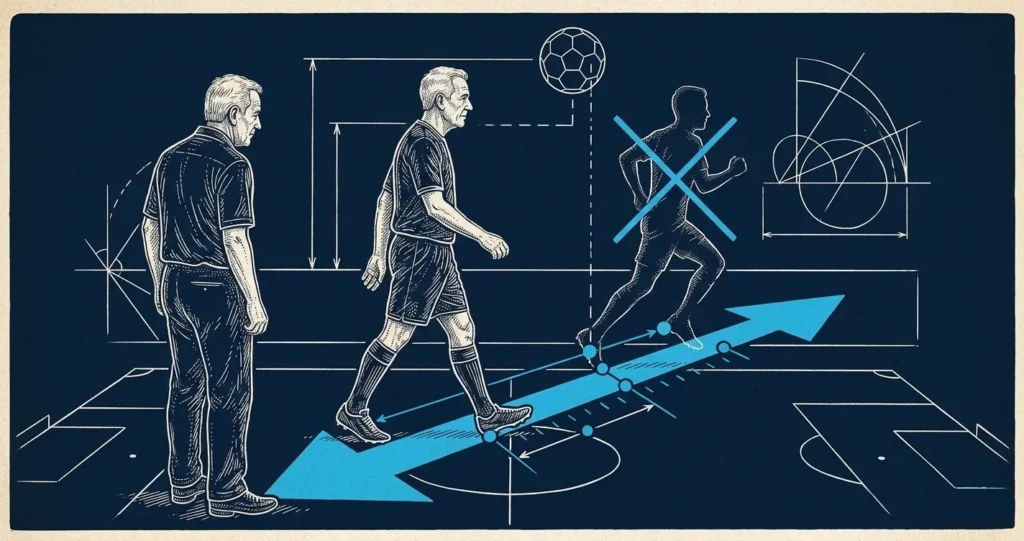
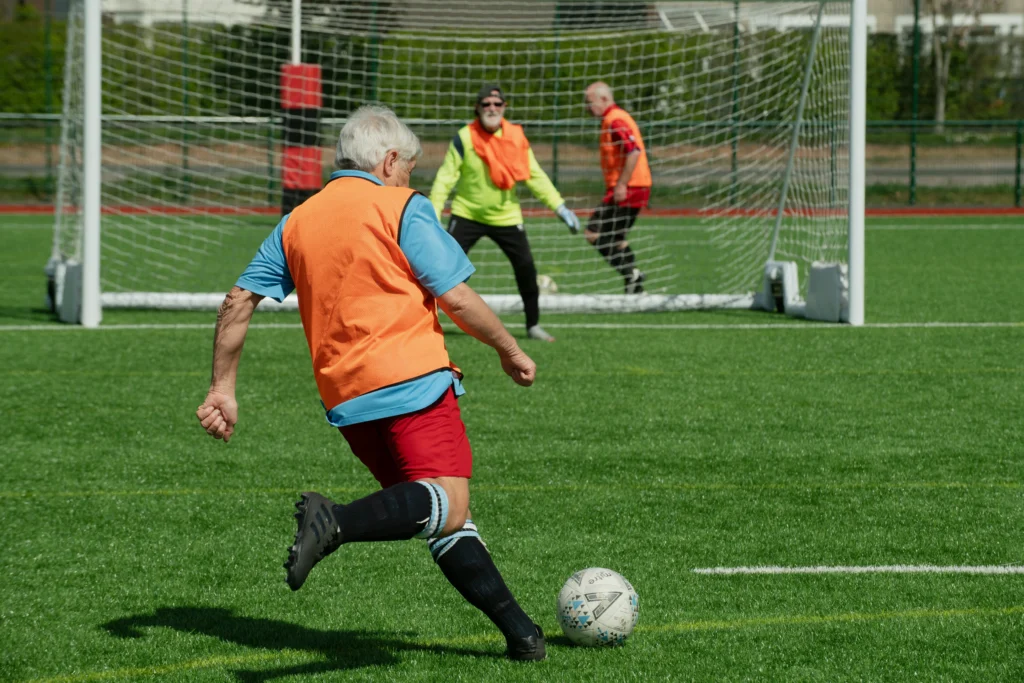
The defining rule of walking football is that all players must walk at all times. One foot must remain in contact with the ground throughout play. Any player who runs or jogs concedes a free kick to the opposing team.
Beyond the core movement rule, most walking football formats apply the following:
- Slide tackles are prohibited at all times
- Shoulder-to-shoulder charging is not permitted
- Heading is restricted or banned in the majority of organised formats
- Teams consist of 4 to 7 players per side depending on pitch size and session type
- Goalkeepers may be subject to separate movement rules depending on the organiser’s ruleset
- Pitch dimensions are significantly reduced compared to the standard 11-a-side game
Rule variations exist between county football associations and independent competition organisers. The table below compares walking football directly against standard football across the key rule areas.
| Rule Area | Walking Football | Standard Football |
|---|---|---|
| Movement | Walking only. Running or jogging concedes a free kick. | Running permitted at all times. |
| Tackling | Slide tackles prohibited. | Slide tackles permitted within the rules. |
| Heading | Restricted or prohibited in most organised formats. | Permitted at all times. |
| Team size | 4 to 7 players per side depending on format. | 11 players per side. |
| Pitch length | 30 to 50 metres. | Up to 105 metres. |
| Pitch width | 20 to 30 metres. | Up to 68 metres. |
| Match duration | 20 to 30 minutes per half. | 45 minutes per half. |
| Physical contact | No shoulder-to-shoulder charging. | Shoulder charging permitted within the rules. |
Who Can Play Walking Football?
Walking football is designed primarily for players aged 50 and over, though it is open to any adult who benefits from a lower-intensity format. Common participant groups include:
- Players over 50 seeking continued participation in structured football
- Adults returning from surgery, injury, or a long period out of sport
- Players managing chronic conditions such as osteoarthritis, cardiovascular limitations, or type 2 diabetes
- Adults new to football who prefer a more accessible starting point
Many sessions also offer women-only or mixed-gender formats. County FAs across England, Northern Ireland, and the Republic of Ireland operate walking football alongside their standard grassroots programmes.
Walking Football Pitch Dimensions and Format
Walking football is predominantly played as a 5-a-side or 6-a-side format on artificial 3G or 4G pitches, or on indoor sports hall courts. A standard walking football pitch ranges from 30 to 50 metres in length and 20 to 30 metres in width. Goals are proportionally smaller than full-size goals, and match duration is typically 20 to 30 minutes per half.
For players based in the South West of England, Cornwall FA provides region-specific session listings and club contact details. The Irish FA Foundation coordinates walking football across affiliated clubs and community organisations throughout Northern Ireland.

What Is a Walk-On in Football?
Different from walking football, a walk-on in football is a player who joins a team without a prior contract, formal recruitment agreement, or scholarship offer. The term originates in American college football, where walk-ons are athletes who join a squad on a non-scholarship basis and must earn their place through open trials or sustained training performance.
In UK football, the closest practical equivalent is an unsigned trialist attending an open trial at a semi-professional club, or an academy-age player continuing in a programme without a confirmed scholarship agreement. The term describes the route of entry into the squad rather than the player’s position, role, or eventual contribution once accepted.
A walk-on carries no specific contractual definition under FA rules in England. It is a colloquial term used to describe joining a team on an informal or probationary basis, most commonly referenced when discussing American football or lower-league recruitment.

Frequently Asked Questions
What is walking football?
Walking football is an adapted version of association football in which all players must walk at all times. It is designed for players aged 50 and over and is played on small-sided pitches with modified contact and movement rules.
What is the main rule in walking football?
The main rule is that all players must walk throughout play. One foot must remain in contact with the ground at all times. Running or jogging results in a free kick being awarded to the opposing team.
Is walking football only for men over 50?
No. Walking football is available to players of any gender and is primarily aimed at those aged 50 and over, but it is open to any adult who benefits from a lower-intensity format, including those recovering from injury or managing long-term health conditions.
What is a walk-on in football?
A walk-on in football is a player who joins a squad without a formal contract or scholarship, earning their place through an open trial or sustained training performance. The term originated in American football and is used more broadly to describe unsigned trialists in a football context.
What is a football walk-on?
A football walk-on is a player who earns their place in a squad without having been formally recruited. They attend trials or training sessions and are assessed before receiving any formal agreement. The term applies in principle to any player who joins a team on an informal or probationary basis.