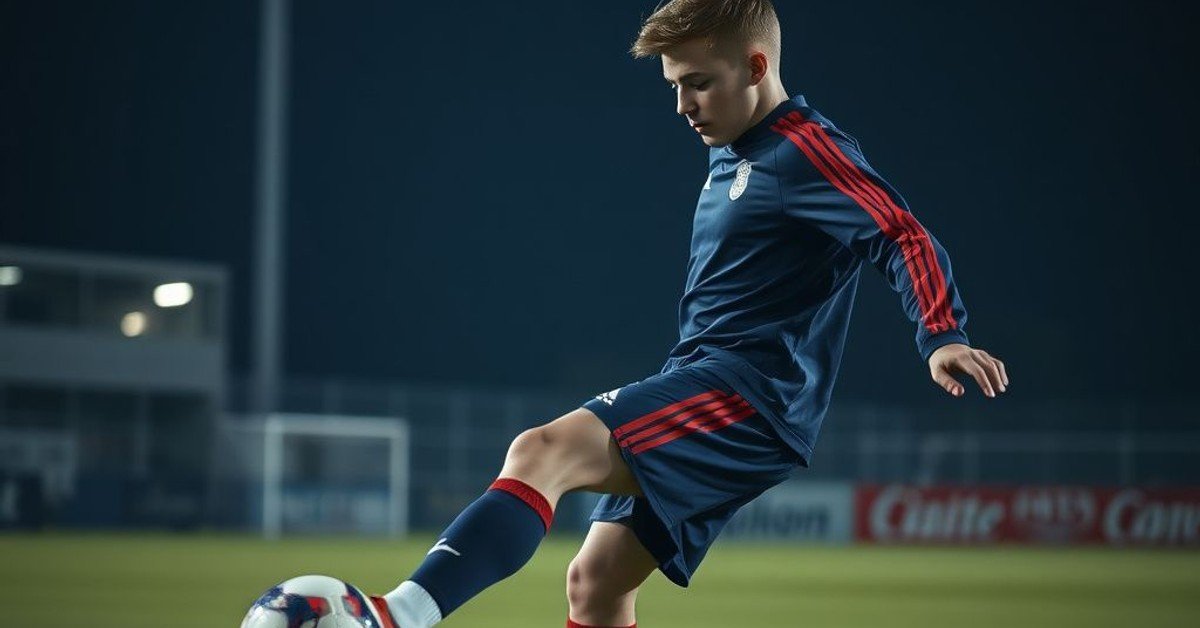
The most predictable thing about most footballers is not their passing direction or their first touch. It is which foot they use when the pressure arrives.
By David Findlay, Founder of KiqIQ.
Quick Answer: The weak foot in football is the player’s non-dominant foot: the foot used less frequently and with less precision during normal play. Structured training of the weak foot reduces the functional asymmetry between limbs and expands a player’s effective technical range on the pitch.
Definition: The weak foot refers to the non-dominant lower limb of a footballer, typically the foot used less often for passing, shooting, and ball control in match conditions. Research published in the Journal of Sports Sciences identifies lower-limb functional asymmetry as a measurable performance variable that specific non-preferred foot training can reduce in game situations.
Key point: A player with a significant gap between dominant and non-dominant foot ability is tactically readable. Opponents, coaches, and analysts identify which foot a player prefers and apply pressure toward the weaker side to force errors or restrict passing options. The weak foot is not a private development concern: it is a match-condition constraint.
What the Weak Foot Means in Practice
The weak foot is not defined by anatomy but by use patterns. It is the foot that receives less practice time, less match exposure, and less technical reinforcement through repetition. Because most players naturally favour their dominant foot in every training drill and match action, the asymmetry between feet tends to compound unless deliberately addressed.
In match conditions, the practical effect of a significant weak foot is a reduction in available options. A player forced onto their non-dominant side by a press cannot switch play, shoot, or receive with the same reliability as on the dominant side. The weak foot acts as a predictable constraint that experienced opponents can target directly. Press your opponent onto their non-dominant side, and the decision tree narrows considerably.
What a Six-Month Randomised Trial Found
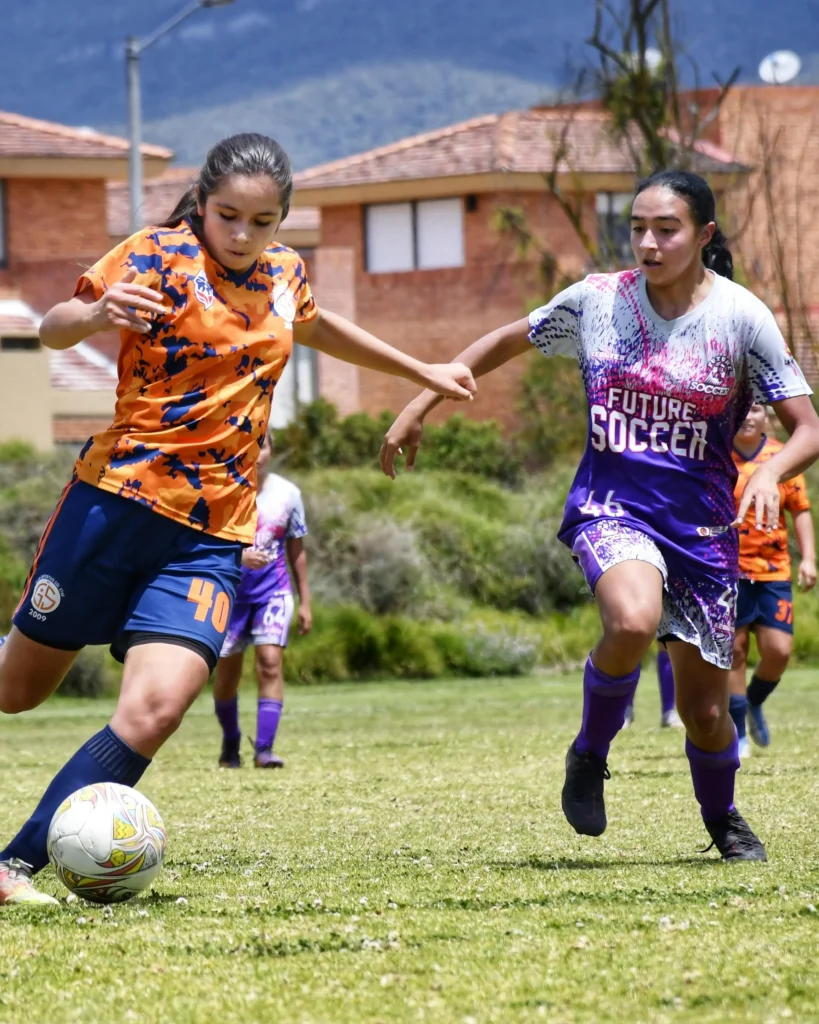
A study by Guilherme and colleagues, published in the Journal of Sports Sciences in 2015, tested the effect of a structured non-preferred foot training programme on 71 young football players over six months. The experimental group received specific technical training targeting the non-preferred foot. The control group did not.
The finding was direct: “the use of the non-preferred foot increased significantly with the technical training programme in the experimental group” while remaining constant in controls. Preferred foot use decreased in the experimental group as non-preferred foot use increased. The researchers concluded that systematic, specific technical training for the non-preferred foot increases its use in game situations and reduces functional asymmetry, improving overall player performance.
The study assessed on-pitch behaviour rather than isolated drill scores. The improvement transferred to match conditions, not just training environments. That distinction matters for how training time is allocated.
The Bilateral Transfer Effect
Research by Haaland and Hoff, published in the Scandinavian Journal of Medicine and Science in Sports in 2003, examined 39 soccer players aged 15 to 20 over an eight-week intervention. The experimental group trained exclusively using their non-dominant leg during all football activities except full play.
Non-dominant leg performance improved significantly compared to controls, as expected. The more notable result was that the trained group also improved significantly on tests using the dominant side. The authors attributed this to improved generalised motor programmes: training one limb intensively appears to enhance the motor system’s overall organisation, with measurable crossover to the opposite limb.
The practical implication is that focused non-dominant foot training does not come at the cost of dominant foot performance. The bilateral transfer effect suggests the two are connected, not competing.
What Systematic Review Evidence Shows
A 2025 systematic review by Zhang and colleagues, published in Frontiers in Physiology, synthesised nine studies on non-dominant side training across sports including soccer, covering 359 athletes aged 12 to 24. Intervention durations ranged from eight weeks to 16 months at one to four sessions per week.
The review identified improvements across technical skill, strength, directional change speed, jumping capability, and balance as outcomes associated with non-dominant side training. For soccer specifically, the authors note that coaches apply non-dominant training to enhance lower-limb strength and balance, with injury reduction identified as an additional benefit alongside technical development.
How to Structure Weak Foot Training
The research evidence points consistently toward one design principle: specific, progressive, and sustained contact time with the non-dominant foot, across both isolated and game-based conditions.
Isolated repetition builds the foundation. Passing against a wall, receiving and controlling the ball, and shooting from set positions all generate contact time with the non-dominant foot outside competitive pressure. Volume precedes quality in early development phases.
Game-based constraints transfer the gains. Limiting dominant foot use in small-sided training scenarios forces non-dominant foot decisions under realistic conditions. The Guilherme et al. study measured change specifically in game behaviour: the training design should reflect that target environment.
Mixed-foot sequences capture the bilateral effect. Haaland and Hoff’s finding that non-dominant training improves dominant foot performance suggests that alternating between feet in drill sequences carries broader technical benefit beyond the non-dominant foot in isolation.
Consistency over arbitrary timeframes matters most. The studies reviewed used six-month and eight-week programmes respectively. Neither provides a single benchmark for general improvement. The research supports continued, deliberate practice over sustained periods rather than short bursts of remedial work.
The KiqIQ Angle
The weak foot is one of the most discussed development topics in grassroots coaching and one of the least systematically addressed in practice. The research mechanism is clear: specific training of the non-dominant foot reduces functional asymmetry in game situations, and the bilateral transfer effect means dominant foot performance does not suffer as a result. What the research cannot resolve is the structural gap between knowing this and building it into a programme. Most players practice with their dominant foot because it produces better immediate results. Most coaches focus on dominant-foot quality because it makes training sessions look cleaner. The weak foot problem is partly a technical asymmetry and partly a default bias toward what already works. Closing that gap requires deliberate allocation of training time across both feet, from the earliest development stages, not remedial work added at the end of a session after the dominant foot has already had the majority of touches.
Frequently Asked Questions
What is the weak foot in football?
The weak foot is the non-dominant foot of a footballer: the foot used less frequently and with less precision in training and match conditions. The gap in quality between the two feet is called lower-limb functional asymmetry, which structured training can reduce according to research published in the Journal of Sports Sciences.
Can you improve your weak foot in football?
Yes. A six-month randomised trial by Guilherme and colleagues, published in the Journal of Sports Sciences (2015), found that specific non-preferred foot training significantly increased non-preferred foot use in game situations and reduced functional asymmetry in young football players. The improvement transferred to on-pitch behaviour, not just isolated drills.
Does weak foot training affect your dominant foot?
Research by Haaland and Hoff, published in the Scandinavian Journal of Medicine and Science in Sports (2003), found that eight weeks of exclusive non-dominant leg training improved both non-dominant and dominant leg performance in soccer players aged 15 to 20. The authors attributed this to improved generalised motor programmes, a bilateral transfer effect.
How long does it take to improve your weak foot?
Published studies used intervention periods of eight weeks and six months. Neither provides a universal benchmark for individual development. The research supports consistent, specific practice over sustained periods rather than short remedial blocks. Meaningful change in game behaviour requires repeated contact time across training and match scenarios.
Why do opponents target a player’s weak foot?
A player with a weaker non-dominant foot has fewer reliable options when pressed toward that side. Opponents can predict passing lanes, reduce shooting angles, and trigger errors by forcing the ball to the non-dominant foot under pressure. Reducing functional asymmetry through training directly reduces that tactical vulnerability.
Sources
- Guilherme et al. (2015): Non-preferred foot technical training and lower-limb functional asymmetry, Journal of Sports Sciences
- Haaland and Hoff (2003): Non-dominant leg training and bilateral motor performance in soccer players, Scandinavian Journal of Medicine and Science in Sports
- Zhang et al. (2025): Effects of non-dominant side training on athletic performance, Frontiers in Physiology