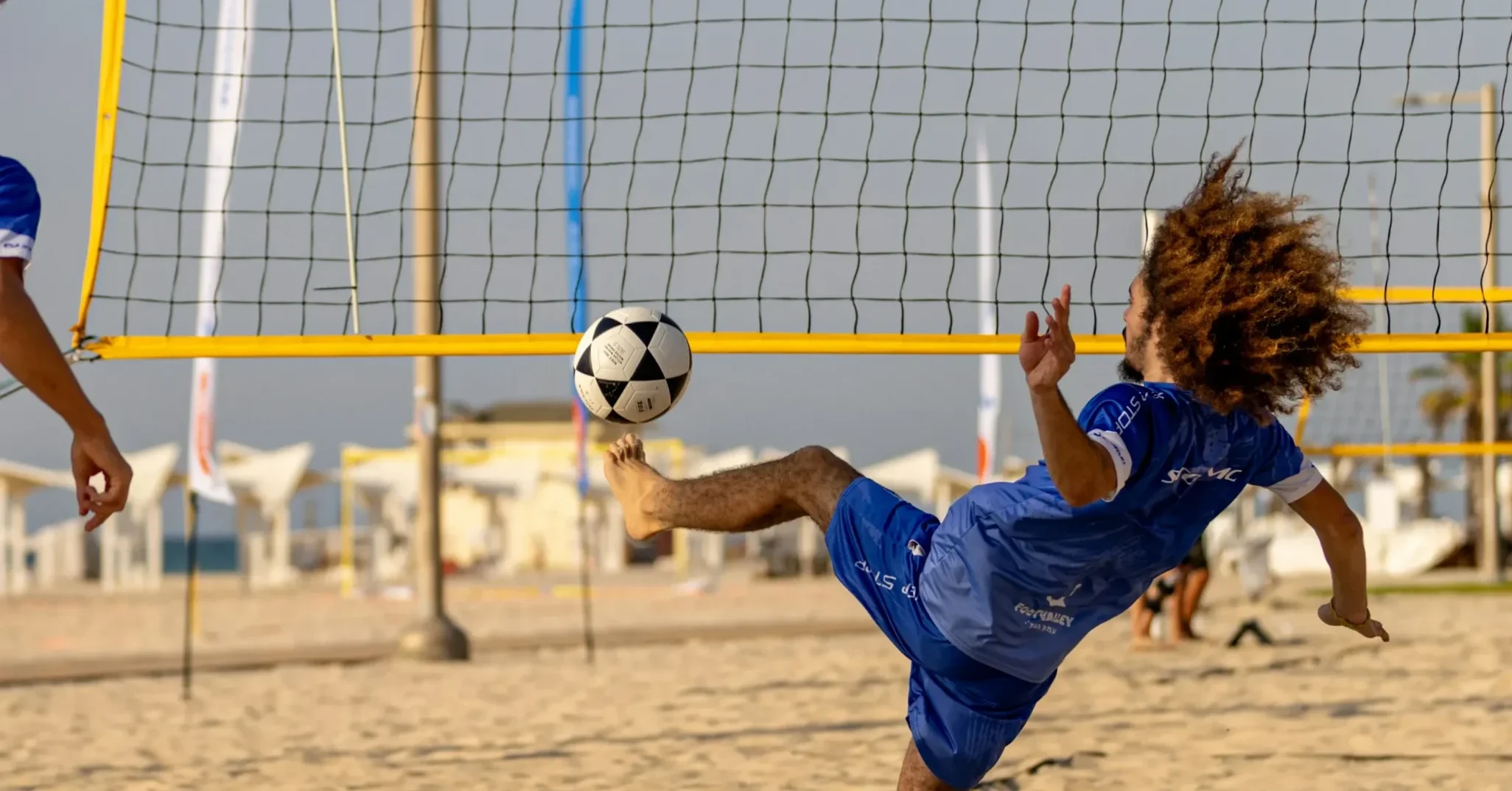
A sport banned from Copacabana beach gave rise to one of the most technically demanding net games in the world.
By David Findlay, Founder of KiqIQ.
Quick Answer: Footvolley is a two-a-side beach sport combining football technique with volleyball rules. Players use their feet, knees, thighs, chest, shoulders, and head to pass the ball over a net, with hands and arms strictly prohibited. The game was invented in Brazil in the 1960s and is now played competitively across more than 50 countries.
Definition: Footvolley is a competitive beach sport in which two players per side attempt to ground the ball on the opponent’s side of a net using only football technique. Hands and arms are prohibited at all times. Each side may take a maximum of three touches before returning the ball. The game is played on a sand court and uses a dedicated footvolley ball or a standard football.
Key point: Footvolley reduces football to its purest technical form. With no goalkeeper, no outfield structure, and only three touches permitted, individual ball mastery and court reading are the only variables that matter.
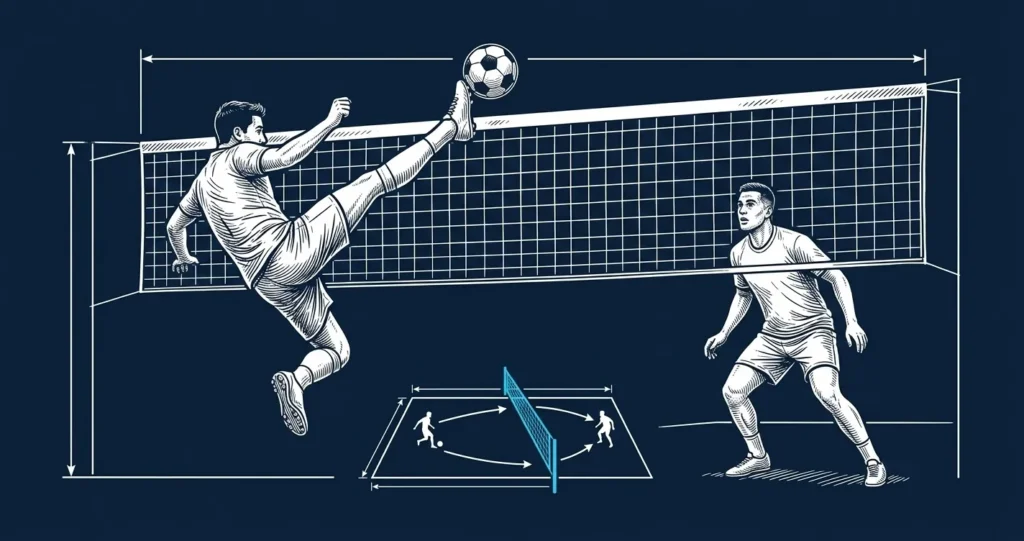
Where Was Footvolley Invented?
Footvolley was invented on Copacabana Beach in Rio de Janeiro, Brazil. The mid-1960s is the most widely cited period of origin, with 1965 referenced most consistently across the sport’s documented history.
The circumstances of the sport’s creation are directly tied to restrictions placed on playing football in certain beach areas at the time. A group of players, denied access to the sand for football, began adapting their skills to existing volleyball courts. Rather than using hands as volleyball required, they applied football technique to pass and attack over the net. The format proved immediately popular.
Footvolley Brazil spread rapidly along the Rio de Janeiro coastline through the late 1960s and throughout the 1970s and 1980s before extending to other Brazilian states. Brazil has remained the sport’s dominant nation at international level and continues to define the aesthetic and technical standards of the game. The sport’s identity is inseparable from Brazilian football culture and beach life.
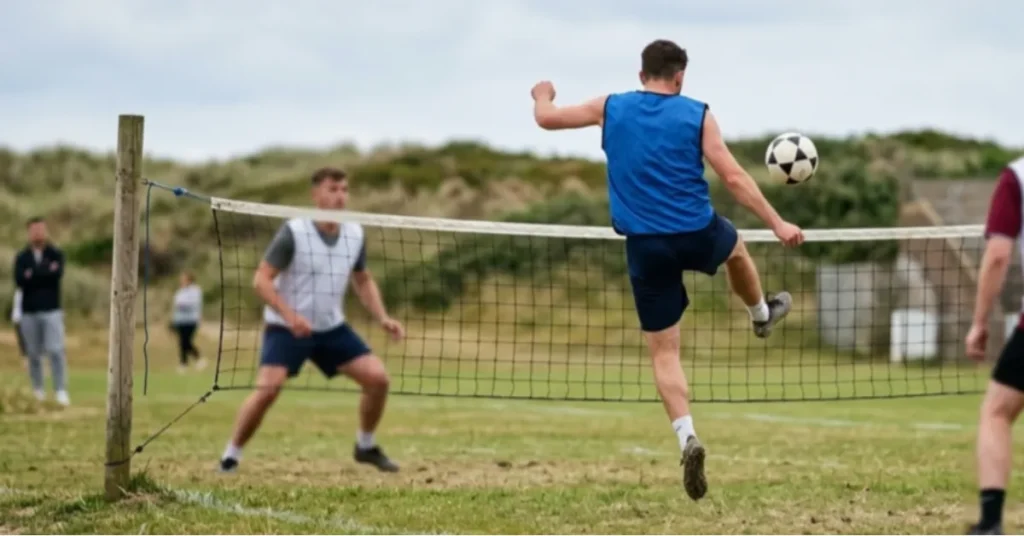
How to Play Footvolley: The 7 Core Rules
Footvolley follows a structure closely aligned to beach volleyball. The defining distinction is that hands and arms cannot be used at any point during play. The following rules govern the standard competitive format.
- No hands or arms: Players may not contact the ball with their hands or forearms. Legal contacts include the feet, knees, thighs, chest, shoulders, and head.
- Three touches maximum: Each side may take up to three touches before the ball must cross the net. The same player cannot take two consecutive touches in a single rally.
- Net crossing: The ball must pass over the net and land within the opponent’s court boundaries to remain in play.
- Serving from the baseline: The server stands behind the baseline and kicks the ball over the net to begin each rally. The serve must land in the opponent’s court to be valid.
- Rally point scoring: A point is awarded on every rally regardless of which side served. Sets are played to 18 points, with a two-point lead required to win the set.
- Best of three sets: Matches are decided over three sets. The first side to win two sets wins the match. A deciding third set is played to 15 points.
- Court boundary rule: If the ball lands outside the marked court lines or fails to clear the net, a point is awarded to the opposing side immediately.
Footvolley Court and Ball Specifications
Setting up a footvolley court correctly requires accurate dimensions. The standard competitive court mirrors a beach volleyball doubles court in size, though minor variations exist between national federations. The table below sets out the key specifications for competitive footvolley.
| Specification | Standard Value | Notes |
|---|---|---|
| Court Length | 18 metres | Consistent with beach volleyball doubles court |
| Court Width | 9 metres | Consistent with beach volleyball doubles court |
| Net Height (Men) | 2.20 metres | Standard across international competition |
| Net Height (Women) | 2.00 metres | Standard across international competition |
| Players Per Side | 2 | Doubles is the standard competitive format |
| Maximum Touches Per Side | 3 | Same player cannot take two consecutive touches |
| Set Length | First to 18 points | Two-point lead required to win the set |
| Deciding Set Length | First to 15 points | Applies to the third set only |
| Recommended Ball | Mikasa MG5500 | Purpose-built for sand play at size 4 equivalent |
The Mikasa MG5500 footvolley ball is one of the most widely used options in competitive and recreational play. It is purpose-built for sand court conditions and designed to withstand the repeated high-impact contacts that footvolley demands. The ball is the approximate size of a size 4 football, making it smaller and lighter than a standard size 5 match ball. This supports the aerial control and touch precision that the sport’s three-touch format requires.
Beach Footvolley and the International Game
Beach footvolley is the standard outdoor format of the sport, played on natural or artificial sand courts in open-air settings. This is the dominant format at both national and international level and the context in which all major tournaments are staged.
The sport is governed internationally and a World Footvolley Championship is held annually. Brazil has been the historically dominant nation, but competitive depth has developed significantly in Portugal, Italy, and across parts of northern Europe. The United Kingdom has seen consistent growth in participation over the past decade, with league structures and open competitions now operating in London and other major cities.
The British Footvolley Association supports grassroots and competitive play across the country, providing access to fixtures, coaching resources, and information on local participation. The sport’s low equipment cost and its appeal to players with a football background have both contributed to its growth at recreational level in the UK.
Sand play increases the physical demand of each session relative to turf. The surface removes explosive speed as a dominant factor and places a premium on balance, technique, and repeated low-impact movement. This has made beach footvolley an increasingly popular supplementary training format for football players during the off-season, particularly for improving first touch, aerial control, and decision-making under fatigue.
Footvolley for Football Development
Footvolley is used by coaches and players as a targeted training complement to football. The constraints of the net and the three-touch rule create specific technical and cognitive demands that transfer directly to the football pitch.
- First touch quality: Controlling a difficult ball in one touch under competitive pressure is a constant requirement of the footvolley format.
- Aerial technique: Heading, chest control, and thigh trapping in quick sequence develop the three-dimensional ball mastery that football rewards in congested areas.
- Cognitive processing speed: Players must plan two or three touches ahead at all times, accelerating decision-making under physical load.
- Weaker foot development: The confined court and unpredictable ball flight create natural conditions for using both feet, reducing over-reliance on the dominant side.
Professional and semi-professional clubs have incorporated footvolley into pre-season schedules. The format delivers high technical repetition in a competitive environment with reduced injury risk compared to contact football. For academy environments, footvolley sessions provide a structured and engaging format for developing individual technique without tactical instruction overhead.
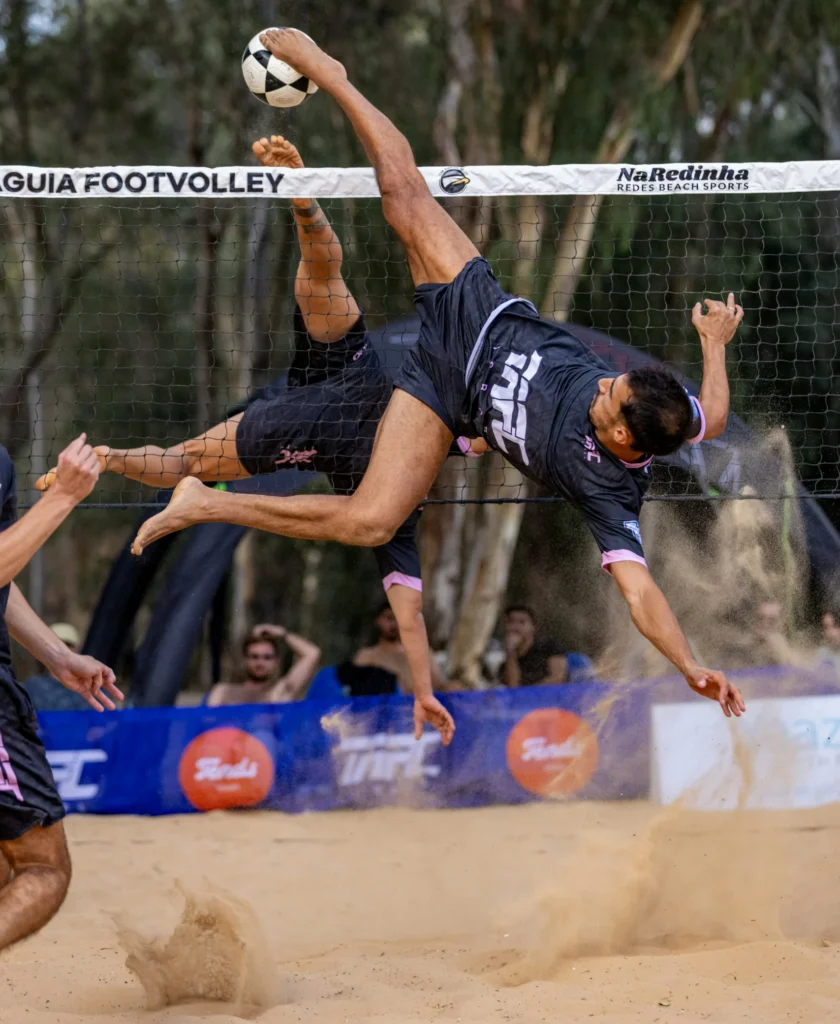
How to Get Started With Footvolley
No specialist facility is required to begin playing footvolley. A sand court, a net set to the appropriate height, and a footvolley ball or size 4 football are the only equipment requirements. Most beach volleyball courts can be adapted with a net height adjustment.
For those in the United Kingdom looking to enter structured competition or find regular sessions, the Footvolley League provides competition at multiple skill levels alongside a clear guide to the rules for new participants. Recreational and beginner-friendly sessions are widely available in London throughout the year.
Players with a strong football background can typically develop competent footvolley technique within a small number of practice sessions. The fundamental rules are straightforward, and the learning curve is steep in the most productive sense: mistakes are immediately visible, feedback is instant, and improvement is rapid with focused repetition on sand.
Frequently Asked Questions
What is footvolley?
Footvolley is a competitive beach sport in which two players per side use football technique to pass the ball over a net without using their hands or arms. The sport originated in Brazil in the 1960s and is now played in over 50 countries at both recreational and international competitive level.
Where was footvolley invented?
Footvolley was invented on Copacabana Beach in Rio de Janeiro, Brazil, in the mid-1960s. The sport emerged when football players adapted their skills to volleyball courts after football was restricted in certain beach areas. Brazil remains the dominant nation in international competition.
What ball is used in footvolley?
Dedicated footvolley balls are used in competitive play. The Mikasa MG5500 is one of the most widely recognised options. The ball is the approximate size of a size 4 football, smaller and lighter than a standard size 5 match ball, which supports the aerial control the sport demands in sand conditions.
How many players are in footvolley?
The standard competitive format is two players per side. Doubles is the dominant format at all levels of the game. Singles formats exist but are less common in structured competition.
Can you head the ball in footvolley?
Yes. Heading is a legal and frequently used technique in footvolley. Players may use their feet, knees, thighs, chest, shoulders, and head. The only prohibited contacts are the hands and forearms.