
Professional football clubs now employ more specialists in performance science than most NHS physiotherapy departments. The science infrastructure behind a first-team squad has grown into one of the most operationally complex parts of the modern game.
By David Findlay, Founder of KiqIQ.
Quick Answer: Football science is the application of evidence-based disciplines including physiology, biomechanics, nutrition, psychology, and performance analysis to the preparation, development, and recovery of football players. It operates across professional clubs, national associations, and increasingly at grassroots level.
Definition: Football science is a multidisciplinary field that applies scientific methods to maximise football player performance and minimise injury risk. According to Chris Barnes, who established the first multidisciplinary sports science department at an English Premier League club (Middlesbrough FC) in 1997, “fundamentally sports science is based on the same set of principles as many other areas of applied science. Science in the broadest sense is a way of approaching problems and the creation of systems which enable you to deliver in a systematic and effective way.”
Key point: Football science is not a single discipline. It is the coordinated application of multiple scientific fields to a sporting context. The Football Association’s Sports Medicine and Sports Science Department coordinates across more than 43,000 affiliated clubs in England, making the institutional infrastructure for football science one of the largest in any sport.
The Core Disciplines
Catapult Sports identifies three primary components of sports science in football: physiology, biomechanics, and psychology. In practice, professional clubs apply these alongside nutrition science, performance analysis, and sports medicine as integrated functions rather than separate departments.
Physiology covers the body’s responses to training and match demands: oxygen uptake, lactate threshold, heart rate, and recovery capacity. Biomechanics examines how players move: running mechanics, kicking technique, jumping and landing patterns, and injury-related movement asymmetries. Psychology addresses decision-making under pressure, focus, motivation, and the mental demands of competition.
Nutrition science manages energy availability, hydration, body composition, and recovery fuelling across a match and training schedule. Performance analysis applies video and data methods to evaluate technical, tactical, and physical output. Sports medicine sits across all disciplines, addressing injury prevention, diagnosis, rehabilitation, and return-to-play protocols.
Physiology and Fitness Monitoring
The measurement and management of physiological load is central to modern football science. GPS tracking devices, worn in vests during training and matches, generate continuous data on distance covered, high-speed running distance, acceleration and deceleration counts, and heart rate. According to The FA’s official guidance on training monitoring, player training intensities can be tightly planned and monitored through GPS systems or rates of perceived exertion, in which the player scores a session subjectively.
The St. George’s Park Human Performance Lab, operated by The FA at its national football centre, provides physiological assessments, conditioning programmes, and hydrotherapy recovery strategies to England national team players and performance programme participants. The laboratory model used at elite level is now replicated in varying forms across the professional pyramid.
Biomechanics in Football
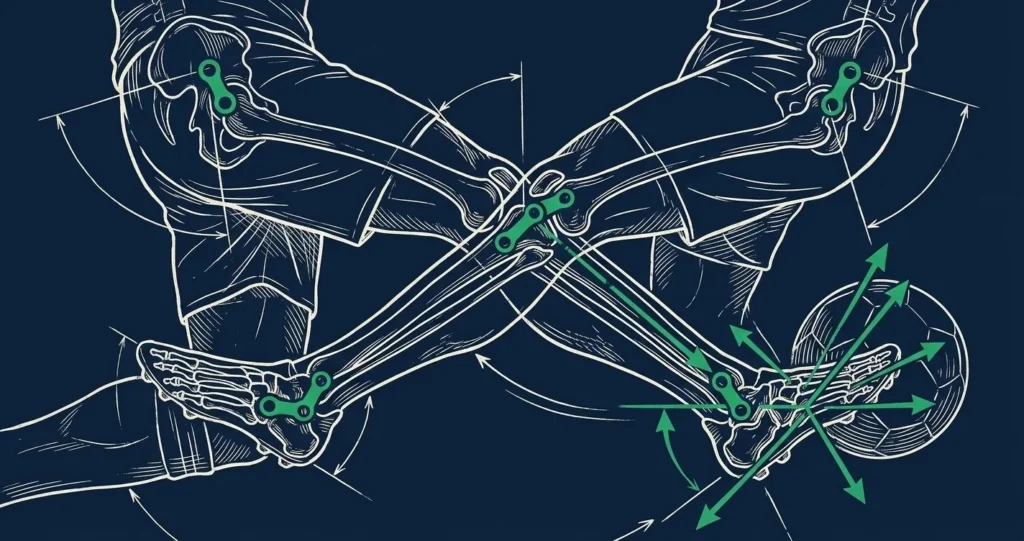
Biomechanics in football applies the study of movement to two principal areas: performance enhancement and injury prevention. Kicking technique, sprint mechanics, and positional movement patterns are all analysed to identify inefficiencies and correct movement habits that increase injury risk or reduce output.
The Association Football Medical Screening Programme, run by The FA, assesses approximately 750 youth players aged 16 annually across 18 regional cardiological and orthopaedic centres. This programme combines biomechanical and medical screening to identify structural vulnerabilities before they result in injury, applying football science to a safeguarding function as much as a performance one.
Nutrition Science
Nutrition science in football manages energy balance across high-load match and training periods, optimises body composition for positional demands, and structures recovery fuelling to minimise soft tissue injury risk and maintain training quality across a congested schedule. The integration of nutrition into sports science departments is standard at Premier League level, where dietitians and nutritionists work alongside physiologists and strength and conditioning coaches as part of a coordinated performance team.
Psychology and Performance Analysis
Psychology in football science addresses the cognitive and emotional demands of competition: decision-making speed, attentional control, anxiety management, and team dynamics. The FA’s Sports Medicine and Sports Science Department runs active research programmes including a brain function study conducted in collaboration with the PFA, examining the long-term neurological effects of football participation.
Performance analysis uses video and statistical data to evaluate individual and team output across tactical, technical, and physical dimensions. The Premier League’s Football Intelligence Platform, developed in partnership with technology providers, aggregates player and staff data across coaching, medical, sports science, operations, player care, and education for all Premier League and EFL club academies.
How Football Science Is Structured in Professional Clubs
According to Chris Barnes, writing for Catapult Sports, most Premier League clubs now employ between eight and ten sports scientists in various roles. A significant portion of their work involves handling and making sense of performance information, alongside the physical preparation and recovery of players. Barnes notes that when he established the sports science function at Middlesbrough in 1997, the model was novel within English professional football. Today, Barnes reports the approach has expanded from Premier League clubs down to what he describes as “tier four or five clubs.”
The Football Association’s Sports Medicine and Sports Science Department sits above this club-level infrastructure, coordinating education, research, anti-doping, and safeguarding across the full football pyramid. The department conducts more than 1,200 unannounced anti-doping tests annually across professional clubs and provides drug education to around 20,000 young players aged nine to 21. It has organised the Chartered Physiotherapists in Association Football Forum since 1998 and coordinates four annual professional conferences for football medicine and science practitioners.
The KiqIQ Angle
Football science has moved from a marginal function at a handful of clubs to a standard operational layer across the professional game in under three decades. The speed of that change is partly technological: GPS tracking, force plates, and integrated data platforms made measurement cheap and accessible. But the more significant shift is institutional. The FA now coordinates sports science infrastructure across more than 43,000 clubs. The Premier League introduced a unified data platform covering academies across the entire competition. The discipline has formal academic representation through the peer-reviewed journal Science and Medicine in Football. What happens next is a question of depth rather than reach: the tools and the institutional structures are in place across the pyramid. The quality gap between how a top-six Premier League club uses its data and how a League Two academy uses the same platform is the next frontier, not the presence of the platform itself.

Frequently Asked Questions
What is football science?
Football science is the application of evidence-based disciplines to the preparation, development, and recovery of football players. The core disciplines identified by Catapult Sports include physiology, biomechanics, and psychology, with nutrition science, performance analysis, and sports medicine applied alongside these in professional club environments.
How is science used in football?
Science is applied across training load monitoring (via GPS and physiological testing), injury prevention and rehabilitation, nutrition periodisation, psychological support, biomechanical analysis, and performance data systems. The FA’s Sports Medicine and Sports Science Department coordinates these applications across more than 43,000 affiliated clubs in England.
When did sports science enter professional football?
According to Chris Barnes, writing for Catapult Sports, the first multidisciplinary sports science department at an English Premier League club was established at Middlesbrough FC in 1997. Barnes identifies this as the origin point for the model now standard across the professional game.
How many sports scientists work in a Premier League club?
According to Chris Barnes, most Premier League clubs now employ between eight and ten sports scientists in various roles. Their responsibilities span performance data analysis, physical preparation, and player recovery management.
Is there an academic journal for football science?
Yes. Science and Medicine in Football is a peer-reviewed academic journal published by Taylor and Francis, dedicated specifically to scientific research in football. It covers the full range of disciplines applied in the field, from physiology and biomechanics to sports psychology and performance analysis.