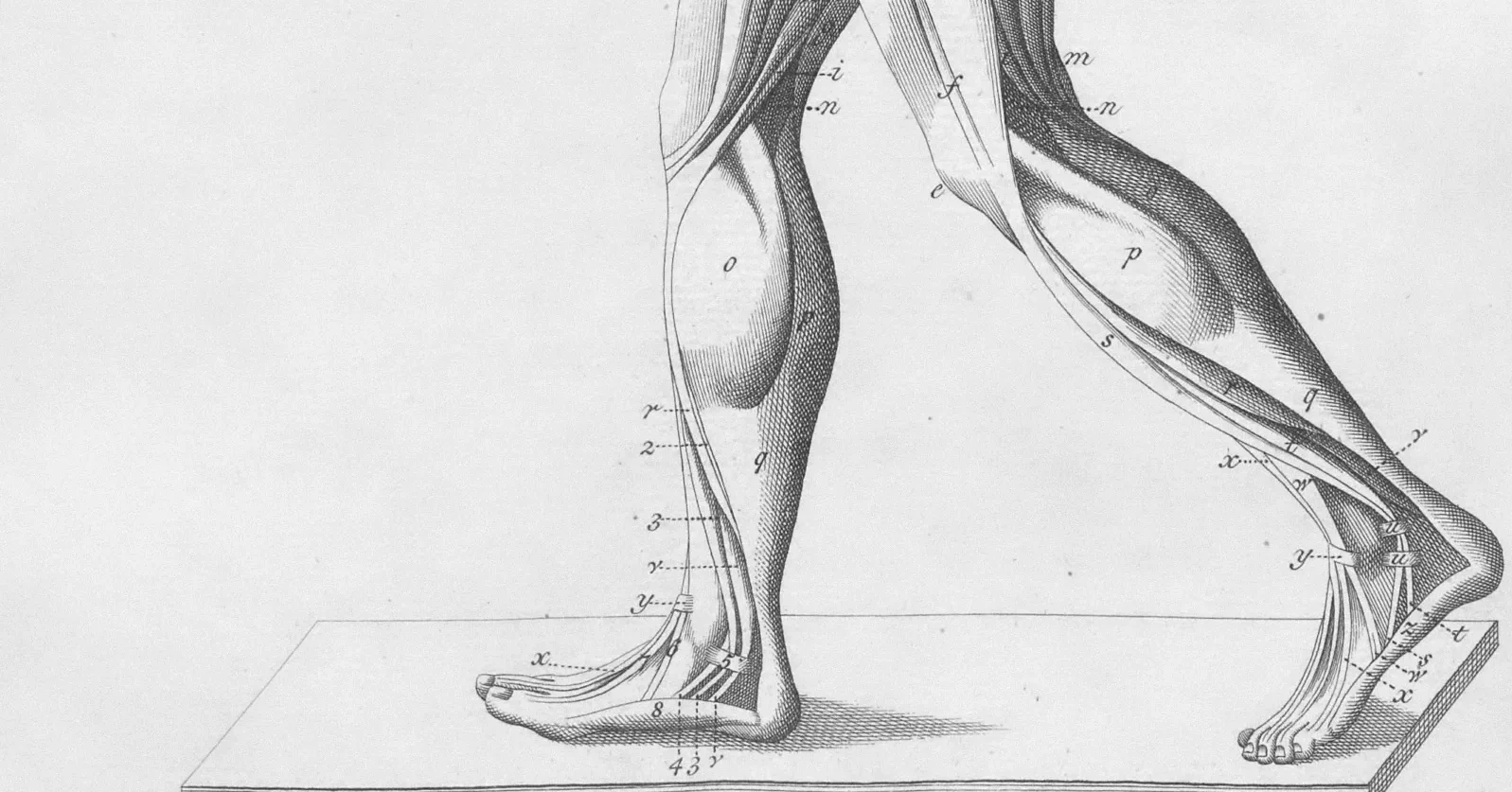
The science of football movement has decades of research behind it. The three principles at its core rarely appear in applied coaching practice.
By David Findlay, Founder of KiqIQ.
Quick Answer: Football biomechanics is the scientific study of how mechanical forces govern movement in association football. Three foundational principles, ground reaction force, angular momentum, and deceleration mechanics, explain how players sprint, kick, jump, and absorb contact. Understanding these principles gives performance staff an evidence-based framework for technique analysis, session design, and load management.
Definition: Football biomechanics is the application of mechanical principles to human movement in association football. It examines how internal forces (muscular contraction) and external forces (gravity and ground reaction) interact with the body to produce and control motion. The discipline covers linear kinematics, angular kinematics, kinetics, and the biomechanical demands of sport-specific actions including sprinting, striking, jumping, and change of direction.
Key point: The three basic biomechanical principles in football, force production, rotational mechanics, and deceleration load, underpin every movement decision a performance coach makes. Ignoring any one of them allows injury risk and technical error to accumulate undetected across a season.
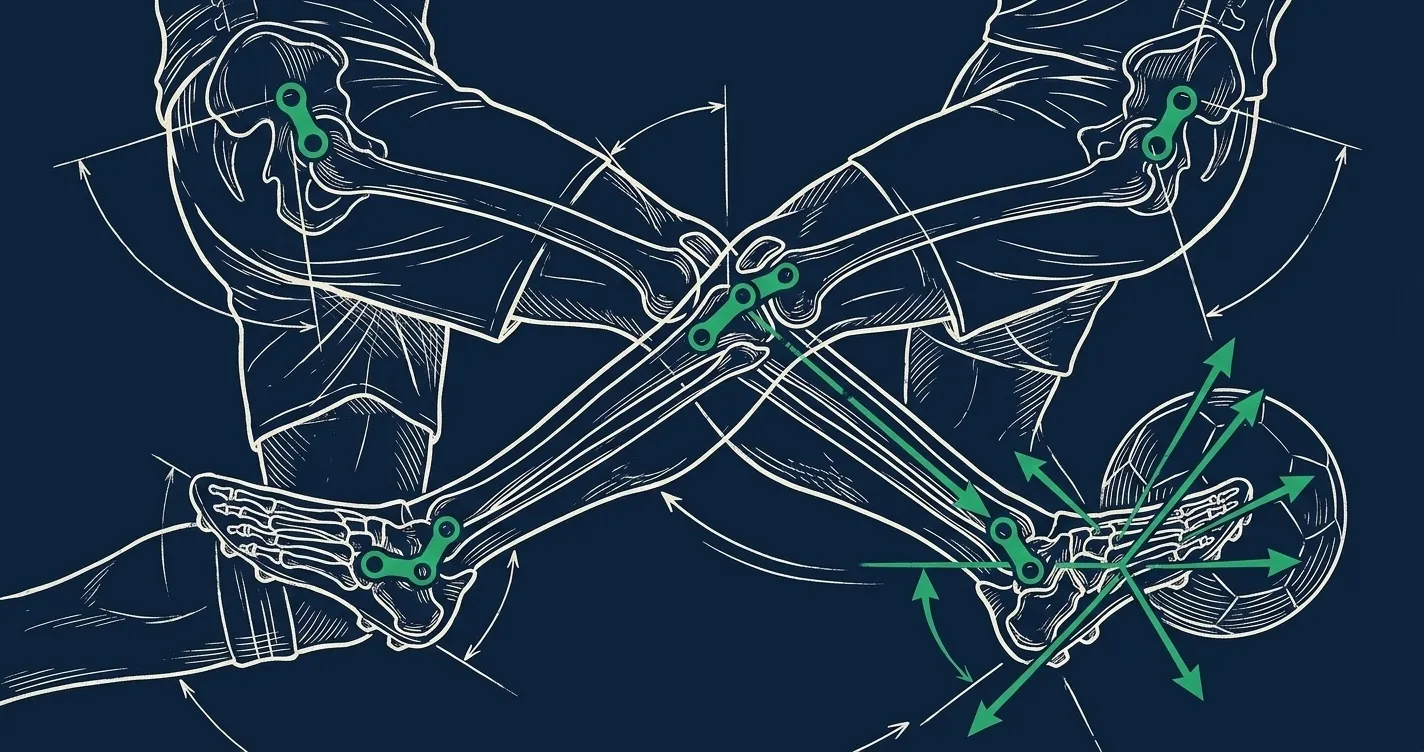
The Three Basic Biomechanical Principles in Football
While the definition is standard, the instrumentation friction is where most performance departments fail to find signal. Football movement science draws on a broad evidence base, but three principles consistently form the foundation of applied biomechanical analysis at every level of the game.
Principle 1: Ground Reaction Force and Force Production
Every movement a footballer makes begins with a force applied to the ground. By Newton’s third law, the ground returns an equal and opposite force. This ground reaction force is the primary driver of acceleration during sprint starts, jumps, and change of direction. The magnitude, direction, and timing of this force determine both performance output and musculoskeletal load simultaneously.
During a sprint, a player applies force predominantly in the horizontal direction. Research consistently shows that elite sprinters generate greater anterior horizontal ground reaction force relative to total force compared to recreational athletes. In football, this is complicated by the need to repeatedly reorient force across multiple planes as players react to ball position, opposition shape, and game state.
Peak vertical ground reaction force values during a contested aerial ball are typically recorded between 3.0 and 4.5 times bodyweight. Heading duels and aerial challenges place repeated high-load events on the musculoskeletal system that accumulate across a 90-minute match and compound over a full competitive season.
Principle 2: Angular Momentum and Rotational Motion
The majority of explosive football actions are rotational. Kicking, turning, and heading all rely on the coordinated transfer of angular momentum through the kinetic chain, from hip to foot or trunk to head.
In a maximal instep kick, the striking leg undergoes rapid internal hip rotation followed by knee extension. Research published on the biomechanics of kicks in football identifies the proximal-to-distal sequencing of joint torques as the primary mechanical determinant of ball velocity. A coach observing poor shooting power may be watching a proximal generation deficit rather than a technical error at the foot itself.
Angular momentum is conserved unless an external torque is applied. This is why a player who positions the plant foot too wide cannot transfer rotational energy efficiently through the kinetic chain. The result is reduced ball velocity and elevated medial knee load, a combination that is both a performance and injury concern for youth players whose technical patterns are still forming.
Principle 3: Deceleration Mechanics and Eccentric Load
Deceleration is the most underestimated mechanical demand in football. Players decelerate from high speed between 1,200 and 1,500 times per match, with the majority of these braking events occurring in under two seconds. The musculotendinous load associated with high-intensity deceleration exceeds that of acceleration across most speed zones.
Eccentric force production, where the muscle lengthens under tension, is the primary mechanism of deceleration. The quadriceps, hamstrings, and gastrocnemius absorb kinetic energy during braking. Inadequate eccentric strength capacity is a well-established injury risk factor for hamstring strain and anterior cruciate ligament rupture in football.
Research from the Aspetar sports medicine journal on football musculoskeletal load reinforces that deceleration demands targeted monitoring because standard GPS-derived speed metrics underreport the magnitude of eccentric loading placed on lower limb structures during match play.
Signal vs. Friction: Tracking Biomechanical Metrics in Practice
Not every biomechanical variable that matters in theory is practical to capture outside a laboratory. The table below identifies the easy-to-track version of each core metric alongside the high-value version and the real capture cost associated with each, so performance staff can make an informed prioritisation decision for their environment.
| Metric | Easy-to-Track Version | High-Value Version | Capture Cost |
|---|---|---|---|
| Ground Reaction Force | Vertical jump height in cm | Peak GRF via force plate in N per kg | Lab-grade force plate required |
| Deceleration Load | Session distance in high-speed zones | High-intensity deceleration count and severity per session | GPS unit at 10Hz minimum with validated deceleration algorithm |
| Angular Momentum (Kicking) | Observational technique rating by coach | Hip-to-foot angular velocity via 3D motion capture | Full motion capture laboratory and specialist post-session analysis |
| Eccentric Muscle Load | Subjective RPE or athlete fatigue score | Musculotendinous strain via calibrated inertial sensors | IMU placement calibration and session integration workflow |
| Sprint Kinematics | Top speed in km/h from GPS | Step frequency and ground contact time via optical timing | Specialised timing gates or instrumented sprint treadmill |
Football Movement Science Across Key Actions
Football movement science describes the full mechanical profile of sport-specific actions, not isolated muscle tests or single-joint assessments. The primary movement categories each carry distinct biomechanical signatures that inform both technical coaching and physical preparation.
Sprinting in football occurs in short bursts averaging three to five seconds with incomplete recovery between efforts. Unlike track sprinting, football sprints begin from walking or jogging pace, placing greater demand on the force-velocity profile of the player at lower initial velocities. The acceleration phase, typically the first 10 to 20 metres, is where ground reaction force orientation is most mechanically decisive for total sprint distance achieved.
Changing direction imposes combined sagittal and frontal plane loading in a way that straight-line sprinting does not. A cutting movement at speed generates medial knee loading and requires rapid co-contraction of the hip stabilisers, knee extensors, and ankle dorsiflexors to maintain joint integrity through the movement. The biomechanics of football resource from The Coaching Family details how change-of-direction mechanics differ from linear sprinting in terms of joint angle and peak force magnitude at each lower limb segment.
Jumping and heading introduce ballistic loading through the cervical spine. The heading contact phase lasts approximately 20 milliseconds. The cumulative cervical load across a session involving repeated heading practice is a current area of active biomechanical investigation, particularly in youth development settings where long-term tissue adaptation is still occurring.
Deceleration Load in Football: Why It Demands Separate Analysis
Standard GPS outputs present distance, speed, and sprint count. These metrics do not adequately capture deceleration load. A player can complete a session with low total distance and a moderate sprint count but experience significant musculotendinous loading if the session involves repeated high-intensity braking events from near-maximal velocity.
The key biomechanical distinction is that deceleration requires higher eccentric force than acceleration requires concentric force across equivalent velocity changes. For the hamstrings specifically, the combination of high hip flexion angle and active knee extension during late swing phase of sprinting places the hamstring in a lengthened position under substantial tension. A rapid deceleration at the end of that sprint adds an additional eccentric demand that is entirely invisible to top-speed GPS metrics.
A review of biomechanical research available through PubMed on football movement demands confirms that eccentric load monitoring requires a dedicated analytical framework rather than integration into standard speed-zone reporting, which was not designed to capture braking intensity or direction-change loading.
Performance staff using GPS systems should request deceleration count and deceleration intensity outputs rather than treating speed zones alone as a proxy for session load. Where this data is unavailable at the required granularity, session design, specifically limiting maximal-velocity sprints immediately followed by physical contact, serves as a practical risk mitigation for lower-resource environments.
Applying Football Biomechanics Basics in Coaching Practice
Football biomechanics basics are not exclusively a laboratory science. The three core principles have direct and immediate application to coaching cues, session sequencing, and injury risk management without requiring specialist equipment in most cases.
A coach observing a player who struggles to shoot powerfully from wide angles should first evaluate hip rotation range and plant foot position rather than foot contact point alone. A full ground reaction force and angular momentum analysis would identify the proximal cause, but observational screening of plant foot angle and trunk lean is a practical field equivalent that requires no instrumentation.
A fitness coach designing a deceleration conditioning block should include eccentric-biased lower limb exercises, such as Nordic curls and single-leg Romanian deadlifts, before progressing to repeated sprint protocols. This sequencing reflects the biomechanical demand order: build eccentric capacity before exposing the player to repeated high-velocity deceleration in open training.
Football biomechanics basics also directly inform warm-up design. Dynamic stretching at appropriate joint ranges, combined with progressive speed exposure, primes the neuromuscular system for the force demands of match play. The Motion Specific Release overview of soccer biomechanics highlights how pre-match neuromuscular activation correlates with early-match injury incidence, reinforcing the applied value of structured biomechanical warm-up protocols grounded in the same three foundational principles.

Frequently Asked Questions
What are the three basic biomechanical principles in football?
The three basic biomechanical principles in football are ground reaction force and force production, angular momentum and rotational motion, and deceleration mechanics with eccentric load. Together, they explain the mechanical basis of sprinting, kicking, jumping, changing direction, and absorbing contact across a full match.
What is football movement science?
Football movement science is the interdisciplinary field that applies biomechanics, physiology, and motor control research to the specific movement demands of association football. It examines how players produce, transfer, and absorb force across sprint cycles, kicking actions, aerial challenges, and change-of-direction events throughout a competitive match and season.
Why is deceleration load important in football?
Deceleration load represents the eccentric muscular demand placed on the lower limb during braking from high speed. It is a primary injury risk factor for hamstring strains and anterior cruciate ligament injuries. Standard GPS metrics consistently underreport this load, making dedicated deceleration monitoring essential for accurate session planning and injury prevention at all levels.
How does angular momentum apply to kicking in football?
In a maximal instep kick, angular momentum is generated at the hip, transferred through the thigh, and expressed at the foot via the proximal-to-distal sequencing of joint torques. A deficit at any proximal joint reduces ball velocity and increases mechanical compensation at distal structures, which is a common cause of knee and foot overload in youth players developing their striking technique.
What is ground reaction force in football biomechanics basics?
Ground reaction force is the force the ground exerts on a player equal and opposite to the force they apply downward. It is the primary driver of acceleration, jump height, and change-of-direction velocity in football. Its magnitude, direction, and timing determine sprinting efficiency and musculoskeletal load distribution across the full lower limb chain.