
Football's Most Iconic Trophies: Design, History and Meaning
From the FA Cup's 1872 Victorian silverwork to the UEFA Champions League's 1966 modernist redesign, the stories and craftsmanship behind the silverware that defines the sport.
 Tap to enlarge
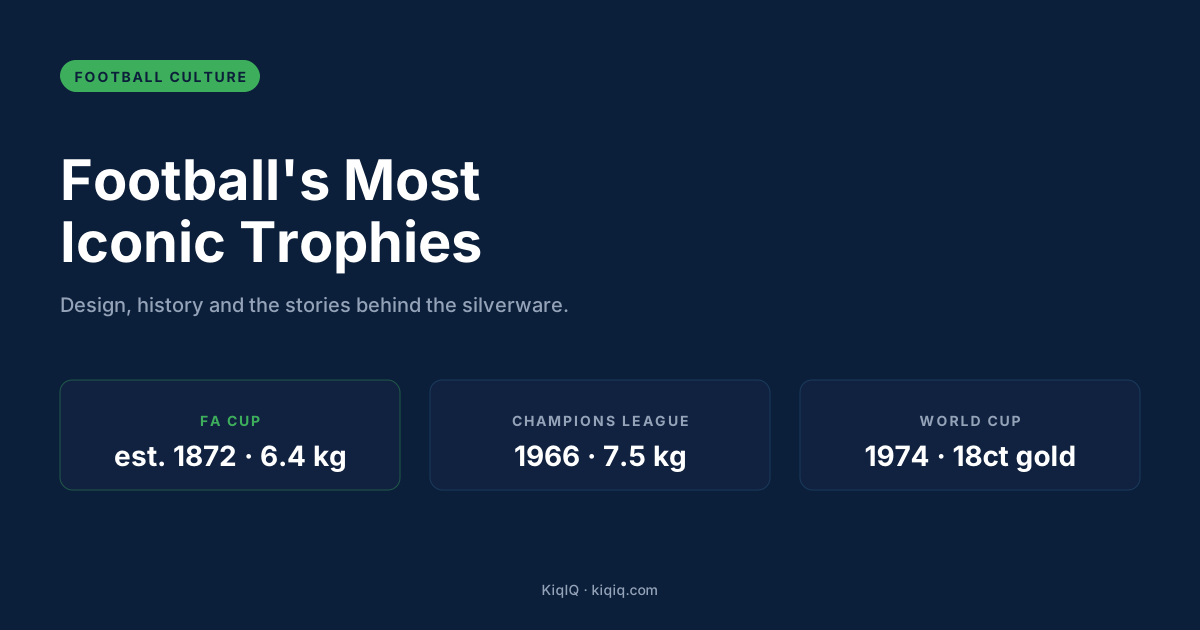
The FA Cup, first awarded in 1872, is the oldest football trophy still contested. The Champions League trophy, designed by Bernese silversmith Hans Tinguely in 1966, weighs 7.5 kg and stands 73.5 cm tall. The current FIFA World Cup trophy, sculpted by Silvio Gazzaniga in 1974 to replace the Jules Rimet cup, is solid 18-carat gold with malachite inlays at the base. The Premier League trophy, redesigned in 2004 by Asprey London, weighs 25 kg and features two lion-head handles flanking a crown. Each trophy has its own silversmith, its own founding myth, and a craft tradition that the on-pitch result alone can't convey.
The FA Cup: the oldest survivor, on its fourth body
The current FA Cup is the fourth physical trophy in a 152-year lineage. Hand-engraved replicas have always tracked alongside the official cup — supporters who want a scale Champions trophy collection now have a market that runs from £15 desk pieces to £5,000 full-scale gold-plated commissions. The original 1872 cup, designed by Martin, Hall & Co. of Sheffield for £20, was stolen from a Birmingham shop window in 1895. The second trophy, an exact replica, was used until 1910 when it was retired and given to FA president Lord Kinnaird, eventually selling at auction for £478,000 in 2005. The third trophy, by Fattorini and Sons, was used 1911-91. The current FA Cup, made by Toye, Kenning and Spencer of Birmingham in 1992, replicates the 1911 design at the same dimensions, weighing 6.4 kg with a height of 38 cm.
The trophy's "eared lid" silhouette — the lid handles arc outward like teacup ears — is the most iconic profile in English football. The design dates to the original 1872 commission, and every replica has preserved the dimensions to within a millimetre. The trophy is hand-engraved with the winning team each year, with engravers from Toye, Kenning and Spencer flying to the final to begin the inscription within minutes of the final whistle.
Quick question
Which is the oldest football trophy still contested?
The Champions League trophy: modernist with no fixed weight
When UEFA replaced the original 1955 European Cup trophy in 1966, they chose a design by Bernese silversmith Hans Tinguely that broke with the Victorian template entirely. The "big ears" trophy stands 73.5 cm tall, weighs 7.5 kg, and features two large asymmetric handles that double as the carrying loops when the winning captain lifts it. Tinguely's brief was a trophy "that lifts well," and the asymmetric handles concentrate the weight close to the captain's chest when raised.
The trophy is solid sterling silver with no gold inlay. UEFA awards it permanently to any club that wins the competition five times overall or three times in succession (Real Madrid, Ajax, Bayern Munich, AC Milan, Liverpool and Barcelona have all qualified). The current holder of the original 1966 trophy is UEFA itself; each "permanent" winner receives a smaller replica. Engraving runs around the base in a continuous spiral that has accommodated every winner from Real Madrid 1956 to the current era.
The Champions League trophy is permanently awarded to any club winning 5 times overall or 3 consecutive seasons. Real Madrid have won 5 of the originals on this rule, leaving them displayed at the Santiago Bernabeu museum.
The FIFA World Cup: Gazzaniga's 1974 redesign
The original 1930 Jules Rimet trophy was awarded permanently to Brazil after their 1970 third win. It was stolen from the Brazilian FA in 1983 and has never been recovered. The current World Cup trophy, commissioned in 1971 and first awarded in 1974, was designed by Italian sculptor Silvio Gazzaniga. The design depicts two human figures lifting the world, sculpted in solid 18-carat gold with malachite inlays at the base. Total weight is 6.175 kg, height 36.8 cm.
Unlike the Champions League trophy, the FIFA trophy is NOT permanently awarded to any nation, regardless of wins. The trophy itself stays with FIFA in Zurich between tournaments. Winning nations receive a gold-plated bronze replica known as the FIFA World Cup Winners' Trophy. The original travels to the winning nation's capital for a celebration period (typically 3-5 days) before returning to FIFA. The base has engraving space for 17 winning teams; once filled, FIFA will commission a replacement plinth.
The Premier League trophy and the lion-head handles
The current Premier League trophy was commissioned in 2004 from Asprey London to replace the simpler 1992 original. The 25 kg trophy stands 76 cm tall with two cast lion-head handles flanking a sterling-silver crown. The lions reference the three-lion crest on the English national team kit; the crown denotes the trophy's status as the highest English club honour. The "Champions" plinth is hand-engraved with the winning club each season, with the inscription completed by the Asprey workshop within 72 hours of the final-day result.
A "second" Premier League trophy exists, weighing the same and made to the same dimensions, used when the title is mathematically secured before the final matchday. The first trophy is held at Premier League headquarters until the title is confirmed; the second is rushed to the ground where the title-winning club next plays. The same dual-trophy protocol applies for the Women's Super League, which uses a smaller (12 kg) Asprey trophy commissioned in 2010.
Why replica trophies became a collectors' market
The boundary between "official" and "replica" matters more for football trophies than for most collectibles. UEFA, FIFA and the FA all license a small number of official-replica producers (Toye, Kenning and Spencer for the FA Cup; Asprey for the Premier League; selected European workshops for the Champions League). Beyond the licensed makers, a much larger market exists for unofficial replicas at varying scales — typically 25-40% of original size, made of resin or zinc alloy rather than silver or gold.
For supporters, the appeal of an unofficial replica is access to a silhouette they could otherwise only see in stadium displays. A scale-replica collection brings several iconic trophy silhouettes onto a fan's shelf, with the proportions preserved even when the materials differ.
Frequently asked questions
- How old is the FA Cup trophy?
- The FA Cup tradition is the oldest in football, dating to 1872. The current physical trophy is the fourth: the 1872 original was stolen in 1895; the second was retired in 1910; the third (Fattorini and Sons, 1911) was used until 1991; the current Toye, Kenning and Spencer trophy from 1992 replicates the 1911 design to within a millimetre. The trophy weighs 6.4 kg and stands 38 cm tall.
- Who designed the Champions League trophy?
- Bernese silversmith Hans Tinguely, commissioned by UEFA in 1966 to replace the 1955 original. The "big ears" silhouette — two large asymmetric handles forming carrying loops — was designed so the trophy lifts well in the winning captain's hands. The trophy weighs 7.5 kg, stands 73.5 cm tall, and is solid sterling silver. UEFA permanently awards it to clubs that win 5 times overall or 3 consecutive seasons.
- Is the FIFA World Cup trophy solid gold?
- Yes. The current trophy, designed by Silvio Gazzaniga in 1971 and first awarded in 1974, is solid 18-carat gold with malachite inlays at the base. It weighs 6.175 kg and stands 36.8 cm tall. The trophy is NOT permanently awarded to winning nations — they receive a gold-plated bronze replica. The original travels to the winning capital for 3-5 days before returning to FIFA in Zurich.
- Why does the Premier League have two trophies?
- Logistics. The "first" trophy is held at Premier League headquarters until the title is mathematically confirmed. The "second", made to identical Asprey London specifications (25 kg, 76 cm, sterling silver with lion-head handles), is rushed to the ground where the title-winning club next plays so the trophy lift can happen on the same day. The protocol was introduced in 2004 alongside the current Asprey design.
- What happened to the original Jules Rimet trophy?
- It was awarded permanently to Brazil after their 1970 third World Cup win, per FIFA's pre-1974 rules. The trophy was kept by the Brazilian Football Confederation until December 1983, when it was stolen from a display case in Rio de Janeiro. Despite multiple investigations it has never been recovered. The current trophy, designed by Silvio Gazzaniga, is its successor and not subject to the same permanent-award rule.
References
- The FA: History of the FA Cup trophy · The Football Association
- UEFA: The Champions League trophy story · UEFA
- FIFA: The World Cup Trophy · FIFA
- Asprey London: Premier League Trophy commission · Asprey London
- Toye, Kenning and Spencer: heritage and FA Cup commission · Toye, Kenning and Spencer
- The Jules Rimet Trophy: A History · FIFA Museum
Key terms in this article
Ask KiqIQ a follow-up
Get a live, data-driven answer powered by our live data feeds + KiqIQ's Poisson model. Try one of these prompts or write your own.
Part of pillar
Football Culture
See every article in this knowledge pillar →
Related
Reviewed by a KiqIQ editor before publication. Spotted an error? Email editor@kiqiq.com. We follow our Corrections Policy.