
The FIFA World Cup Trophy: Design, Materials and Half a Century of Lifts
Silvio Gazzaniga's 1974 design replaced the stolen Jules Rimet cup with 18-carat gold and malachite. The story of the trophy, its predecessor, and how it actually gets engraved each tournament.
 Tap to enlarge
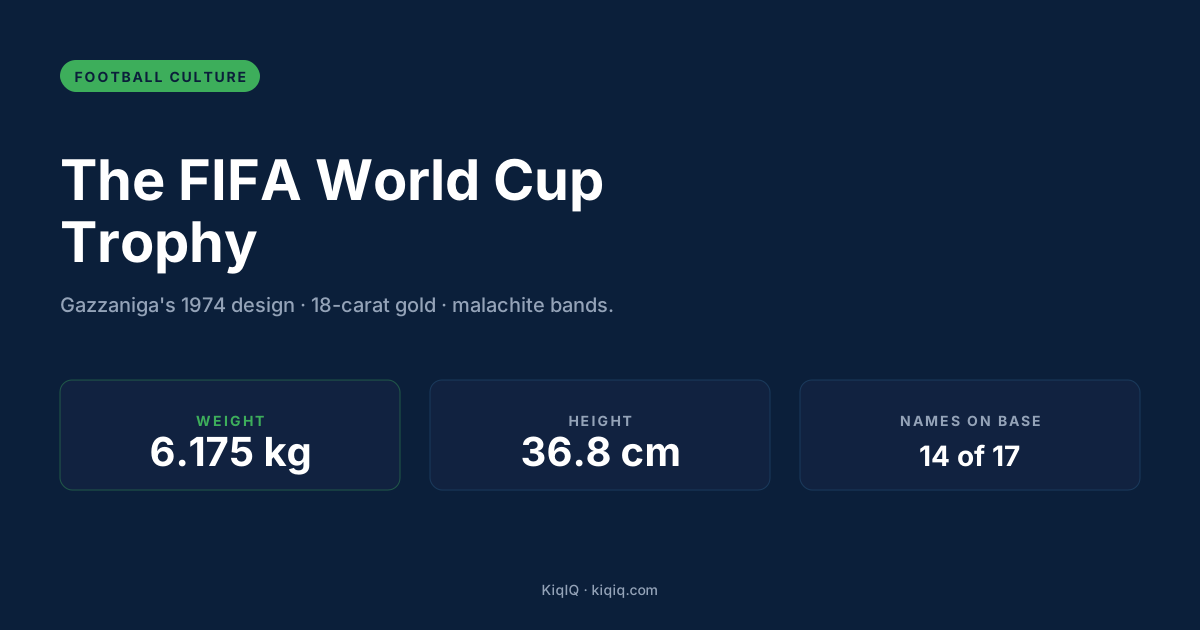
The current FIFA World Cup trophy was sculpted in 1971 by Italian artist Silvio Gazzaniga and first awarded in 1974. It stands 36.8 cm tall, weighs 6.175 kg, and is made of solid 18-carat gold with two bands of malachite at the base. FIFA solicited 53 design entries from sculptors in seven countries; Gazzaniga's submission, depicting two human figures with arms outstretched supporting the globe, was chosen by a panel chaired by FIFA president Stanley Rous in March 1971. The trophy has been lifted 14 times since West Germany's 1974 win, by eight different countries. It is not awarded permanently to any winning nation, unlike the predecessor Jules Rimet trophy.
The Jules Rimet trophy and the 1970 ownership rule
The original World Cup trophy, designed by French sculptor Abel Lafleur for the 1930 inaugural tournament in Uruguay, was made of gold-plated sterling silver on a lapis lazuli base. It stood 35 cm tall and weighed 3.8 kg. Lafleur's design depicted Nike, the Greek goddess of victory, holding an octagonal vessel above her head. The trophy was renamed the Jules Rimet Trophy in 1946 to honour the FIFA president who had founded the World Cup.
FIFA's 1930 rules awarded the trophy permanently to the first nation to win it three times. Brazil reached that threshold in 1970 with Pele's third World Cup, and the Jules Rimet trophy was handed to the Brazilian Football Confederation in perpetuity. The trophy was kept at the CBF headquarters in Rio de Janeiro until 19 December 1983, when it was stolen from a wooden-fronted display case. Despite multiple police investigations across three decades it has never been recovered, with most theories concluding the gold was melted down within weeks of the theft.
The original 1930 Jules Rimet trophy was awarded permanently to Brazil after their 1970 third win and was stolen in 1983. The current Gazzaniga design will never be awarded permanently — winning nations receive a gold-plated bronze replica.
Quick question
Why did Brazil keep the Jules Rimet trophy permanently in 1970?
Gazzaniga's 1971 brief and the figures-and-globe motif
FIFA's 1971 brief for the replacement trophy was specific: a design that "captures the moment of victory" without depending on figurative deities (Nike was felt to be too Eurocentric for a global tournament). 53 sculptors submitted entries. Gazzaniga's submission depicted two unidentified human figures, arms upraised, jointly supporting a stylised globe etched with continental outlines. The figures were deliberately ambiguous in gender and ethnicity, the goal being a universal rather than nationally specific image.
Gazzaniga later described the design as influenced by the Italian Futurist sculpture tradition of Umberto Boccioni, with the dynamic upward curve of the figures echoing Boccioni's 1913 "Unique Forms of Continuity in Space." Production was awarded to Italian goldsmith Bertoni of Milan, with the trophy cast in solid 18-carat gold and the malachite bands sourced from a mine in the Democratic Republic of the Congo. Total production cost in 1971 was approximately $50,000 (around £550,000 in 2026 money).
The post-tournament protocol and the replica system
Unlike the Jules Rimet trophy, the Gazzaniga trophy is never awarded permanently. After a World Cup final, the winning team's captain receives the original for the post-match podium ceremony. The trophy then accompanies the team home for a 3-5 day victory celebration in the winning country, traveling under FIFA security. After that period it returns to FIFA headquarters in Zurich, where it is kept in a vault between tournaments.
Each winning nation receives a gold-plated bronze replica known officially as the "FIFA World Cup Winners' Trophy." The replica is dimensionally identical to the original but weighs slightly less (5.9 kg vs 6.175 kg) due to the bronze-and-plating construction. The replica is the version typically displayed at national football association headquarters — the trophy on display at the German DFB Museum in Dortmund, for example, is the Winners' Trophy replica from West Germany's 1974 win, not the original.
Engraving, base limits and the looming 2042 problem
The base of the Gazzaniga trophy has space for 17 winning teams' names. As of 2026 (after Argentina's 2022 win), 14 names have been engraved: West Germany 1974, Argentina 1978, Italy 1982, Argentina 1986, West Germany 1990, Brazil 1994, France 1998, Brazil 2002, Italy 2006, Spain 2010, Germany 2014, France 2018, Argentina 2022, and one slot pending for 2026. The 2030 winner will fill the 16th slot, the 2034 winner the 17th, and after that FIFA will need to commission a replacement plinth or modify the trophy.
FIFA confirmed in a 2018 statement that the long-term plan is to commission a new identical-design plinth at the same goldsmith (Bertoni of Milan, still operational and still the only authorised producer of the Gazzaniga design) when the 17 slots are filled. The Gazzaniga sculpture itself would remain unchanged. The detail explains why Bertoni's 1971 archival drawings and material specifications are stored at FIFA headquarters — the design is meant to outlast its original plinth.
The replica market and licensed scale models
Beyond the official Winners' Trophy replicas, FIFA licenses a tiered system of unofficial replicas at varying scales. Full-size 36.8 cm replicas in gold-plated bronze (without the malachite bands, which are export-restricted from the DRC) sell at £2,000-5,000 from licensed producers. Half-scale replicas in zinc alloy run £80-200. Below that, miniature 10-15 cm desk replicas in resin sell from £15-40 at the entry level.
A separate licensing track exists for construction-toy replicas, with brick-built editions that recreate the Gazzaniga silhouette at desk scale marketed in the run-up to the 2026 World Cup.
Frequently asked questions
- When was the current World Cup trophy designed?
- In 1971, by Italian sculptor Silvio Gazzaniga, after a FIFA design competition that drew 53 entries from sculptors in seven countries. The trophy was first awarded at the 1974 tournament in West Germany. It is solid 18-carat gold with two bands of malachite at the base, stands 36.8 cm tall and weighs 6.175 kg.
- What happened to the original Jules Rimet trophy?
- It was awarded permanently to Brazil in 1970 after Pele's third World Cup win, per the pre-1974 rule that gave the trophy to the first nation to win it three times. The trophy was stolen from the Brazilian Football Confederation's headquarters in Rio de Janeiro on 19 December 1983 and has never been recovered. Most theories conclude the gold was melted down within weeks of the theft.
- Do winning nations get to keep the trophy?
- No. Unlike the Jules Rimet trophy, the Gazzaniga design is never permanently awarded. The original returns to FIFA headquarters in Zurich after a 3-5 day victory celebration in the winning country. Each winning nation receives a gold-plated bronze replica (the "FIFA World Cup Winners' Trophy"), dimensionally identical but weighing 5.9 kg vs the original's 6.175 kg.
- How many names will fit on the base?
- 17. As of 2026 (after Argentina's 2022 win), 14 names have been engraved. The 2030 and 2034 winners will fill slots 16 and 17. FIFA has confirmed that when the 17 slots are filled, Bertoni of Milan — the original 1971 goldsmith — will produce a new identical-design plinth. The Gazzaniga sculpture itself will remain unchanged.
- Why does the trophy include malachite?
- Aesthetic and provenance. Gazzaniga chose the green malachite bands at the base to break up the gold visually and to add a "non-European" material to a deliberately universal design. The malachite was sourced from a mine in the Democratic Republic of the Congo (then Zaire) and was selected for its deep banded patterning. Export restrictions on Congolese malachite now make sourcing identical replacement material difficult, which is why most licensed replicas omit it entirely.
References
- FIFA: The World Cup Trophy · FIFA
- FIFA Museum: Gazzaniga design archive · FIFA Museum, Zurich
- The Jules Rimet Trophy: A History of the World Cup Trophy · FIFA Museum
- Bertoni Milan: official heritage and FIFA commission · Bertoni Milano
- The Stolen Cup: investigating the 1983 Jules Rimet theft · BBC Sport
- Umberto Boccioni: Unique Forms of Continuity in Space · Tate Modern
Ask KiqIQ a follow-up
Get a live, data-driven answer powered by our live data feeds + KiqIQ's Poisson model. Try one of these prompts or write your own.
Part of pillar
Football Culture
See every article in this knowledge pillar →
Related
Reviewed by a KiqIQ editor before publication. Spotted an error? Email editor@kiqiq.com. We follow our Corrections Policy.