
Wembley Stadium: A Century of English Football at the National Home
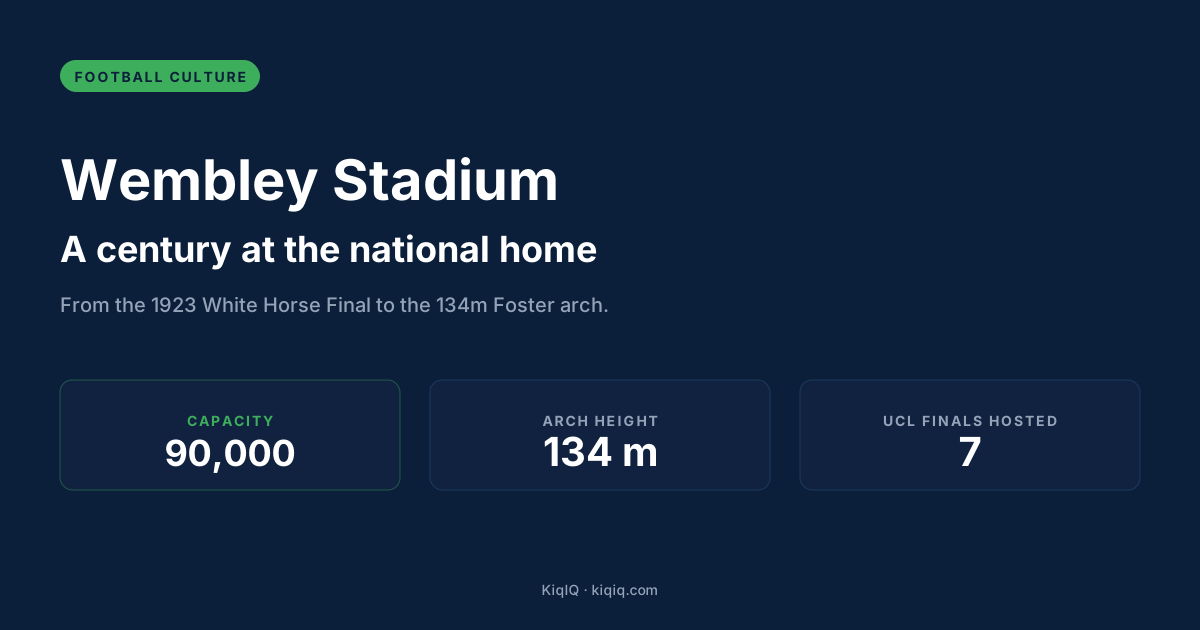
From the 1923 White Horse Final to Foster + Partners' 2007 arch redesign, the venue that has hosted every England home international, FA Cup Final and modern UEFA showpiece.
 Tap to enlarge
Wembley Stadium opened on 28 April 1923 as the Empire Stadium, built in 300 working days at a cost of £750,000 (around £55 million in 2026 terms) for the British Empire Exhibition. Its first event was that year's FA Cup Final between Bolton Wanderers and West Ham United, known forever after as the White Horse Final for the police horse named Billie that cleared the overcrowded pitch. The original twin towers stood until 2002, when the entire stadium was demolished and replaced with Foster + Partners' £798 million arch design that opened in 2007. The new Wembley's 90,000-seat capacity makes it the second-largest stadium in Europe after Camp Nou.
The 1923 build and the White Horse Final
The Empire Stadium at Wembley was commissioned by the British Government as the centrepiece of the 1924-25 British Empire Exhibition, with construction starting in January 1922 and the official opening on 28 April 1923. The architects Sir John Simpson and Maxwell Ayrton designed twin 38-metre towers flanking a Mediterranean-style facade, a deliberate break from the brick-and-corrugated-iron norm of British football grounds at the time. Total construction cost was £750,000.
The opening FA Cup Final between Bolton Wanderers and West Ham United on 28 April 1923 was billed as a "free public event" up to a 127,000-ticket cap. An estimated 300,000 people turned up. Spectators flooded the pitch, the kickoff was delayed by 45 minutes, and police constable George Scorey on a white horse named Billie (actually grey, but appearing white in the photographs) became the central figure in clearing the playing surface. The final eventually started and Bolton won 2-0. The day permanently changed crowd management at British football venues and became the Empire Stadium's founding myth.
Quick question
What was the original Wembley called when it opened in 1923?
The 1966 World Cup and the Twin Towers era
Wembley hosted the 1948 Olympics, the 1956 Rugby League Cup, and steadily built its status as England's national football home through the 1950s. The defining moment came on 30 July 1966, when England beat West Germany 4-2 in extra time to win the World Cup, the only senior trophy English football has ever lifted. Geoff Hurst's hat-trick — the only hat-trick scored in a World Cup final — was sealed by his final goal as "they think it's all over, it is now" played out on BBC commentary. The match attendance was 96,924, with the Twin Towers framing the trophy lift photographs that became the defining image of English football.
The Twin Towers era continued through 1968 (Manchester United's European Cup win on the ground), 1996 (Euro 96 semi-final between England and Germany), and the 2000 FA Cup Final between Chelsea and Aston Villa, the last match before the closure. Capacity in the post-Taylor-Report all-seater conversion stood at 82,000, with the pitch frequently relaid for Rugby League finals, NFL exhibitions, and concerts (Live Aid 1985, Queen's 1986 set, the Three Tenors 1996).
England 4-2 West Germany on 30 July 1966 remains the only senior trophy England have won in football. The match was watched by 96,924 at Wembley and by an estimated 32.3 million on UK television.
The 2002-07 rebuild and the Foster arch
The Twin Towers were demolished in February 2003 after the stadium hosted its final match in October 2000. The replacement Wembley, designed by Foster + Partners and Populous (then HOK Sport) with Mott MacDonald as structural engineers, was originally budgeted at £475 million and projected to open in 2003. Cost overruns, contractor disputes (notably with Multiplex) and design changes pushed the total to £798 million and the opening to March 2007. The 134-metre arch — the longest unsupported roof structure in the world — became the new visual signature, replacing the Twin Towers in tourist photographs and broadcasting opens.
The arch performs a structural function as well as an aesthetic one: it bears 60% of the weight of the partially retractable north roof, which means the south end can have no roof-supporting columns and offers a fully unobstructed view. The arch is illuminated at night (typically white, red for England matches, blue for Champions League finals), and is visible from across north-west London. The pitch is a hybrid Desso grass-fibre surface relaid every 12-18 months, with a heated subsurface that prevents frost and a drainage system rated for 40mm of rain per hour.
Wembley today: capacity, calendar and Category 4 status
The current capacity is 90,000 (originally 90,000 at opening, briefly 86,000 between 2010-15 during a corporate-seat expansion, restored to 90,000 since 2017). It is a UEFA Category 4 venue, the top tier in UEFA's stadium classification, qualifying it to host Champions League and Europa League finals (last in 2024 and 2011). Wembley has hosted seven Champions League finals (1963, 1968, 1971, 1978, 1992 in the old stadium; 2011, 2013, 2024 in the new one), more than any venue except Hampden Park.
The annual calendar is dense: every England home senior international, the FA Cup Final and semi-finals, the FA Community Shield, the EFL Cup Final, the FA Trophy Final, the FA Vase Final, the Rugby League Challenge Cup Final, and several concerts per summer. The Football Association generates approximately £80-100 million per year from stadium operations alone, the single largest revenue line in their balance sheet.
Wembley as cultural icon and the construction-set market
Wembley's status outside football is unique among British grounds. Live Aid 1985, the 1996 European Championship final, the 2012 Olympic football final, the Euro 2020 final — the venue carries a level of national-cultural meaning that no club stadium can match. Tourist visitor numbers to the Wembley exterior (no entry required) sit at an estimated 1.5-2 million per year, comparable to Buckingham Palace's exterior visitor traffic. The arch is included on the London skyline shots used in the title sequences of EastEnders, the BBC News opens, and most football broadcasts.
The market for Wembley memorabilia extends beyond programmes and tickets. Scale models of the arch-era stadium have become standard fixtures in football-fan gift catalogues, with officially licensed brick-builds capturing the Foster arch and the bowl proportions at desk scale.
Frequently asked questions
- When did Wembley Stadium open?
- 28 April 1923, as the Empire Stadium, with the FA Cup Final between Bolton Wanderers and West Ham United (the "White Horse Final"). The current Wembley, after a 2002-03 demolition and 2007 reopening, was designed by Foster + Partners and Populous with a 134-metre arch as its visual signature. Total cost of the rebuild was £798 million.
- What is the White Horse Final?
- The 1923 FA Cup Final, the opening match at the new Empire Stadium. An estimated 300,000 people turned up for a venue capped at 127,000. Police constable George Scorey on a horse named Billie cleared the pitch over 45 minutes so the match could start. Bolton beat West Ham 2-0. The day reshaped crowd management at British football grounds and became the venue's founding myth.
- How tall is the Wembley arch?
- 134 metres at its peak. It is the longest unsupported roof structure in the world and supports 60% of the weight of the partially retractable north roof, allowing the south end to be column-free. The arch is illuminated white at night, red for England matches, blue for Champions League finals, and is visible from across north-west London.
- What is Wembley's current capacity?
- 90,000 — the second-largest stadium in Europe after Camp Nou (99,354 after its 2026 redevelopment). Wembley is a UEFA Category 4 venue (the top classification), eligible to host Champions League finals. It has hosted seven Champions League finals overall (1963, 1968, 1971, 1978, 1992 in the old stadium; 2011, 2013, 2024 in the new one).
- Why was the old Wembley demolished?
- By the late 1990s the original 1923 stadium was structurally aging, lacked modern accessibility and corporate facilities, and could not be cost-effectively retrofitted to UEFA Category 4 standards. The FA chose a full rebuild over refurbishment. The Twin Towers came down in February 2003 and the new Wembley opened in March 2007 after construction overruns pushed the schedule by four years.
References
- The FA: Wembley Stadium history · The Football Association
- Foster + Partners: Wembley Stadium project record · Foster + Partners
- The 1923 FA Cup Final: official record · The Football Association
- UEFA Stadium Category Classification · UEFA
- England 4-2 West Germany 1966: BBC archive · BBC Sport
- Mott MacDonald: Wembley Stadium structural design · Mott MacDonald
Ask KiqIQ a follow-up
Get a live, data-driven answer powered by our live data feeds + KiqIQ's Poisson model. Try one of these prompts or write your own.
Part of pillar
Football Culture
See every article in this knowledge pillar →
Related
Reviewed by a KiqIQ editor before publication. Spotted an error? Email editor@kiqiq.com. We follow our Corrections Policy.