
Decorating a Football Fan Room: Shirts, Trophies and Stadium Prints That Work
From framed match-worn shirts to scale-model stadiums to championship-trophy replicas, the practical guide to building a fan space that doesn't look like a teenage bedroom.
 Tap to enlarge
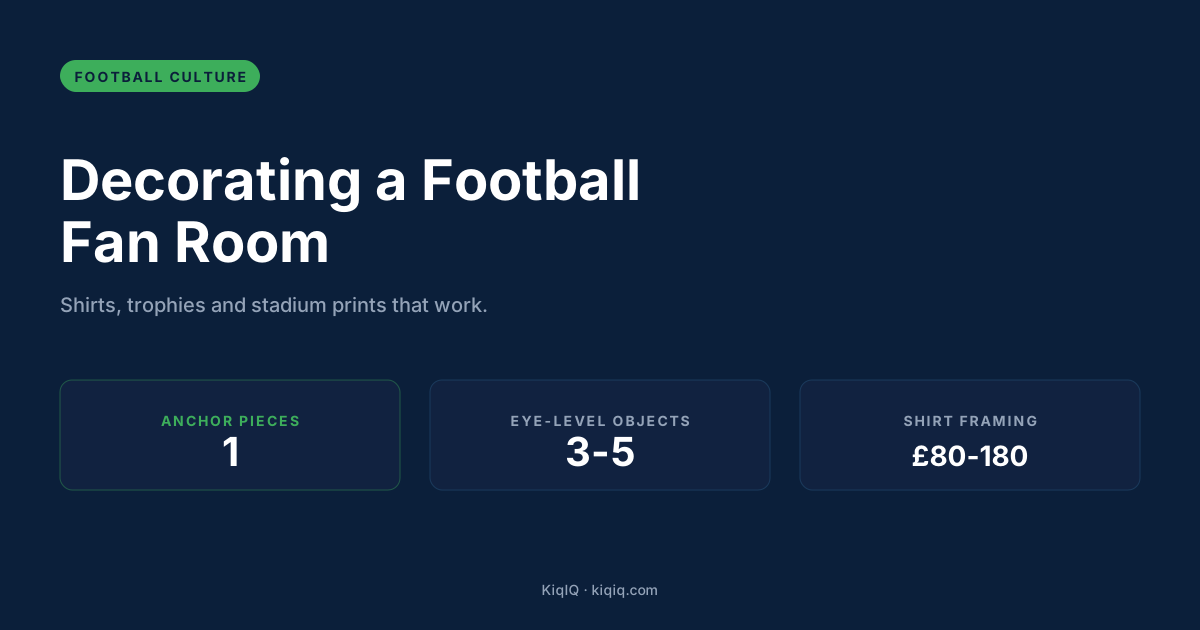
House Beautiful magazine's 2023 reader survey on hobby rooms found that 14% of UK male homeowners and 6% of female homeowners have a dedicated space at home themed around a single sports club — football accounting for 78% of those rooms. The same survey identified the most common design failure as "wall clutter": too many items, no clear hierarchy. The best-rated rooms (judged by a panel of three interior designers) shared four traits: a single anchor piece (typically a framed match-worn or signed shirt), 3-5 secondary display objects at eye level, neutral wall colours, and accent lighting on the display pieces rather than overhead general lighting.
The anchor piece: a framed shirt, properly framed
Every well-designed fan room has a single hero object. Most often it is a framed shirt, ideally match-worn (sourced from a club auction or a charity sale) or signed (with provenance documentation). Below the anchor, a curated band of secondary pieces — scarves, programmes, champions collectibles — gives the room its texture. The frame matters more than amateur collectors realise. Conservation-grade UV-filtering acrylic prevents fade over 10-20 years; a wooden frame at least 4 cm deep allows the shirt to be mounted shadow-box style without compression; a backing in neutral linen or felt rather than the club's primary colour stops the frame from looking like a club shop display.
Framing services like Etsy specialist shops or local picture-framers will mount a shirt for £80-180 depending on size and complexity. The cheaper "shirt frame" kits sold online (typically £15-30) use thin polystyrene and unfiltered acrylic and lead to noticeable fade within 3-5 years on a sunlit wall. For a piece you might pay £200-2,000 for, the framing should match the value.
Trophies and scale models at eye-level
Beneath the anchor shirt, 3-5 secondary objects at eye level (approximately 1.4-1.6 m from the floor for an adult standing) give the room its texture. Scale-replica trophies are the most common choice. The Champions League, Premier League, FA Cup and World Cup designs have all been licensed to various replica manufacturers, with scale ranging from miniature (10-15 cm desk pieces) to half-scale (35-40 cm) and rare full-scale gold-plated replicas (£2,000+, only for serious collectors).
Scale-model stadiums sit in the same eye-level band. The brick-built scale stadium genre (FOCO's BRXLZ line and equivalents from other licensed makers) produces models of Old Trafford, Stamford Bridge, the Emirates, Etihad, Anfield, Selhurst Park, St James' Park, Ibrox, Hampden, Wembley and several European venues at desk scale. They work as both a display object and an active-build hobby — most kits run 600-1,200 bricks and 4-8 hours of build time, with the finished model occupying a 25-40 cm shelf footprint.
House Beautiful's 2023 hobby-room survey rated the best-designed fan spaces by four traits: a single anchor piece, 3-5 secondary objects at eye level, neutral wall colours, accent lighting on the display. Wall clutter was the most common design failure.
The stadium print and the counterweight wall
Opposite the anchor shirt wall, the best-designed fan rooms place a single large piece — typically a panoramic stadium print, an aerial photograph of the club's ground, or a stylised illustration of the team in a famous fixture. The piece needs to be physically large (60×40 cm minimum, often 90×60 cm) to balance the anchor wall opposite. Black-and-white photography or a single-accent-colour print works better than full-colour photography, which competes with the framed shirt for attention.
Specialist sports photography prints from outlets like Sports Press Photo (the official Press Association sports archive) or club museum shops cost £40-200 depending on size and edition. Independent illustrators on Etsy produce graphic-style prints of iconic moments for £25-80. The framing rule is the same as the shirt: deep frames, conservation-grade glass, and a mat board (the inner frame between print and glass) that picks up a single accent colour from the print rather than matching the club's primary kit.
Lighting, paint and the practical mistakes
The single biggest difference between an interior-designed fan room and a teenage bedroom is lighting. The amateur instinct is to paint the walls in the club's primary colour and rely on overhead general lighting. The interior-designer instinct is neutral walls (warm white, oatmeal, dark grey) and accent lighting (small picture lights above the framed shirt, an LED strip on the back of the trophy shelf) so the display pieces stand out against a quiet background.
Other common mistakes: overcrowding the walls, mixing too many clubs or eras, hanging items too high (above 1.8 m), and using cheap "official merchandise" items as display pieces when they were designed as kit-shop ephemera. The exception that proves the rule is genuine retro merchandise — a 1980s programme collection, an enamel pin set, a vintage scarf — which works when framed and grouped as a single composition rather than scattered.
A starter cluster of 3-4 trophy replicas on a single shelf covers the eye-level secondary band without overloading the room — photographed and re-arranged a couple of times to find the spacing that feels right.
Frequently asked questions
- What's the most important piece in a fan room?
- The anchor piece — typically a framed match-worn or signed shirt. Every well-rated room in House Beautiful's 2023 hobby-room survey had a single hero object that dominated one wall. Without an anchor, the room looks like wall clutter no matter how many items are on display.
- How should I frame a football shirt?
- Use a shadow-box frame at least 4 cm deep with conservation-grade UV-filtering acrylic, a neutral linen or felt backing (not the club's primary colour), and mount via clear thread or specialist mannequin board. Specialist framers charge £80-180; the £15-30 kits sold online use thin polystyrene and unfiltered acrylic, leading to noticeable fade within 3-5 years.
- Are scale-model stadiums a good display piece?
- Yes — they work as both an active-build hobby and a display object. Brick-built stadium kits from FOCO and equivalent licensed makers run 600-1,200 bricks and 4-8 hours of build time, with finished models occupying a 25-40 cm shelf footprint. Most major Premier League, Scottish Premiership and European grounds have officially licensed versions.
- Should the walls be painted in club colours?
- No. Interior designers consistently rate neutral walls (warm white, oatmeal, dark grey) higher than club-coloured walls in fan-room judging. The display pieces stand out against a quiet background; bright club colours on the walls compete with the displays and read as adolescent. Accent lighting on the display pieces is the better way to make the room feel like a fan space.
References
- House Beautiful UK: Hobby Rooms 2023 reader survey — House Beautiful UK (Oct 2023)
- V&A Museum: framing and conservation guidelines — Victoria and Albert Museum
- Sports Press Photo: licensing and print archive — Press Association
- Match-worn shirt provenance: official guidance — MatchWornShirt
Ask KiqIQ a follow-up
Get a live, data-driven answer powered by api-football + KiqIQ's Poisson model. Try one of these prompts or write your own.
Part of pillar
Football Culture
See every article in this knowledge pillar →
Related
Reviewed by a KiqIQ editor before publication. Spotted an error? Email editor@kiqiq.com — we follow our Corrections Policy.