
Football’s most debated infraction takes one second to commit and divides opinion for ninety minutes.
By David Findlay, Founder of KiqIQ.
Quick Answer: Diving in football means deliberately falling to the ground or exaggerating the effect of contact to deceive the referee into awarding a free kick, penalty, or dismissing an opponent. The Laws of the Game classify this conduct as simulation, a cautionable offence under Law 12 that results in a yellow card for unsporting behaviour.
Definition: Diving in football is the deliberate act of a player falling, feigning injury, or exaggerating physical contact in order to deceive the match official. Under Law 12 of the Laws of the Game, published by the International Football Association Board, this conduct is formally defined as simulation and is punishable by a yellow card for unsporting behaviour, regardless of whether a foul was initially perceived by the referee.
Key point: Diving is officially termed simulation under Law 12 of the Laws of the Game and carries a mandatory yellow card for unsporting behaviour. In professional matches, VAR can review and overturn decisions where simulation directly influenced the outcome.
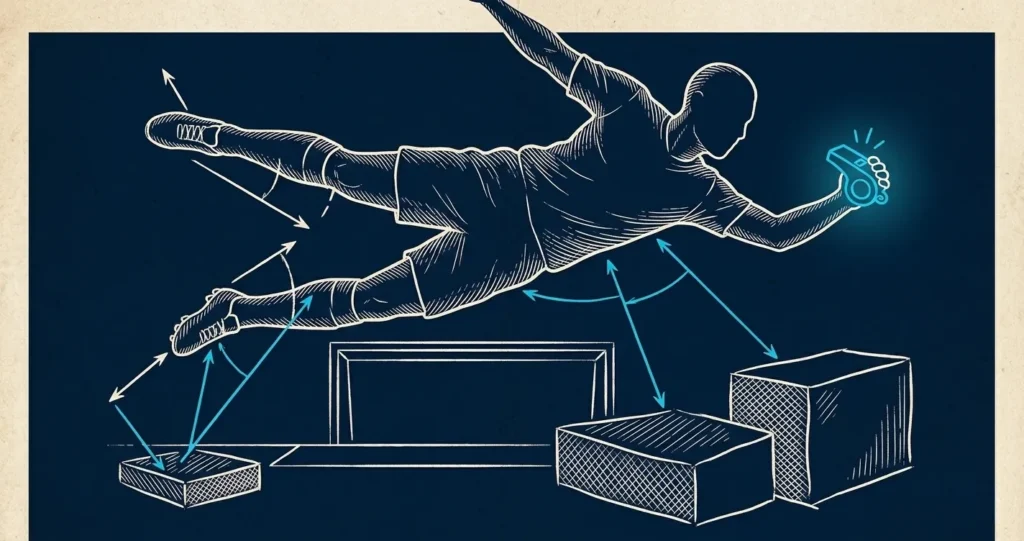
What Counts as Diving in Football
The word diving covers several distinct behaviours, all of which fall under the official term simulation. A player does not need to perform a theatrical fall to be cautioned. Minor exaggerations that clearly influence the referee’s decision also qualify.
The International Football Association Board defines simulation as any attempt by a player to deceive the referee. This includes the following acts:
- Falling without any contact from an opponent
- Exaggerating the impact of genuine but minimal contact
- Feigning injury to win a free kick or penalty
- Clutching a body part that was not struck
- Delaying a restart by pretending to be hurt after a decision has already been made
The referee’s primary test is whether the player’s reaction was proportionate to the contact received. Where no contact occurred, the decision is straightforward. Where contact did occur, the referee must judge whether the player amplified the effect beyond what was genuinely felt.
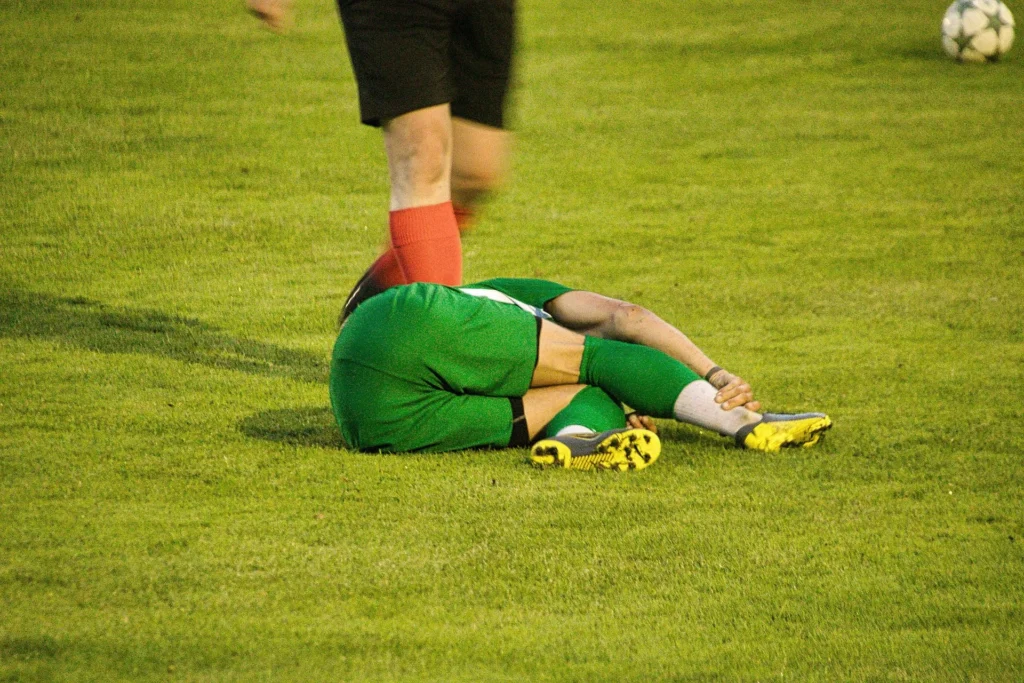
The Law 12 Definition of Simulation
Law 12 of the Laws of the Game governs fouls and misconduct. Under this law, simulation is listed as an act of unsporting behaviour warranting a yellow card. The formal language used is simulation or attempting to deceive the referee. The word diving does not appear in the Laws of the Game.
The relevant Law 12 provision states that a player must be cautioned for attempting to deceive the referee, for example by feigning injury or pretending to have been fouled. This wording makes clear that the intent to deceive is the determining factor, not the outcome of the decision made by the referee on the pitch.
If a referee awards a penalty and subsequently recognises that the player simulated, the penalty must be overturned and the player cautioned. The reverse also applies. If a foul was correctly given but the referee missed a simultaneous act of simulation, a caution can still be issued for the deceptive act.
Types of Simulation in Football
Simulation takes several recognisable forms across the pitch. The table below sets out the main categories that match officials and analysts use to distinguish between them, along with the corresponding disciplinary risk at each level of the game.
| Type | Description | Common Scenario | Disciplinary Risk |
|---|---|---|---|
| No-Contact Dive | Player falls to the ground with no opponent contact | Striker enters the box and collapses without being touched | Yellow card |
| Exaggerated Contact | Genuine minor contact amplified into a dramatic fall | Defender brushes attacker who then collapses to the pitch | Yellow card |
| Feigned Injury | Player pretends a body part is injured after minimal or no contact | Player grabs face after a standard shoulder-to-shoulder challenge | Yellow card |
| Phantom Foul Appeal | Player appeals for a foul or penalty that did not occur | Winger rolls after a sliding tackle makes no contact | Yellow card |
| Penalty Area Simulation | Any simulation type performed inside the penalty box | Forward falls under light contact to manufacture a spot kick | Yellow card plus penalty overturned if VAR is active |
Punishments for Diving in Football
At all levels of the game, the punishment for simulation is a yellow card. This applies whether the incident occurred inside the penalty area or in open play elsewhere on the pitch. No provision in the Laws of the Game escalates a diving offence to a straight red card on a first instance.
A second yellow card in the same match, whether for simulation or any other cautionable offence, results in a red card and dismissal. Where VAR is in use, the review process can issue a retroactive yellow card for simulation even if the original decision awarded a penalty or free kick to the offending player.
In some domestic competitions, retrospective disciplinary panels have reviewed diving incidents that were not caught by the referee or VAR during the match. The English Football Association introduced a simulation review panel for Premier League matches, though its scope has varied across different seasons.
VAR and Diving Reviews
The Video Assistant Referee system provides match officials with a secondary review layer for simulation in defined high-impact situations. Under current FIFA and UEFA protocols, VAR can intervene where simulation directly leads to a goal, a red card, a penalty award, or a case of mistaken identity.
VAR does not review every simulation incident in open play. A theatrical fall that earns a free kick thirty metres from goal falls outside the standard VAR review criteria unless it leads directly to a goal or contributes to a red card decision.
When VAR does recommend a review, the on-field referee checks the pitchside monitor and makes the final call. VAR cannot independently overturn a decision. The referee retains full authority over the final outcome in all circumstances.
Why Diving Remains a Persistent Problem
Research published in sport science journals identifies several consistent factors. The probability of a penalty being awarded in any given match is low, which increases the incentive to seek one by alternative means. Studies examining elite European leagues have found that simulation attempts rise sharply in tight matches and in the closing twenty minutes of play.
The asymmetric risk also contributes. In many leagues, the punishment for simulation, a yellow card, is considered less costly to the player than missing out on a penalty or a free kick in a dangerous position. Where retrospective panels are not routinely active, players may calculate that the risk of being caught and cautioned is sufficiently low to justify the attempt.
Academic research also identifies cultural normalisation within specific leagues. Players operating in environments where simulation is more prevalent tend to adopt the behaviour at a faster rate, which creates a self-reinforcing cycle that referees alone cannot fully address.
Diving in Football Meaning: Key Takeaways
The diving in football meaning, in formal terms, is simulation under Law 12 of the Laws of the Game. It is the deliberate attempt to deceive the referee through exaggerated or fabricated contact. The punishment is a yellow card for unsporting behaviour. VAR provides a review layer in professional competition. At grassroots and amateur level, the referee’s on-field judgement remains the primary and only check.
Understanding the exact definition matters for players, coaches, and anyone responsible for analysing match footage. The line between a genuine foul reaction and simulation is a referee judgement call, but Law 12 sets the framework and the standard for that decision at every level of the game.
Frequently Asked Questions
What does diving mean in football?
Diving in football means deliberately falling or exaggerating physical contact to deceive the referee. It is formally defined as simulation under Law 12 of the Laws of the Game and results in a yellow card for unsporting behaviour.
What is the official term for diving in football?
The official term is simulation. The Laws of the Game, published by the International Football Association Board, use the phrase attempting to deceive the referee under Law 12 to describe the offence. The word diving is not used in the formal rules.
Can you get a red card for diving in football?
A first instance of simulation results in a yellow card only. A red card follows if the player receives a second yellow card in the same match, whether for diving or any other cautionable offence accumulated during that fixture.
Does VAR overturn decisions made because of diving?
VAR can review and reverse decisions where simulation directly led to a penalty award, a goal, a red card, or a case of mistaken identity. It does not review every simulation incident in open play and cannot independently overturn a referee’s decision.
What is the dive meaning in football under the Laws of the Game?
Under the Laws of the Game, the dive meaning in football corresponds to simulation, which is listed as an act of unsporting behaviour in Law 12. The law makes the intent to deceive the referee the central test, not the severity or theatrics of the fall itself.