
How Financial Fair Play and PSR Actually Work in Football
UEFA Financial Fair Play, the Premier League PSR £105m rule, APT regulations and the points-deduction cases. A working guide to football financial regulation as it stands in 2026.
 Tap to enlarge
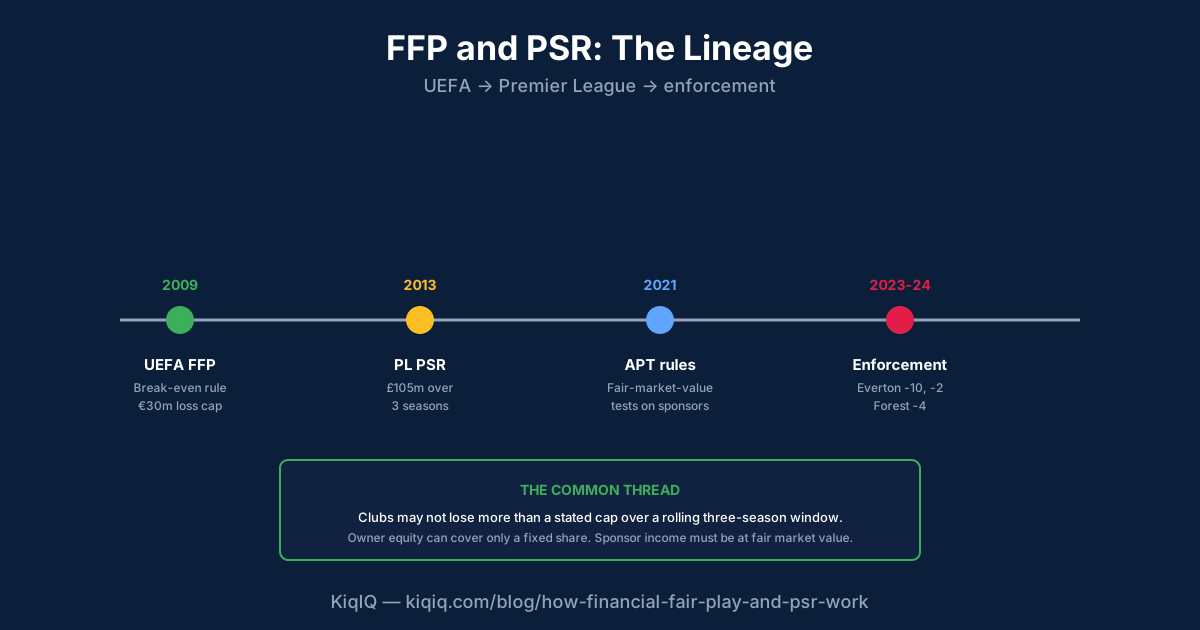
Football financial regulation is two things at once. UEFA's Financial Fair Play framework, introduced for the 2011-12 season, sits over clubs competing in European competition. The Premier League's Profit and Sustainability Rules (PSR), modelled on FFP but adapted for the English domestic context, sit over the 20 clubs in the top flight. Both bodies share a goal (stop clubs spending themselves into insolvency) and a method (capped accumulated losses across a rolling window). They differ on what counts as football revenue, how related-party transactions are valued, and how breaches are punished. The points-deduction cases against Everton and Nottingham Forest in 2024 made the framework concrete in a way the prior decade of theoretical debate had not.
Where FFP came from and what it tried to fix
UEFA approved Financial Fair Play in September 2009, with the substantive break-even requirement taking effect from the 2013-14 club-licensing cycle. The diagnosis behind the rules was straightforward. Aggregate top-flight losses across Europe had reached around €1.7bn in 2010-11 (UEFA Club Licensing Benchmarking Report), with several clubs running on owner cash injections that bore no relationship to operating income. The concern was systemic, not moral. A handful of distressed clubs propagating wage inflation across the market made the whole pyramid more expensive to operate, and the failure of any one of them risked dragging suppliers, smaller clubs and competition organisers down with it.
The FFP break-even rule capped accumulated losses at €5m over a three-year monitoring period, with an "acceptable deviation" of up to €30m permitted if owners covered the gap with equity injections rather than debt. Sponsorship and commercial revenue from owner-related parties had to reflect "fair market value" so the rule could not be circumvented by a club's sovereign-wealth-fund owner buying a £200m stadium-naming deal at multiples of the going rate. Sanctions ran from warnings and fines through to the withholding of UEFA prize money and, at the top of the scale, exclusion from European competition.
The framework was renamed UEFA Financial Sustainability Regulations in 2022 and now layers a squad-cost ratio (capping wages, transfers and agent fees at 70% of football revenue from 2025-26) on top of the legacy break-even calculation. The new framework keeps the break-even logic but reweights enforcement towards in-season operational discipline rather than retrospective profit checks.
PSR — the Premier League adaptation
The Premier League adopted its own version of the framework in 2013 under the Profit and Sustainability Rules. PSR borrowed FFP's rolling-window approach but set the parameters to fit the English domestic context. Clubs are permitted to record cumulative pre-tax losses of up to £105m across a three-season monitoring window, provided owners cover any losses above £15m with equity rather than debt (Premier League Handbook). Spending on infrastructure (stadiums, training grounds), women's football, academy investment and community programmes is excluded from the calculation, which removes the perverse incentive of penalising clubs for building long-life assets.
The £105m figure is materially higher than UEFA's headline tolerance. The gap is intentional. The Premier League's rights deal generates more revenue per club than any other domestic competition, and the PSR threshold was set so the rule constrained reckless overspending rather than ordinary operating losses absorbed during a poor on-pitch season. Clubs that drop into the Championship trigger a separate (and tighter) calculation under the EFL's own profitability rules, which is one reason relegated Premier League clubs work hard to defer wage commitments or restructure contracts before their final top-flight game.
PSR's enforcement architecture is what made it visible. Breaches are referred to an independent commission, which can impose sporting sanctions (points deductions, transfer embargoes) as well as financial penalties. The Premier League's 2023-24 calendar-year activity confirmed that points deductions are the operative tool. Everton received a 10-point deduction in November 2023 (later reduced to six on appeal) for a £19.5m breach across the period to 2021-22. Nottingham Forest received a four-point deduction in March 2024 for a £34.5m breach. Both clubs avoided relegation but the deductions materially reshaped the bottom of the table that season.
PSR permits cumulative pre-tax losses of £105m over a rolling three-season window, with infrastructure, academy, women's football and community spending excluded. Breaches are referred to an independent commission and have resulted in points deductions, not just financial penalties.
APT — the related-party fair-market-value rules
The Associated Party Transaction (APT) rules sit alongside PSR and address a specific gap. If a club is owned by an entity that also owns a major sponsor, a hospitality operator or a stadium-naming partner, the related-party commercial deals between them can be valued at whatever the parties agree, and that inflated value flows straight into the club's commercial revenue line, lifting the PSR ceiling. UEFA's FFP framework had a fair-market-value test from the outset; the Premier League introduced its own APT rules in late 2021 in response to specific clubs entering large related-party sponsorship deals.
APT requires the Premier League to assess whether a related-party commercial agreement is being struck at fair market value. The league benchmarks against comparable arm's-length deals, applies its own valuation methodology, and can require the contract value to be re-stated for PSR purposes if it judges the deal materially overpriced. The arbitration ruling in the Manchester City APT case (decided in October 2024) found parts of the rules procedurally defective and required the league to amend them; the substantive principle of fair-market-value scrutiny survived.
The practical effect of APT is asymmetric. Clubs without related-party sponsorship structures (the majority of the league) are unaffected. Clubs with state-linked or owner-linked commercial counterparties operate under a routine valuation review that can compress reported revenue against the unreviewed figure they would otherwise post. The framework matters most for clubs whose ownership model deliberately blurs the line between sporting and commercial entities.
The Everton and Nottingham Forest cases — what actually happened
The Everton case ran across the 2021-22 monitoring period. The club had submitted accounts showing accumulated losses of approximately £124.5m, against a £105m permitted ceiling, and argued that around £85m of those losses should be excluded under PSR's carve-outs (interest payments on the Bramley-Moore Dock stadium, COVID-related revenue shocks, and a write-down on a sponsorship with a company linked to a Russian-state-adjacent entity). The independent commission accepted some of those exclusions but ruled that £19.5m of overspend remained. The original sanction of 10 points was reduced to 6 on appeal, with the appeal panel finding that the first commission had over-weighted the size of the breach relative to comparable historical cases.
The Nottingham Forest case turned on the timing of player sales. Forest sold Brennan Johnson to Tottenham in September 2023, but the £47.5m fee did not count for the 2022-23 monitoring period because the sale was completed after the 30 June PSR cut-off. Forest argued that the imminent sale should be factored in; the commission ruled the cut-off is the cut-off, and the £34.5m breach stood. The four-point deduction landed in March 2024.
Both cases established practical precedents. Points deductions are real, they are imposed mid-season, and they are calibrated by reference to the size of the breach rather than by formula. Manchester City's much larger set of historic-period charges (115 separate alleged breaches dating back over a decade) remains under arbitration as of mid-2026 and will, when resolved, set the upper bound on what the framework can deliver.
- FFP (UEFA, 2011-12) — break-even rule, €5m accumulated loss ceiling, €30m with equity coverage.
- FSR (UEFA, 2022) — adds squad-cost ratio capping wages, transfers and agent fees at 70% of revenue from 2025-26.
- PSR (Premier League, 2013) — £105m cumulative loss ceiling over three seasons, infrastructure / academy / women's football excluded.
- APT (Premier League, 2021) — fair-market-value test on related-party commercial deals, methodology amended after 2024 arbitration.
- Enforcement — independent commission, points deductions in addition to financial penalties.
Why the framework matters beyond the cases
PSR's effect on club behaviour shows up most clearly in transfer-window patterns. Clubs running close to the ceiling routinely accelerate academy-graduate sales before 30 June so the profit lands in the closing financial year. The summer 2022 window contained an unusual concentration of academy-graduate trades between clubs (Conor Gallagher considered, Anthony Gordon, Aaron Ramsdale renegotiations) that the financial-analytics community traced largely to PSR-window management rather than pure sporting logic. The same dynamic shapes contract amortisation choices: longer contracts spread the book cost over more years and create more PSR headroom for new signings, which is why eight-year deals briefly proliferated until UEFA capped amortisation at five years in 2023.
The framework also reshapes how relegation candidates manage wage bills. A Premier League club in genuine relegation danger faces a structurally tighter PSR position than a mid-table club at the same loss-per-year level, because relegation collapses the broadcast revenue line that PSR is measured against. Wage clauses with parachute-payment triggers and contract-length-reduction options on relegation have become standard in player contracts at the lower end of the top flight precisely because PSR makes the asymmetric outcome unaffordable otherwise.
The Premier League moves to SCR + SSR from the 2026-27 season, which closes some of PSR's structural gaps (retrospective enforcement, conflation of infrastructure and football spending). PSR itself will keep applying to the periods it was measuring, so the case law it has produced (Everton, Forest, the pending City decision) remains the precedent base for how financial sanctions in English football operate. UEFA's FSR continues to govern European competition independently of whatever the Premier League adopts domestically.
Try it
PSR headroom over three seasons
Enter each season's assessed loss in millions. The Premier League cap is GBP 105m across the rolling three-season period.
Remaining headroom
GBP -10.0m
Three-season losses total GBP 115.0m against the GBP 105m cap, a breach of GBP 10.0m before allowable deductions. Infrastructure, academy and women's football spending come out before the assessment, which is why headline losses and assessed losses rarely match.
Enter a profit as a negative number. The cases that produced points deductions turned on the assessed figure after allowable deductions, not the number in the published accounts.
Frequently asked questions
- What is Financial Fair Play in football?
- Financial Fair Play (FFP) is UEFA's framework for clubs in European competition, introduced for the 2011-12 season and renamed Financial Sustainability Regulations in 2022. The core rule caps accumulated losses at €5m over three years, with up to €30m permitted if covered by owner equity. From 2025-26 a squad-cost ratio caps wages, transfers and agent fees at 70% of football revenue.
- What is PSR in the Premier League?
- PSR is the Premier League's Profit and Sustainability Rules, introduced in 2013. Clubs may record cumulative pre-tax losses of up to £105m across a rolling three-season window, with owners required to cover any losses above £15m with equity rather than debt. Infrastructure, academy, women's football and community spending are excluded from the calculation.
- Why did Everton get a points deduction?
- Everton breached PSR for the monitoring period ending in 2021-22, with accumulated losses of around £124.5m against a £105m ceiling. After permitted exclusions, the overspend was assessed at £19.5m. An independent commission imposed a 10-point deduction in November 2023; an appeal reduced the sanction to 6 points in February 2024.
- What are the APT rules?
- Associated Party Transaction (APT) rules require the Premier League to assess whether commercial deals between a club and an entity related to its ownership reflect fair market value. The rules prevent owners from inflating commercial revenue through sponsorships with related parties to lift the PSR ceiling. The methodology was amended in late 2024 after a Manchester City arbitration ruling.
- Is PSR being replaced?
- Yes. The Premier League is replacing PSR with the Squad Cost Ratio (SCR) and Squad Spending Ratio (SSR) from the 2026-27 season. PSR continues to apply to the historical monitoring periods it was measuring, so the precedent cases (Everton, Nottingham Forest, the pending Manchester City case) remain the operating case law for English football financial regulation.
References
- Profit and Sustainability Rules · Premier League handbook · Premier League
- UEFA Financial Sustainability Regulations · UEFA
- Club Licensing Benchmarking Report · UEFA
- Annual Review of Football Finance 2024 · Deloitte Sports Business Group
- Everton FC independent commission decision · Premier League
- Nottingham Forest FC independent commission decision · Premier League
Key terms in this article
Ask KiqIQ a follow-up
Get a live, data-driven answer powered by our live data feeds + KiqIQ's Poisson model. Try one of these prompts or write your own.
Related
- Premier League prize money: TV share, merit, facility fees →
- How football clubs make money →
- How Premier League prize money is distributed →
- How Premier League prize money works →
- Football TV rights deals explained →
- Premier League SCR + SSR explained →
- Multi-club ownership: the financial reality →
- Richest football clubs: Deloitte Money League 2026 →
- Football Governance Act 2025 →
- How football transfer windows work →
Reviewed by a KiqIQ editor before publication. Spotted an error? Email editor@kiqiq.com. We follow our Corrections Policy.