
Football TV Rights Deals Explained: Big-5 Leagues + Streaming Entrants
A comparative breakdown of broadcast revenue across the Premier League, La Liga, Bundesliga, Serie A and Ligue 1, plus MLS, DAZN and the Saudi Pro League.
 Tap to enlarge
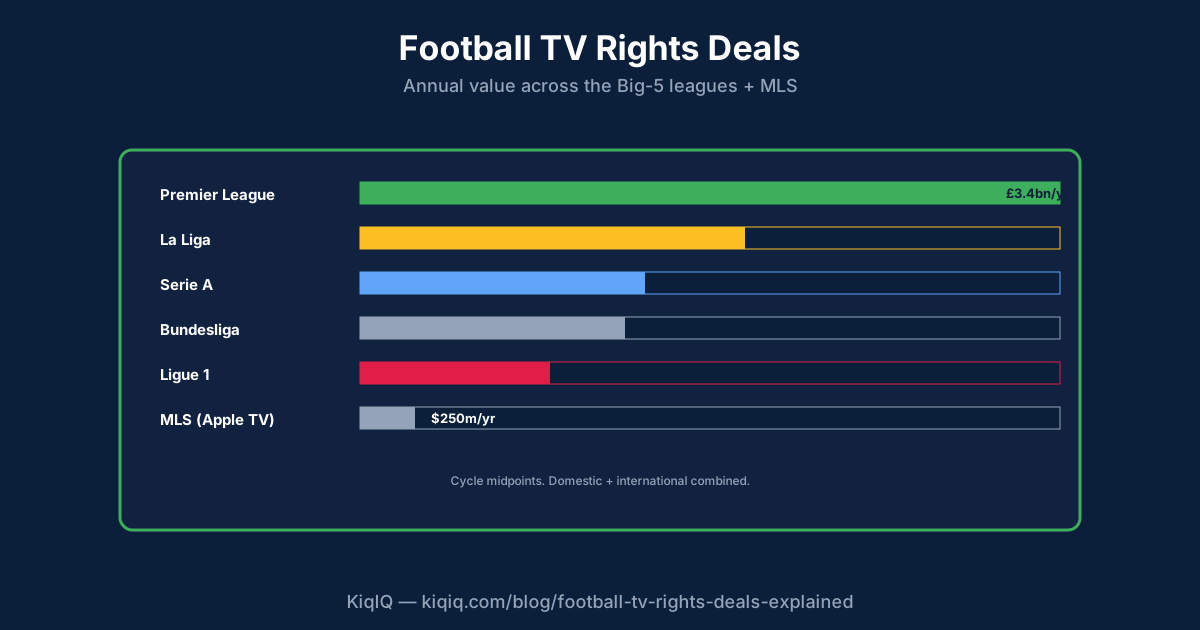
Broadcast rights are the single largest line on a top-flight football club's P&L, and the gap between leagues is wider than headline numbers suggest. The Premier League's 2025-29 international cycle pushed the four-year package above £12.25 billion, double La Liga's comparable window. Bundesliga and Serie A sit in a tight cluster around €1.1bn a season. Ligue 1's 2020-21 Mediapro collapse halved the French league's broadcast base, and four years on it has still not recovered. The streaming entrants (Apple, DAZN, the Saudi Pro League) are smaller in cash terms but matter strategically: each has rewritten one league's distribution model in the last 36 months.
Premier League: £6.7bn domestic + the international engine
The Premier League's 2025/26 to 2028/29 domestic rights cycle is worth roughly £6.7 billion across four seasons, split between Sky Sports (which retained the bulk of fixtures), TNT Sports, Amazon Prime Video and BBC highlights (Premier League, 2024; Sky News, 2023). That is a modest uplift on the 2022-25 cycle but the headline cash figure understates what the league actually banked. International rights for the same window are estimated above £6.0 billion across the cycle, taking the total package over £12.25 billion and overtaking domestic for the first time in the league's history.
The distribution formula is what makes Premier League broadcast income structurally different from anywhere else in Europe. Domestic central distributions are split 50% equal share, 25% merit-based on final league position, and 25% as a facility fee weighted by live broadcast appearances. International rights, historically pooled equally, now distribute on a 44/40/16 split: 44% to the equal-share pot, 40% to the merit-payment pot and 16% to the facility-fee pot. The 2024/25 financial year was the first under this revised overseas formula, and the model is the negotiated compromise from the 2022 "Big Six versus the 14" standoff that nearly produced an Anfield-led ESL revival.
The arithmetic effect is that even the bottom club in the 2024/25 Premier League banked around £110m in central distributions. That floor is materially higher than every other league's top earner outside Real Madrid, Barcelona and Bayern Munich (Deloitte, 2024). It is also why Championship promotion remains the single most valuable financial event in European football: one full Premier League season pays more than four years of Ligue 1 broadcast income at current rates.
La Liga: roughly €4.5bn but more top-heavy
La Liga's comparable rights window (2024/25 to 2027/28) totals approximately €4.5 billion across four seasons, with domestic broadcasters Movistar Plus+ and DAZN holding the bulk of fixtures and international distribution sold piecemeal through regional packages (La Liga, 2024). The headline cash gap with the Premier League is roughly 2.7x — large, but smaller than the gap that opens once distribution is layered on.
Collective bargaining in Spain only arrived in 2015. Before that point, Real Madrid and Barcelona negotiated individually and captured around 50% of total domestic broadcast income between them — a structural advantage that funded the Galácticos era and Barcelona's mid-2000s rebuild. Royal Decree 5/2015 introduced collective sale via LFP, and the resulting formula distributes 50% equally, 25% by recent on-pitch performance (a five-year rolling weight) and 25% by "social implementation" (a proxy for fanbase + TV audience).
The reform compressed but did not eliminate the top-heavy bias. Real Madrid's 2024/25 broadcast income sat near €170m; the lowest-ranked La Liga club received around €56m. The 3.0x ratio between top and bottom is meaningfully wider than the Premier League's ratio of roughly 1.6x in the same window. For mid-table La Liga sides, this distribution dispersion is the single biggest structural disadvantage they face when recruiting against equivalent-position Premier League clubs.
La Liga's 2015 LFP reform forced collective sale but kept on-pitch performance as a 25% weight. The result: more even than pre-2015, less even than England. Real Madrid still earns roughly 3.0x the bottom club; the Premier League ratio is 1.6x.
Quick question
How does La Liga's broadcast money differ from the Premier League's?
Bundesliga and Serie A: the €1.1bn-a-season cluster
The Bundesliga's 2025/26 to 2028/29 rights cycle is worth approximately €4.4 billion across four seasons, with Sky Deutschland and DAZN sharing domestic fixtures and the DFL retaining a 50+1 ownership model that constrains how aggressively clubs can monetise the rights base (DFL, 2024). The Bundesliga's domestic-to-international ratio sits at roughly 70/30, the inverse of the Premier League trajectory, and reflects a German league whose international reach has plateaued since the Klopp-era Dortmund peak.
Serie A's 2024/25 to 2028/29 cycle is structurally similar in size — roughly €4.5 billion across five seasons, with DAZN holding the bulk of the domestic package and Sky Italia retaining a partial co-exclusive (Lega Serie A, 2024). DAZN's Serie A foothold matters strategically: it is the largest single streaming-only domestic rights deal in European football, and the platform's subscriber economics in Italy are watched closely by every other Big-5 league as a leading indicator for what comes after the next cycle.
Both leagues are now structurally below the Premier League by roughly 3x on annual broadcast value, and the gap has widened in each of the last three rights cycles. The Bundesliga's 50+1 ownership rule limits the league's ability to take in sovereign or private-equity capital that would otherwise fund the kind of stadium and commercial investment that pulls international audiences. Serie A faces a separate problem: its stadium estate is the oldest in Europe, with municipal ownership and planning friction that makes the kind of Bernabéu or Tottenham rebuild commercially unviable for most clubs.
Ligue 1: the Mediapro collapse and what came after
Ligue 1 awarded its 2020-24 rights to Spanish-Sino consortium Mediapro for €814m a season in 2018, a 60% uplift on the previous deal and the largest contracted rights figure in French football history (LFP, 2018). Mediapro launched the Téléfoot channel in August 2020, failed to make its second contractual payment in October, and entered judicial reorganisation in December (Reuters, 2020; The Guardian, 2020). The LFP terminated the contract and re-sold the rights to Canal+ and Amazon under emergency arrangements that delivered roughly €663m a season for the back end of the cycle.
The 2024/25 to 2028/29 cycle has been worse. The LFP's formal tender in 2024 received no bids at the reserve price, and the eventual deal with DAZN and beIN Sports delivered approximately €500m a season — a 40% real-terms cut versus the pre-Mediapro level (L'Équipe, 2024). DAZN subsequently sought to renegotiate within months of the cycle starting, citing subscriber acquisition costs running materially above forecast, and a partial restructuring was agreed for the 2025/26 season.
The financial consequence for Ligue 1 clubs is structural. PSG's 2024/25 broadcast income was estimated at €60m, less than the bottom Premier League club received in central distributions for the same season. For the rest of Ligue 1, the broadcast line now sits below matchday at several clubs, inverting the revenue mix that defines elite professional football elsewhere in Europe. Lyon, Marseille and Monaco have all responded by accelerating player trading as the primary balance-sheet line — a model that worked for Brighton and Benfica but requires uninterrupted recruitment quality to sustain.
Streaming entrants: Apple, DAZN, Saudi Pro League
MLS sold its global rights to Apple in June 2022 for $2.5 billion across 10 years, replacing a fragmented patchwork of national broadcasters with a single streaming partner that distributes every fixture worldwide through MLS Season Pass on Apple TV (Apple, 2022; The Athletic, 2022). The deal is structurally different from any Big-5 arrangement: it is global rather than territorial, flat-fee rather than auction-driven, and bundles ancillary content (the Messi documentary, weekly highlights show, club-produced features). Apple's subscriber acquisition strategy for the platform leans heavily on Lionel Messi's 2023 arrival at Inter Miami, and MLS revenue from the deal is reportedly being augmented by performance bonuses tied to Season Pass subscriber milestones.
DAZN's position now extends across Serie A (primary), Ligue 1 (partial), Bundesliga (partial) and La Liga (partial). The platform's pan-European football footprint is the largest of any single broadcaster, but the underlying subscriber economics remain unresolved publicly. DAZN's parent company filed combined losses of roughly $1.4bn in 2023, and the platform's 2024 strategic shift toward bundling Saudi Pro League fixtures into European subscription tiers signalled that organic football-only revenue is not yet covering acquisition costs.
The Saudi Pro League's international rights are nascent but growing. SRMG and SSC signed a 10-year domestic deal in 2023 reportedly worth $600m, and the league has subsequently sold non-exclusive international packages to DAZN, Canal+ and a handful of regional broadcasters across MENA and South-East Asia. The strategic interest sits less in the headline cash and more in the trajectory: a single full-cycle pricing benchmark has not yet been established, and the next rights cycle (post-2027) is the data point that will tell whether the Saudi domestic league has built durable international audience or whether the 2023-24 player-recruitment wave was the peak.
- Premier League 2025-29 — £6.7bn domestic + £6.0bn+ international, 44/40/16 overseas split.
- La Liga 2024-28 — approximately €4.5bn over four seasons, 50/25/25 distribution since 2015 LFP reform.
- Bundesliga 2025-29 — approximately €4.4bn over four seasons, 70/30 domestic-international skew.
- Serie A 2024-29 — approximately €4.5bn over five seasons, DAZN-led with Sky Italia partial.
- Ligue 1 2024-29 — approximately €500m a season, 40% real-terms cut post-Mediapro.
- MLS — $2.5bn over 10 years from Apple, global flat-fee structure.
Why the gap keeps widening
Three forces sustain the Premier League's structural lead. First, kick-off scheduling: the Premier League's deliberate spread across Saturday lunchtime, Saturday teatime, Sunday afternoon, Monday and Friday nights produces a higher density of unique broadcast windows than any other league, which sustains premium pricing in international markets where football competes with non-football sports for prime-time slots. Second, English-language production: the league's native English commentary and Sky/TNT production stack ships into 188 territories without dubbing infrastructure, lowering the cost of international rollout for any broadcaster.
Third, and most underrated, is the league's aggregate competitiveness floor. Six clubs realistically contend for the top four in any given season, and three to four clubs realistically contend for the title. La Liga's top-two concentration, Bayern's 11-title Bundesliga run from 2013 to 2023, and PSG's decade of Ligue 1 dominance all produced narrower competitive ranges that depress year-on-year international engagement. The Athletic's 2024 analysis of overseas subscriber retention by league found Premier League retention rates running roughly 20% above La Liga and 35% above Ligue 1 across the same overseas markets (The Athletic, 2024).
The streaming entrants are not yet large enough to close the gap. Apple's MLS deal at $250m a year sits below the Premier League's annual international rights for a single major market like the United States ($450m a year through NBC). The Saudi Pro League's international rights collectively run in the low tens of millions a year. DAZN's pan-European football footprint is wide but unprofitable. For the 2028-32 rights cycle, the structural question is whether at least one streaming entrant can sustain pricing pressure against the incumbent broadcasters, or whether the next Premier League auction simply produces another inflation-led headline number with no fundamental change to the competitive set.
Frequently asked questions
- How much is the Premier League TV deal worth?
- The Premier League's 2025/26 to 2028/29 domestic rights cycle is worth approximately £6.7 billion across four seasons (Sky, TNT, Amazon, BBC). International rights for the same window are estimated above £6.0 billion, taking the total package above £12.25 billion. The 2024/25 season was the first under the revised 44/40/16 overseas distribution formula.
- Why is La Liga's TV money so top-heavy?
- Until 2015, Real Madrid and Barcelona negotiated rights individually and captured around half of all domestic broadcast income. Royal Decree 5/2015 forced collective sale through LFP under a 50% equal share, 25% performance and 25% social-implementation formula. The reform compressed the top-to-bottom ratio from roughly 8x to around 3x, but kept it materially wider than the Premier League's 1.6x.
- What happened to Ligue 1's TV deal?
- Ligue 1 awarded its 2020-24 rights to Mediapro for €814m a season. Mediapro defaulted on its second payment in October 2020 and entered judicial reorganisation in December. The league re-sold to Canal+ and Amazon at materially lower rates, and the 2024-29 deal with DAZN and beIN delivered roughly €500m a season — a 40% real-terms cut from the pre-Mediapro level.
- How much is the MLS Apple TV deal worth?
- MLS sold its global rights to Apple in June 2022 for $2.5 billion across 10 years, equivalent to $250m a year. The deal is structurally different from European league deals: it is global rather than territorial, flat-fee rather than auction-driven, and distributes every fixture through MLS Season Pass on Apple TV worldwide. Performance bonuses are reportedly tied to subscriber milestones.
- Why is the Premier League pulling away from other leagues?
- Three factors. Kick-off scheduling produces more unique broadcast windows than any other league. Native English-language production ships into 188 territories without dubbing. And aggregate competitiveness — multiple clubs contending for the title and the top four every season — sustains overseas engagement in ways La Liga, Bundesliga and Ligue 1 have not matched over the last decade.
References
- Premier League broadcast rights · 2025-28 cycle announcement · Premier League
- Premier League agrees £6.7bn domestic TV deal · Sky News (Dec 2023)
- Annual Review of Football Finance 2024 · Deloitte Sports Business Group
- Ligue 1 broadcast deal: how Mediapro collapse hit French football · The Guardian (Dec 2020)
- MLS announces 10-year partnership with Apple · MLS / Apple (Jun 2022)
- The Premier League international rights story and what it means for the top six · The Athletic
Ask KiqIQ a follow-up
Get a live, data-driven answer powered by our live data feeds + KiqIQ's Poisson model. Try one of these prompts or write your own.
Related
- Premier League prize money: TV share, merit, facility fees →
- How football clubs make money →
- How Financial Fair Play and PSR actually work →
- How Premier League prize money works →
- How Premier League prize money is distributed →
- Richest football clubs: Deloitte Money League 2026 →
- Multi-club ownership: the financial reality →
Reviewed by a KiqIQ editor before publication. Spotted an error? Email editor@kiqiq.com. We follow our Corrections Policy.