
How Premier League Prize Money is Distributed: The Formula Explained
Equal share, merit payment, facility fee and the international pool. A breakdown of how the Premier League distributes £1.6bn of central revenue across 20 clubs, plus parachute payments to relegated sides.
 Tap to enlarge
The Premier League pays out a record £1.64 billion in central distributions across the 2024-25 season, with every one of the 20 clubs banking somewhere between £110m and £176m before a ball is sold on commercial or matchday. The formula behind that money has four components: an equal share of the domestic TV pool, a merit payment scaled by final league position, a facility fee weighted by UK live broadcast appearances, and an equal slice of the international TV pool. Parachute payments sit on top for relegated clubs. Understanding the arithmetic explains why finishing 17th is worth so much more than finishing 18th, and why a Championship promotion is the single largest financial event in English football outside winning the title itself.
The four-bucket distribution formula
The Premier League sells two distinct media-rights packages and distributes the resulting revenue through a structured formula. The 2025-28 domestic cycle is worth roughly £6.7 billion across three seasons (Sky, TNT, Amazon and the BBC for highlights), while the international package, sold separately by territory, pushed the total media-rights envelope above £12 billion for the cycle (Premier League, 2024). Central distributions to clubs combine that media revenue with central commercial income (the league's own sponsors, not individual club deals) and prize money for league position.
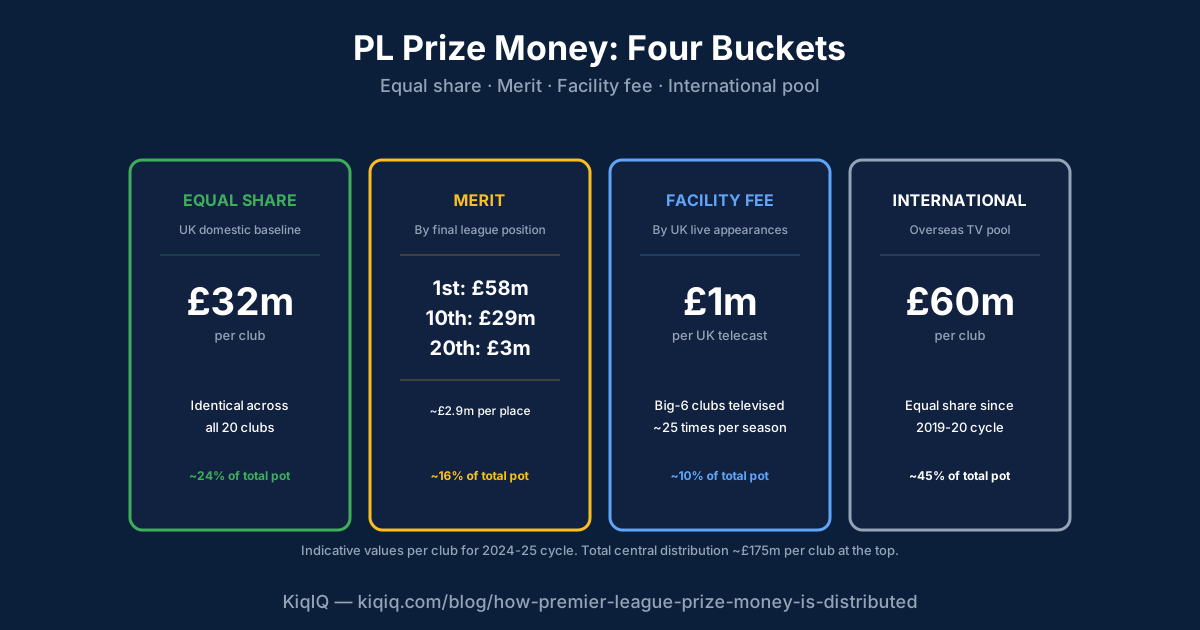
Each club's annual payment is built from four buckets. The first is an equal share of the UK domestic broadcast pool, distributed identically to all 20 clubs. The second is the merit payment, scaled by final league position so the champion banks the most and the bottom club the least. The third is the facility fee, which pays a per-appearance amount each time a club is selected for UK live broadcast. The fourth is an equal share of the international broadcast pool, again split identically across the 20 clubs. League position affects the merit bucket directly and the facility-fee bucket indirectly (top clubs are picked more often), but the two equal-share buckets do not move with position at all.
The arithmetic produces a compressed payout curve relative to most European leagues. Manchester City, as champions in 2023-24, banked roughly £176.0m in central distributions. Sheffield United, finishing 20th the same season, banked roughly £109.7m. The ratio between top and bottom payments is around 1.6 to 1, which is materially lower than La Liga (closer to 4 to 1 in the pre-collective-bargaining era) and lower than every Bundesliga, Serie A and Ligue 1 distribution model.
Equal share and the international pool
The equal-share component of the UK domestic deal is roughly £33m per club for the 2024-25 season. Every club banks the same number whether they finish first or twentieth. The political bargain underpinning this share is what holds the Premier League together as a 20-club competition: a guarantee that promotion brings a meaningfully different revenue base from the Championship, regardless of where the promoted club finishes, makes the bottom half of the top flight financially viable as a long-term proposition rather than a permanent relegation battle.
The international broadcast pool is the structural growth story of the cycle. For the 2019-22 cycle, international rights surpassed domestic rights for the first time in Premier League history. By the 2025-28 cycle, international rights are forecast to clear £6.6 billion against domestic at roughly £6.7 billion, with the international line growing in single percentage points domestically but double digits across the United States (NBC), South-East Asia and the Middle East. The Premier League distributes the entire international pool equally across the 20 clubs (BBC Sport, 2024). Each club's share for 2024-25 sits around £55m, with the share growing every cycle as the international rights base widens.
The equal-share architecture matters in two directions. It is the single biggest reason a Premier League mid-table side outearns the Champions League final's losing semi-finalist in continental revenue, and it is the reason no Premier League club has ever felt obliged to push for a European Super League seriously enough to leave the existing structure. The collective bargaining model produces a revenue floor that no individual breakaway could match unless every other top club broke away in lockstep.
The international TV pool is distributed equally across the 20 clubs. Each club's 2024-25 share sits around £55m, on top of roughly £33m from the equal-share domestic baseline. Before merit or facility fees, every Premier League club banks roughly £88m a season just from the two equal-share buckets.
Quick question
How much of a Premier League club's central payment is identical for every club?
Merit payments — where league position hits the P&L
The merit payment is the league's prize money in the strict sense: a sliding-scale payout where the champion receives 20 shares, the runner-up 19, third place 18 and so on down to the 20th-placed club, which receives one share. For the 2024-25 cycle, each merit share is worth approximately £3.2m. The champion therefore banks around £64m from the merit bucket; the bottom club banks around £3.2m. The £61m gap between top and bottom positions is the single largest position-driven swing in the formula.
Crucially, the merit ladder is linear, not logarithmic. The gap between 17th and 18th is the same as the gap between 1st and 2nd: one share, approximately £3.2m. That linear structure has real consequences for how clubs in the lower half of the table behave in the final third of a season. A team sitting on 35 points with three matches left has materially different financial incentives depending on whether they finish 14th or 17th — every position climbed banks another £3.2m, and there is no diminishing return at the bottom of the table.
The merit pool also explains why "Survival Sunday" is a more financially loaded fixture set than most cup finals. The arithmetic comparison between finishing 17th (16 shares, around £51m of merit money plus continued top-flight equal-share for the following year) and 18th (worth around 15 merit shares plus the loss of next-cycle Premier League membership, only partially offset by parachute payments) produces a single-fixture differential that has been independently valued at around £100m in present-value terms (The Athletic, 2024).
Facility fees — being on TV pays
The facility fee is the bucket that rewards visibility on UK live broadcast. Each club receives a guaranteed minimum number of live appearances per season (currently 10 for the bottom clubs, rising to a structural higher number for the biggest brands), and earns a per-appearance fee for each televised game above the floor. The fee per appearance varied across the prior cycle but sits around £1.0m-£1.2m for the 2024-25 season under the new domestic deal.
In practice, the top six clubs play close to 30 live UK broadcast games each in a typical season, which means the facility-fee bucket on its own is worth around £30m to a Manchester City, Liverpool or Arsenal. A bottom-third club playing 10 to 12 live games banks closer to £12m from the same bucket. The £18m differential is large in absolute terms but small relative to the £61m merit-payment spread, which is why position pressure dominates broadcast-frequency pressure as the season closes out.
The facility-fee mechanism creates a secondary incentive that affects fixture scheduling. UK broadcasters select their preferred matches under quotas agreed with the league, and clubs in genuine title or relegation contention through March, April and May find themselves picked far more often than clubs in mid-table comfort. Securing one extra televised appearance over the back-end of a season is worth more than a Carabao Cup quarter-final exit fee, which is reflected in how managers approach rotation in late-season league fixtures versus domestic cup ties.
Parachute payments — the soft landing
Parachute payments are the central distributions paid to clubs relegated from the Premier League, designed to cushion the broadcast-revenue collapse a club faces when it drops to the Championship. The structure is three seasons long: a relegated club receives approximately 55% of the equal-share domestic baseline in year one, 45% in year two, and 20% in year three (Premier League, 2024). For a club relegated at the end of the 2024-25 season, the three-year parachute envelope is worth roughly £90m-£100m, depending on how long the club spent in the top flight prior to relegation.
The parachute system is one of the most contentious mechanisms in English football. EFL clubs argue that parachute payments distort Championship competitive balance by giving recently-relegated clubs a revenue base several multiples larger than non-parachute Championship sides, which in turn raises wage inflation across the division. Brighton, Bournemouth, Burnley and Brentford have all reached the Premier League without parachute payments at the start of their promotion seasons; the counter-evidence that the system is decisive is contested. UEFA's own analysis flagged parachute payments as a competitive-balance concern in the wider European context, but the Premier League has consistently defended the structure as a precondition for promoted clubs to compete in the top flight without irresponsible spending.
A second-year parachute side that fails to bounce back faces a steep cliff at the end of year three: full Championship-only revenue, typically around £15m-£20m of EFL distributions versus £40m-£50m in parachute terms, against a wage bill that has rarely been fully restructured. Wage clauses with parachute-trigger reductions and contract-length carve-outs on relegation are now standard at the lower end of the Premier League precisely because the year-four financial cliff is brutal without them.
- Equal share (UK domestic) — roughly £33m per club, identical across the 20 clubs.
- International pool — roughly £55m per club for 2024-25, distributed equally across the 20 clubs.
- Merit payment — 20 shares to the champion down to 1 share for 20th place, around £3.2m per share.
- Facility fee — per-appearance payment for UK live broadcast, around £1.0m-£1.2m per televised game above a floor.
- Central commercial — a smaller bucket of league-level sponsor income, distributed equally.
- Parachute payments — 55% / 45% / 20% of the equal share over three seasons for relegated clubs.
How the totals come together
The cycle's 2024-25 distribution illustrates the formula in motion. Manchester City received approximately £176.0m as champions (full merit, top facility-fee tier, both equal shares). Arsenal in second received approximately £172.9m. The gap between adjacent positions in the top half typically sits around £4m-£6m once facility-fee variation is layered onto the merit ladder. The bottom of the table compresses tighter: 19th-placed Burnley received around £110.4m and 20th-placed Sheffield United around £109.7m, with both clubs picking up only the minimum television appearances and the bottom rungs of the merit ladder.
The compression at the bottom is deliberate. The Premier League has consistently chosen a model that protects the financial viability of its lower-half clubs over one that concentrates rewards at the top, on the view that 20 competitive operating units produce a better domestic product (and a more saleable international rights base) than five super-clubs and 15 financial casualties. Whether the model survives the next negotiation cycle is one of the unresolved questions of the late-2020s rights market — particularly as the gap between Champions League prize money and bottom-of-the-table Premier League central distributions has narrowed, raising the strategic question of which is the more valuable underlying asset for the top six clubs (Financial Times, 2024).
For context, even the lowest 2024-25 central distribution to a Premier League club (£109.7m) is roughly four to five times the total revenue of the average Championship side. That gap is the structural fact every promotion campaign is measured against, and it is the reason the Championship play-off final is routinely described as the most valuable single fixture in club football. A play-off win delivers, at minimum, the £90m-£100m parachute envelope plus a year of full Premier League central distributions — a financial swing of around £200m present-value against the alternative of staying down.
Frequently asked questions
- How is Premier League prize money distributed?
- Premier League central distributions split into four buckets: an equal share of the UK domestic TV pool (around £33m per club), an equal share of the international TV pool (around £55m per club), a merit payment scaled by final league position (20 shares to the champion, 1 share to 20th place, around £3.2m per share), and a facility fee paid per UK live broadcast appearance.
- How much does a Premier League club earn from finishing first vs last?
- The 2023-24 champions (Manchester City) banked roughly £176m in central distributions. The 20th-placed club (Sheffield United) banked roughly £110m. The ratio of around 1.6 to 1 is materially flatter than other major European leagues — a deliberate structural choice favouring competitive balance across the 20 clubs.
- What are parachute payments?
- Parachute payments are central distributions paid to clubs relegated from the Premier League. The structure is three seasons long: 55% of the equal-share baseline in year one, 45% in year two, and 20% in year three. The total parachute envelope is worth roughly £90m-£100m for a club relegated at the end of the 2024-25 season.
- How much is one merit-payment share worth?
- For the 2024-25 cycle, each merit-payment share is worth approximately £3.2m. The champion receives 20 shares (around £64m), the runner-up 19 shares, and so on down to the 20th-placed club, which receives one share. The merit ladder is linear, which means the financial gap between 17th and 18th is the same as the gap between 1st and 2nd.
- How much is Championship promotion worth financially?
- Championship promotion via the play-off final is routinely valued at around £200m in present-value terms. The figure combines a year of full Premier League central distributions (a minimum of £110m) plus the three-year parachute envelope of £90m-£100m if the promoted club is relegated immediately. A sustained run in the Premier League pushes the value materially higher.
References
- Premier League broadcast rights · 2025-28 cycle · Premier League
- Premier League central payments to clubs 2023-24 · Premier League
- Premier League TV rights and the international growth story · BBC Sport
- The value of Premier League survival explained · The Athletic
- Annual Review of Football Finance 2024 · Deloitte Sports Business Group
- Premier League international rights and the strategic question for top six clubs · Financial Times
Key terms in this article
Ask KiqIQ a follow-up
Get a live, data-driven answer powered by our live data feeds + KiqIQ's Poisson model. Try one of these prompts or write your own.
Related
- Premier League prize money: TV share, merit, facility fees →
- How football clubs make money →
- How Financial Fair Play and PSR actually work →
- Richest football clubs: Deloitte Money League 2026 →
- Premier League SCR + SSR explained →
- Multi-club ownership: the financial reality →
- How football transfer windows work →
Reviewed by a KiqIQ editor before publication. Spotted an error? Email editor@kiqiq.com. We follow our Corrections Policy.