
Gegenpressing vs Counter-Pressing: Same or Different?
Gegenpressing and counter-pressing describe the same tactical idea: winning the ball back within seconds of losing it. The history, the triggers, and why the two terms diverged.
 Tap to enlarge
Gegenpressing and counter-pressing are the same tactical concept under two different names. Both describe the act of pressing immediately after losing possession, with the goal of winning the ball back inside the opponent half before the opposition can organise a counter-attack. The German term arrived in English through Jurgen Klopp at Borussia Dortmund and Ralf Rangnick at Hoffenheim and RB Leipzig, while the English term emerged from analytics writing in the early 2010s. They are not separate ideas.
What the words actually mean
Gegenpressen is a German compound: gegen (against, counter) plus pressen (to press). In English, the cleanest direct translation is counter-pressing, which is exactly the term StatsBomb, The Athletic and most English-language tactical writers settled on in the early 2010s. The two phrases describe the same behaviour: the moment your team loses the ball, the players nearest to that ball converge on the new ball-carrier and the passing lanes around them, attempting to win possession back before the opponent can play a forward pass.
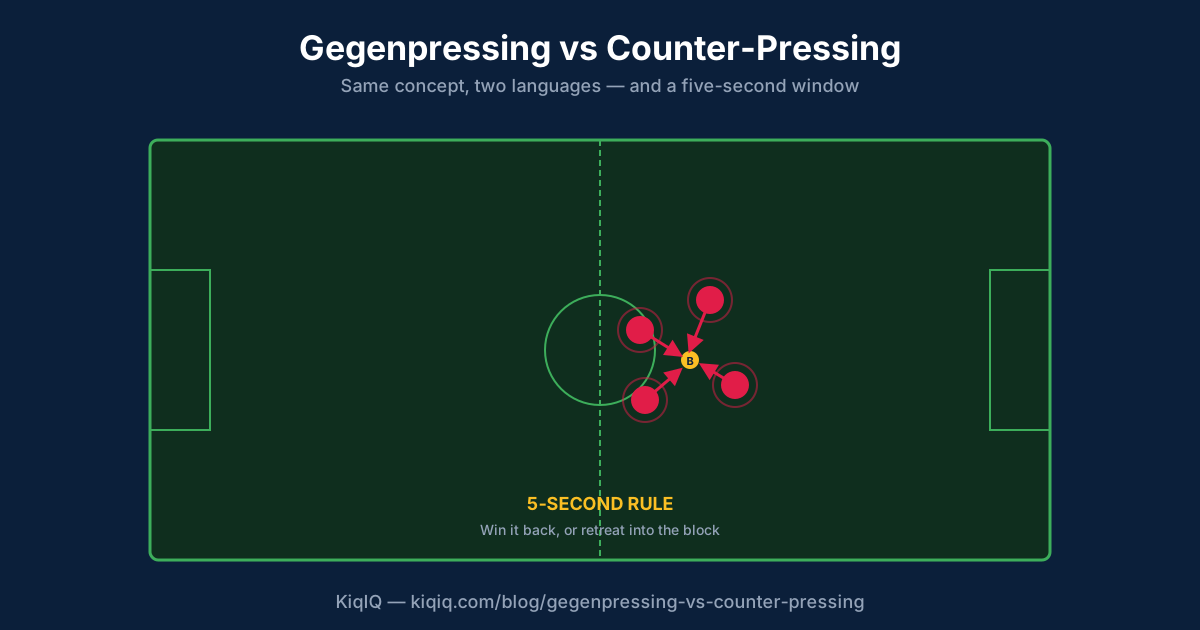
The window for this behaviour is short. Ralf Rangnick, who codified much of the modern pressing playbook at Hoffenheim and RB Leipzig, taught his teams a five-second rule: if the ball is not recovered within five seconds of losing it, the team retreats into its defensive shape rather than committing further bodies forward. Jurgen Klopp used the same five-to-eight-second window at Borussia Dortmund and Liverpool, describing the counter-press as the "best playmaker in the world" because it wins the ball in advanced areas, when the opposition is briefly disorganised.
Counter-pressing is the English translation of gegenpressing. The two terms describe the same tactical behaviour: collective pressing in the five-to-eight seconds immediately after a turnover.
The German lineage: Rangnick, Klopp, Tuchel
The modern German pressing school traces back to the late 1990s and early 2000s, when Ralf Rangnick at SSV Ulm and later TSG Hoffenheim built a coaching framework around vertical, ball-oriented pressing. Rangnick has credited Helmut Gross and the 1980s Dynamo Kiev side under Valeriy Lobanovskyi as influences, with Lobanovskyi the first major coach to demand collective pressure as a primary defensive principle rather than a situational response.
Jurgen Klopp picked up the framework at Mainz and refined it at Borussia Dortmund between 2008 and 2015, winning two Bundesliga titles built on a counter-press that targeted opposition centre-backs the moment they received a pass. Thomas Tuchel, Klopp's successor at Dortmund, sharpened the tactical detail with more positional pressing triggers, and Hansi Flick won the 2020 Champions League with Bayern Munich using a hybrid of high-line counter-pressing and possession football.
Pep Guardiola is sometimes folded into this lineage because his Bayern and Manchester City sides also counter-press aggressively. The Coaches' Voice and The Athletic both note the difference: Guardiola's pressing is more positionally restrained, aimed at funnelling the opposition into traps rather than collapsing on the ball in pure swarm mode. Klopp's counter-press is hotter and more vertical; Guardiola's is cooler and more zonal.
The triggers: when teams actually press
No team counter-presses every turnover. The behaviour is triggered by specific cues that signal a high-probability ball recovery. Coaches' Voice analysis of Klopp's Liverpool listed four core triggers: a back-pass under pressure, a poor first touch by the receiver, a sideways pass when the receiver is facing their own goal, and any pass into a player isolated near a touchline. When none of those cues fire, the team retreats into a mid-block rather than committing to a full press.
The trigger model is also why the five-second rule matters. If the four nearest players cannot win the ball back inside that window, the cues have already evaporated: the receiver has turned, the opposition has spread, and continuing to press leaves vertical gaps that a quick switch will exploit. Recognising when to give up the press is the harder coaching point, and the one that separates Klopp and Tuchel's sides from imitators who press without selectivity.
- Back-pass under pressure. The receiver is facing their own goal with limited time; the press is short and aggressive.
- Poor first touch. The ball escapes the receiver's control by more than a yard; the nearest defender attacks the loose ball.
- Touchline isolation. The opposition plays the ball to a wide player with no nearby support; the press traps them against the line.
- Square pass under pressure. A horizontal pass at midfield height while the press is engaged; the next press wave attacks the receiver.
Why the two terms diverged in English
The English-language tactical scene picked up the German term gegenpressing in the early 2010s through Jonathan Wilson at The Guardian, Raphael Honigstein's reporting on the Bundesliga, and the Spielverlagerung analytics blog, which translated continental tactical writing for English readers. For a few years, gegenpressing was the term of art in English, deployed partly because it sounded sophisticated and partly because the direct translation, counter-pressing, was occasionally confused with the act of pressing during a counter-attack rather than pressing to disrupt one.
The analytics wave that followed (StatsBomb, FBref, The Athletic) shifted toward counter-pressing as the standard English label, partly because the data community needed a stable term to attach to event-data definitions like PPDA (passes per defensive action) and counter-press shots. Both terms are still in active use today. A coach speaking about the German tactical tradition will tend to say gegenpressing; a data analyst writing for an English-language outlet will tend to say counter-pressing. They mean the same thing.
How to spot a counter-press on TV
The visual giveaway is the speed and synchrony of the reaction. Watch the moment a team loses possession: in a counter-pressing side, three to four players move forward toward the new ball-carrier inside one second, with their shape compressing rather than retreating. Non-counter-pressing teams take a half-second longer to start moving and retreat into a defensive line rather than collapsing on the ball.
The second giveaway is what happens at the five-to-eight-second mark. If the ball is not won back, a counter-pressing side will visibly stop pressing as a collective and reset into a mid-block, often with the original ball-carrier already past the front line. Teams that press without a trigger model will keep chasing past that window, leaving the vertical gaps that elite opposition exploit with one or two long passes.
Try it
How long is five seconds, really?
The counter-press window is roughly five seconds from the turnover. Tap the panel as fast as you can for five seconds to feel how little time that is.
The point is not the number. It is that a counter-press is decided in the time it takes to react, which is why it has to be rehearsed rather than called for.
Quick question
What is the difference between gegenpressing and counter-pressing?
Frequently asked questions
- Is gegenpressing the same as counter-pressing?
- Yes. Gegenpressing is the German term and counter-pressing is its direct English translation. Both describe pressing immediately after losing possession, typically within a five-to-eight-second window, with the goal of winning the ball back before the opponent can launch a counter-attack. The two terms are used interchangeably in modern football writing.
- Who invented gegenpressing?
- No single coach invented it, but Ralf Rangnick is widely credited with codifying the modern German version at Hoffenheim and RB Leipzig from the late 1990s onwards. Rangnick himself cites Helmut Gross and the 1980s Dynamo Kiev side under Valeriy Lobanovskyi as influences. Jurgen Klopp and Thomas Tuchel popularised the term internationally through their Bundesliga work.
- What is the five-second rule in pressing?
- The five-second rule is Ralf Rangnick's teaching point that a counter-press is abandoned if the ball is not recovered within five seconds of losing it. If the team has not won the ball back by then, the pressing cues have evaporated and the players retreat into a defensive shape rather than continuing to chase and leave vertical gaps.
- What is the difference between Klopp and Guardiola pressing?
- Klopp's counter-press is vertical and swarm-like: four players collapse on the ball-carrier the moment possession is lost. Guardiola's pressing is more positional and zonal: he funnels opponents into traps and uses pressing as part of a possession game rather than as a primary route to chaos. Both sides press, but Klopp accepts more vertical risk to do it.
References
- The Coaches' Voice: counter-pressing explained · The Coaches' Voice
- Ralf Rangnick interview on pressing principles · The Guardian (Dec 2021)
- Jurgen Klopp on the counter-press as the best playmaker · The Athletic
- Spielverlagerung: gegenpressing tactical archive · Spielverlagerung
- StatsBomb: counter-pressing and PPDA in event data · StatsBomb
Key terms in this article
Ask KiqIQ a follow-up
Get a live, data-driven answer powered by our live data feeds + KiqIQ's Poisson model. Try one of these prompts or write your own.
Part of pillar
Tactical Intelligence
See every article in this knowledge pillar →
Related
Reviewed by a KiqIQ editor before publication. Spotted an error? Email editor@kiqiq.com. We follow our Corrections Policy.