The short answer is no, and the permitted variation is wider than most supporters realise.
By David Findlay, Founder of KiqIQ.
Quick Answer: Football pitches are not all the same size. The International Football Association Board sets minimum and maximum dimension ranges, not a single fixed measurement. International pitches must be between 100 and 110 metres long and 64 and 75 metres wide. Club match pitches follow a broader range of 90 to 120 metres long and 45 to 90 metres wide.
Definition: A football pitch is the rectangular playing surface on which association football is contested. Governing bodies define permitted size ranges rather than a fixed dimension. A senior pitch must always be longer than it is wide, but exact measurements vary by competition level, ground age, and available land. No two professional pitches are required by rule to be identical in size.
Key point: Football pitches are governed by size ranges, not fixed measurements. A legally compliant pitch can be as short as 90 metres or as long as 120 metres, meaning two Premier League grounds can differ in playing area by several thousand square metres.
What Do the Official Rules Say About Football Pitch Size?
The Laws of the Game, maintained by the International Football Association Board, set the governing framework for all pitch dimensions worldwide. These laws apply to every level of the organised game, from international fixtures to grassroots adult matches.
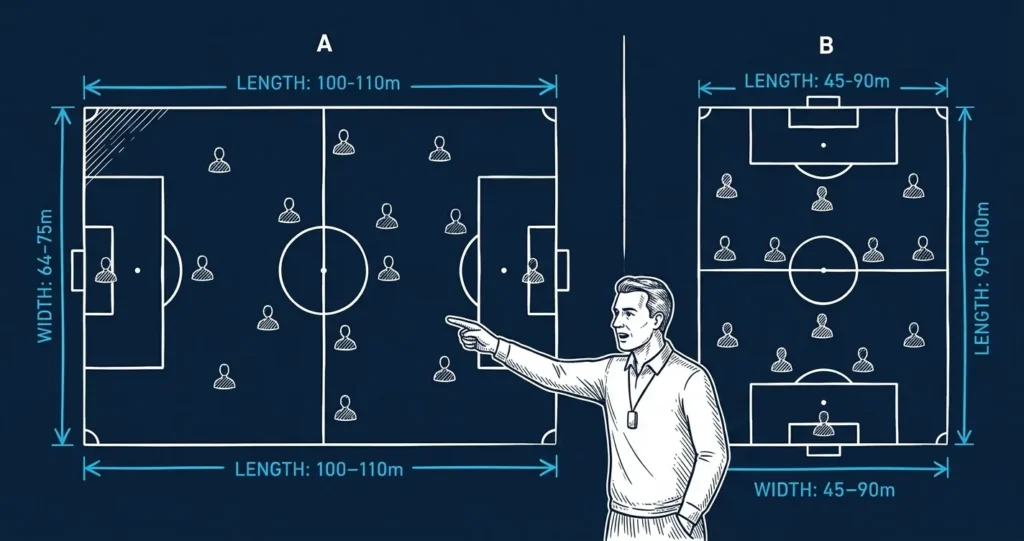
For matches between national representative teams, the rules require the pitch to be between 100 and 110 metres in length and between 64 and 75 metres in width.
For all other matches, including domestic league and cup fixtures at every tier, the permitted range is considerably wider. Length must fall between 90 and 120 metres. Width must fall between 45 and 90 metres. The only absolute rule across both categories is that the length must always exceed the width.
These ranges exist for practical reasons. Football developed across a wide variety of venues, many built before standardised regulations existed. Permitting a range rather than a fixed measurement allowed clubs to bring existing grounds into compliance without wholesale reconstruction.
FIFA formally adopts the Laws of the Game as set by the International Football Association Board. Both organisations align on the same dimension framework, which means the rules quoted above apply universally in organised competition.
Are All Football Pitches the Same Size in England?
In England, professional club pitches vary noticeably in size. The Premier League does not mandate a single fixed pitch dimension beyond the requirements set by the International Football Association Board. Most top-flight clubs voluntarily converge on dimensions close to 105 metres by 68 metres, which aligns with the UEFA recommendation for European competition. This is convention rather than compulsion, and clubs hosting UEFA fixtures are expected to meet that standard as part of licensing requirements.
Historically, some English clubs used their pitch dimensions strategically. A narrower pitch could limit the effectiveness of an opponent built around wide play. A longer pitch could favour a direct, high-tempo style. While modern stadium development has reduced top-level variation, it has not been eliminated.
In the EFL Championship and lower divisions, variation is considerably more pronounced. Older grounds built within tight urban footprints frequently produce pitches at the lower end of the permitted range. The same International Football Association Board rules apply at every professional tier, but clubs operate across a much wider spread of actual dimensions in practice.
At grassroots level, The FA provides recommended dimensions by age group and format. An adult 11-a-side grassroots pitch is recommended to sit between 90 and 120 metres in length and 45 to 90 metres in width, consistent with the standard club match rules. Recommendations for smaller-sided formats follow separate guidance based on the age and development stage of participants.
Football Pitch Size Comparison by Competition Level
The table below sets out the official permitted size ranges across competition levels, alongside the typical dimensions used in practice at the top of the English game.
| Level | Min Length | Max Length | Min Width | Max Width | Notes |
|---|---|---|---|---|---|
| FIFA International Match | 100m | 110m | 64m | 75m | Required for all senior international fixtures |
| FIFA Club Match | 90m | 120m | 45m | 90m | Applies to all domestic league and cup competition |
| Premier League (typical) | 100m | 105m | 68m | 68m | Convention not regulation; most clubs align for UEFA eligibility |
| EFL and Lower Divisions | 90m | 120m | 45m | 90m | Full IFAB range applies; historic grounds show wider variation |
| Grassroots Adult 11v11 | 90m | 120m | 45m | 90m | FA recommended; mirrors IFAB club match minimums |
| Rugby Union (playing area) | Up to 100m | Up to 100m | Up to 70m | Up to 70m | In-goal areas add up to 22m each end; total field up to 144m |
Are Rugby and Football Pitches the Same Size?
Rugby union and football pitches are not the same size, though widths across the two sports sit in a comparable range.
Under World Rugby regulations, the playing area of a rugby union pitch can be up to 100 metres long and up to 70 metres wide. This excludes the in-goal areas at each end. Each in-goal area can extend up to 22 metres in depth, meaning the total length from dead-ball line to dead-ball line can reach 144 metres.
A football pitch has no equivalent of the in-goal area. The pitch ends at the goal line. There is no additional scoring zone extending beyond it in the same way.
In terms of width, the two sports are broadly similar. A rugby pitch of up to 70 metres compares closely to the 64 to 75 metre width range for international football. Several grounds in England are used for both sports, with temporary markings applied depending on the fixture being played.
The practical conclusion is that a rugby pitch is typically longer from end to end when in-goal areas are included. The playing widths of the two sports are comparable, which is why shared venues remain feasible at community and semi-professional level.
Why Do Football Pitch Sizes Vary Between Clubs?
Several factors explain why dimensions differ from club to club, even within the same division.
Ground age is the most significant factor. Many English stadiums were built in the late nineteenth and early twentieth centuries, when land was acquired opportunistically and layouts were determined by surrounding street plans. A club constrained by terraced housing on all four sides had limited options for expanding or reconfiguring its playing surface.
Running tracks present a second constraint. Grounds that previously shared facilities with athletics required the pitch to fit inside a track oval, which often compressed both length and width. As purpose-built football stadiums replaced multi-use venues, this issue became less common at the top level, though some older grounds retained its legacy in their dimensions.
Tactical philosophy has also influenced decisions where clubs have the ability to modify their surface. Adjusting dimensions within the permitted range to suit a specific playing style is legal, and a number of clubs have historically taken that option.
Finally, the move towards UEFA licensing requirements has pushed many top-flight clubs towards the 105 by 68 metre convention, narrowing variation at elite level without removing it at the levels below. Are football pitches the same size across the English football pyramid? No, and the distance between top and bottom of that range is significant.
Frequently Asked Questions
Are football pitches the same size in the Premier League?
Not by regulation. Most Premier League clubs use pitches close to 105 metres by 68 metres, but there is no binding rule requiring a single fixed dimension. Clubs must meet the international match standard if hosting international fixtures, but for domestic matches the full permitted range under the Laws of the Game applies.
What is the minimum size of a football pitch?
For club matches, the minimum permitted by the International Football Association Board is 90 metres in length and 45 metres in width. For international matches, the minimum rises to 100 metres in length and 64 metres in width.
What is the maximum size of a football pitch?
For club matches, the maximum is 120 metres in length and 90 metres in width. For international matches, the maximum is 110 metres in length and 75 metres in width.
Are rugby and football pitches the same size?
No. A rugby union pitch can extend up to 144 metres from dead-ball line to dead-ball line when in-goal areas are included, compared to a maximum football pitch length of 120 metres. The playing widths of the two sports are broadly comparable.
Are all football pitches the same size in England?
No. English pitches vary across all levels of the game. Professional clubs at the top level tend towards similar dimensions, but historic grounds and lower-league venues show considerably more variation within the permitted range set by the Laws of the Game.