The spine is covered in every coaching qualification. Whether yours is functioning as a connected unit under live match pressure is a different question entirely.
By David Findlay, Founder of KiqIQ.
Quick Answer: The spine of a football team is the central vertical axis running from goalkeeper to centre-forward, covering five key positions. These roles govern defensive shape, ball progression, and attacking threat across every phase of play. For coaching and performance staff, spine health is best measured through press-break rate and progression success rate rather than possession percentage or total passes completed.
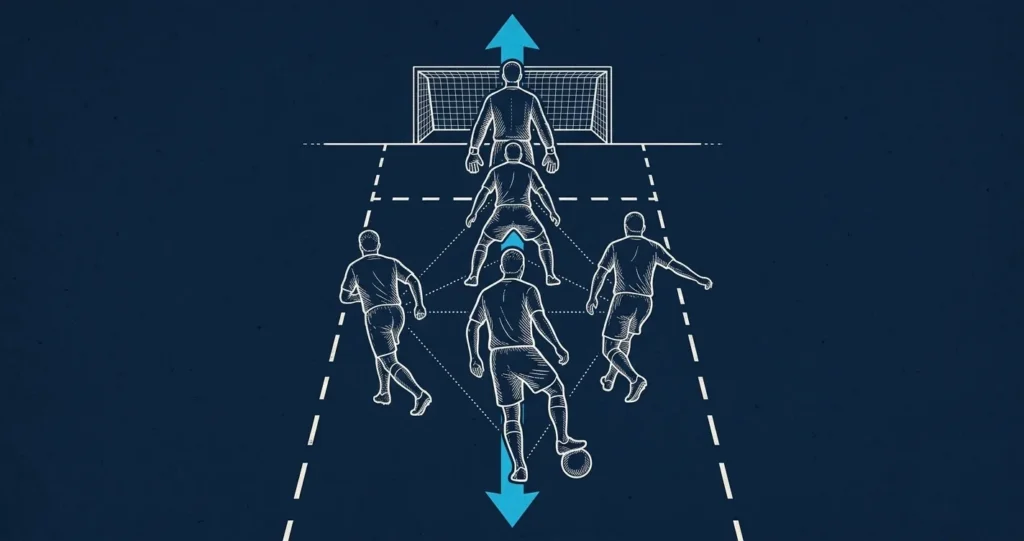
Definition: The spine of a football team is the central vertical line of positions running from goalkeeper to centre-forward through the middle of the pitch. It typically includes the goalkeeper, one or two centre-backs, a central or defensive midfielder, an advanced central midfielder, and the centre-forward. These five roles form the structural and tactical core of any formation, determining how a team defends, transitions, and progresses the ball in every phase of play.
Key point: The spine is not defined by any single formation. It is the central positional axis that every system is built around, and without quality and tactical coordination across all five roles, no tactical structure holds under sustained match pressure.
What the Spine of a Football Team Actually Includes
While the definition is standard across coaching education, the selection friction around which five positions to prioritise and how to measure their combined effectiveness is where most technical departments fail to generate structural advantage.
The spine differs from other positional groups in one structurally important respect. Wide positions change their function depending on the formation. A right winger in a 4-3-3 carries fundamentally different defensive responsibilities than a right wing-back in a 3-4-3. Spine positions are structurally consistent. A centre-back, a central midfielder, and a centre-forward carry broadly the same positional responsibilities regardless of the system operating around them.
This consistency is what makes the spine a practical shorthand for squad-building and tactical planning. A squad with genuine quality across all five spine positions has a structural foundation that most tactical problems cannot break. A squad built around wide talent but lacking spine coherence will find its tactical structure unravelling under press or when game-state demands shift.
The five positions that form the spine are goalkeeper, centre-back, defensive or central midfielder, advanced central midfielder or number ten, and centre-forward. Some coaching frameworks compress this to four by removing the advanced central role in systems relying on box-to-box midfielders or wide forwards cutting inside. The five-position model remains the most widely referenced across coaching education, recruitment practice, and performance analysis.
The Five Positions That Form the Spine of a Football Team
Each spine position carries a distinct set of responsibilities that link directly upward and downward through the central channel. Spine effectiveness as a unit depends on how well each position connects with the roles immediately above and below it, not just how well each role performs in isolation.
| Position | Defensive Role | Offensive Role | High-Signal Metric | Capture Cost |
|---|---|---|---|---|
| Goalkeeper | Shot-stopping and sweeping behind the defensive line | Distribution accuracy and launch pass accuracy into central midfield | Long ball success rate into target zone | Low with basic video tagging |
| Centre-Back | Aerial duels and line-breaking defensive interventions | Ball carry into midfield and switch pass under press | Pass completion rate under direct press | Low with positional video annotation |
| Defensive or Central Midfielder | Cover shadow and press resistance in the central channel | Ball retention and zone-to-zone transition | Press-break rate | Medium with optical or GPS data |
| Advanced Central Midfielder | Defensive transition press trigger and late box arrival | Final third link-up and chance creation through central areas | Progression success rate | Medium with structured video annotation |
| Centre-Forward | High press trigger and aerial involvement in defensive set pieces | Finishing and hold-up play in tight central areas | Pressing trigger completion rate | Medium to high without automated optical tracking |
Goalkeeper
The goalkeeper anchors the spine. Distribution quality is now as structurally important as shot-stopping at every level of the professional game. A goalkeeper who executes accurate goal kicks into central midfield, plays short to centre-backs under press, and sweeps behind a high defensive line extends the spine’s functional range without any structural change to the outfield positions. A goalkeeper with limited distribution creates a ceiling on how high the defensive line can sit and how aggressively the team can press, compressing the tactical options available to the five spine positions above.
Centre-Back
The centre-back provides defensive solidity and, increasingly, the first active phase of build-up. Ball-playing ability at centre-back is a baseline requirement at professional level and a growing expectation in elite academy environments. A centre-back who can carry or pass into midfield under pressure reduces the team’s structural dependence on the defensive midfielder and creates numerical advantages in the first build-up phase. Aerial ability, line-breaking pass accuracy, and press resistance are the three most frequently cited evaluation criteria for this spine role.
Defensive or Central Midfielder
The central midfielder is the spine’s structural bridge. This position connects the defensive unit to the attacking unit and must function effectively in both directions across all game states. It carries the highest capture cost in performance analysis because its most valuable actions, including press resistance, pass-release timing under pressure, and cover shadow positioning, are difficult to track without GPS or optical data.
For squads operating without full data infrastructure, the most defensible proxy metric for this role is press-break rate: how often this player completes a pass, drives with the ball, or repositions successfully when the team is under direct press in central areas.
Advanced Central Midfielder or Number Ten
The advanced central role is the spine’s creative pivot. Whether deployed as a classic number ten between the lines, a box-to-box midfielder, or a second striker dropping deep, this position links the central midfield to the centre-forward and generates goal-scoring opportunities through central combination play. Progression success rate, defined as the percentage of passes and carries from this position that advance the ball into the final third, is the most defensible single metric for evaluating this spine role.
Centre-Forward
The centre-forward is the spine’s terminal point and, critically, its first defensive line. A centre-forward who leads the press effectively triggers the entire defensive shape from the front and creates turnover opportunities high up the pitch. Pressing trigger completion rate, link-up success in tight central areas, and aerial involvement in defensive set pieces define the centre-forward’s structural contribution beyond finishing. A centre-forward who presses correctly but cannot link play in tight central spaces creates a disconnection between the spine’s top two positions that organised opponents will exploit systematically.
How the Spine Shapes Tactical Identity
Every recognisable tactical identity in modern football is built around a defined spine structure. Jurgen Klopp’s Liverpool side used the central midfield and forward line as a coordinated press unit, with precise press triggers between the defensive midfielder and the centre-forward determining when and how the entire team engaged. Pep Guardiola’s Manchester City approach the spine as the primary ball-progression route, building through central positions before switching wide only when central space closes and the progression route narrows.
In lower-league and academy environments, the spine provides a practical priority framework for squad-building decisions. Recruiting for spine positions first establishes a structural foundation that makes the surrounding tactical plan viable. Recruiting wide players or set-piece specialists before the spine is a common structural error that limits tactical development regardless of the formation a manager wants to deploy. The formation changes. The spine requirements do not.
The spine also governs team behaviour under different game states. A team protecting a lead relies on its spine to compact centrally, reduce vertical penetration through the channel, and maintain defensive shape under sustained pressure. A team chasing the game asks the same five positions to accelerate ball progression, retain possession under pressure, and create central overloads against a compact opponent. Both demands require genuine quality across the full vertical axis, not isolated performances from one or two individuals.
Measuring Spine Effectiveness Without Drowning in Data
The most common failure mode in measuring spine effectiveness is tracking volume metrics instead of structural signal. Total passes, possession percentage, and touch counts are straightforward to collect and consistently misleading as indicators of spine health. A team can complete a high volume of central passes in non-threatening areas while its spine is being bypassed in transition on the metrics that matter.
Two metrics provide genuine structural signal for spine evaluation. Press-break rate captures how often the spine, as a connected unit, successfully plays out of or bypasses a structured press in central areas. It reflects both individual quality under pressure and the collective coordination between positions in the build-up phase. Progression success rate captures how often central actions, passes and ball carries combined, advance the ball from one defined zone to the next. It reveals whether the spine is creating directional forward momentum through the channel or circulating possession without purpose.
Both metrics are accessible through optical tracking data and can be estimated through structured video annotation without GPS hardware. For squads without full data infrastructure, a minimum viable annotation approach focuses exclusively on these two metrics during match review, reducing annotation time significantly while improving the quality of structural insight available to the coaching staff at the point of decision.
What to Stop Tracking
Protecting staff adoption requires active decisions about what not to capture. The following metrics generate annotation burden without proportional structural insight for spine evaluation and should be deprioritised in any constrained environment:
- Total passes completed: Volume without directional context confirms nothing about whether the spine is creating structural advantage.
- Possession percentage: Teams regularly dominate possession in deep or wide areas while the spine is being bypassed centrally during transition.
- Touch count by spine position: High central touch counts during opponent pressure frequently indicate a structural problem rather than evidence of spine strength.
- Distance covered by central midfielder: Distance metrics without directional and phase context conflate defensive scrambling with effective ball progression and obscure the real structural picture.
Removing these four metrics from the standard spine review session and replacing them with press-break rate and progression success rate reduces annotation load and sharpens every coaching conversation about how the spine of a football team is actually performing under match conditions.

Frequently Asked Questions About the Spine of a Football Team
What is the spine of a football team?
The spine of a football team is the central vertical axis of positions running from goalkeeper to centre-forward through the middle of the pitch. It typically includes five roles: goalkeeper, centre-back, defensive or central midfielder, advanced central midfielder, and centre-forward. These positions form the structural core of any tactical formation.
What consists of the spine of a football team?
The spine consists of five positions: goalkeeper, centre-back, central or defensive midfielder, number ten or advanced central midfielder, and centre-forward. Some systems operate with four spine positions by removing the dedicated advanced central role, but the five-position model is the most widely used framework in coaching, recruitment, and performance analysis.
Why is the spine the most important part of a football team?
The spine is structurally consistent across formations in a way that wide positions are not. A team with quality and coordination across all five spine positions has a structural base that supports tactical flexibility. A team without it is exposed in every phase of play, regardless of the system deployed around its edges.
How do you measure whether a spine is working?
Press-break rate and progression success rate are the two highest-signal metrics for spine evaluation. Press-break rate measures how often the spine plays successfully out of structured central pressure. Progression success rate measures how often central actions advance the ball into the next zone. Both provide more reliable structural insight than possession percentage or total pass counts.
How should a manager prioritise building the spine of a football team?
Identify and recruit for all five spine positions before addressing wide or wide-forward roles. Build tactical coherence between spine positions through defined press triggers and build-up routes in training. Measure spine health using press-break rate and progression success rate. A spine that passes both tests reliably under match conditions will hold structural shape across most game states and opponent systems.