
Most football injuries happen before the ball is even kicked. The stretching routine a player follows before and after activity directly determines how the body tolerates the physical demands of the game.
By David Findlay, Founder of KiqIQ.
Quick Answer: Footballers need dynamic stretches before matches and training to activate muscles and increase range of motion, and static stretches after activity to restore muscle length and support recovery. The 12 moves in this guide cover both phases with clear guidance on timing, duration, and sequencing for players at all levels.
Definition: Stretches for football are structured mobility and flexibility exercises designed to prepare the muscular and skeletal system for the high-intensity demands of the game, including sprinting, change of direction, kicking, and jumping. Dynamic stretches are performed before activity to raise core temperature and increase joint range. Static stretches are performed after activity to reduce muscle tension and support recovery.
Key point: Dynamic stretching before activity activates the primary muscles used in football and preserves force output. Static stretching after activity reduces cumulative muscle tightness and lowers soft-tissue injury risk. Using the right type at the right time is where most players gain or lose their injury protection.
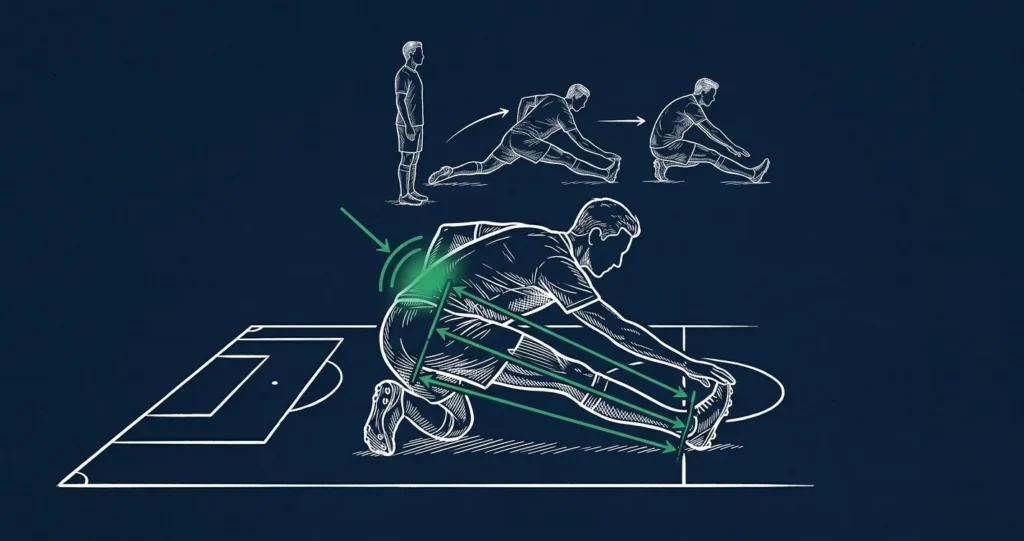
Why the Sequencing of Stretches for Football Players Matters
While the clinical definitions of dynamic and static stretching are well established, the sequencing error most players make in their warm-up routine is where preventable soft-tissue injuries begin.
Football places exceptional demand on the lower body. Players cover between nine and thirteen kilometres per match, execute repeated accelerations and decelerations, and perform rapid changes of direction throughout. Without adequate preparation, the risk of hamstring, groin, and hip flexor strain increases substantially.
Research in the British Journal of Sports Medicine consistently identifies hamstring strains as one of the highest-frequency injuries in professional and amateur football. A structured stretching programme does not eliminate this risk, but it reduces both frequency and severity when applied correctly and consistently across a season.
The key distinction is not which stretches to use. It is when to use them. Dynamic stretches performed before activity improve sprint speed, power output, and joint range. Static stretches performed before activity can temporarily reduce muscular force production. Applying them in the wrong order undermines performance and increases injury exposure at the same time.
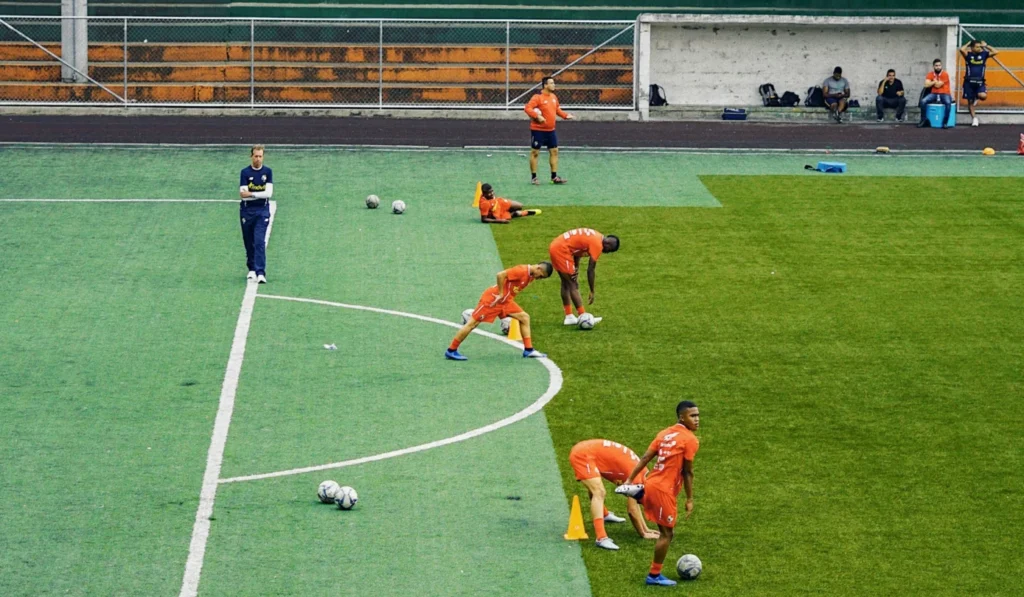
Dynamic Stretches for Football: The Pre-Match Routine
Dynamic stretches for football involve controlled movement through a joint’s full range of motion. They raise core temperature, increase blood flow to working muscles, and prime the neuromuscular system for explosive effort. Each of the following six dynamic stretching exercises for football is appropriate for use before a match or training session.
1. Walking Lunges
Step forward into a lunge position, lower the rear knee towards the ground, then drive through the front foot to continue forward. Walking lunges target the quadriceps, hip flexors, and glutes simultaneously. Perform 10 repetitions on each leg across approximately 10 metres.
2. Leg Swings (Forward and Back)
Stand on one leg and swing the opposite leg forward and back through a controlled arc. This activates the hamstrings and hip flexors and develops anterior to posterior range of motion. Perform 15 swings in each direction per leg. Use a wall or post for support if needed.
3. Hip Circles
Stand with feet shoulder-width apart and rotate each hip through full circular movements. Hip circles mobilise the joint capsule and prepare the adductors and abductors for the lateral movement demands of football. Perform 10 circles in each direction per hip.
4. High Knees
Drive each knee up towards the chest in a fast alternating rhythm across 20 metres. High knees activate the hip flexors, reinforce knee lift mechanics, and elevate heart rate. They bridge the gap between mobility preparation and match-speed movement.
5. Lateral Leg Swings
Stand sideways to a wall and swing each leg across the body and back out to the side. This targets the groin, glutes, and hip abductors. Adductor strains are among the most frequently occurring injuries in football, and lateral leg swings directly address the range of motion that reduces their likelihood. Perform 15 swings per leg.
6. Ankle Rotations
Lift one foot off the ground and rotate the ankle through its full range of motion in both directions. Ankle stability underpins change-of-direction mechanics and ground contact force absorption during sprinting. Perform 10 rotations in each direction per ankle.
Static Stretches for Football: The Post-Match Routine
Static stretches for footballers involve holding a lengthened position for a set period. Their primary role is post-activity recovery. After a match or hard session, static stretching reduces muscle tension, assists clearance of metabolic by-products, and restores resting muscle length.
Each of the following six static stretching exercises should be performed after the final whistle or at the end of a training session. Performing static holds as a primary warm-up method before football is a persistent and well-documented error in grassroots and amateur preparation routines.
7. Standing Quad Stretch
Stand on one leg and draw the opposite foot towards the glutes, holding the ankle with the same-side hand. Keep the knees together and the torso upright. Hold for 30 seconds on each leg. The quadriceps absorb significant eccentric load during deceleration in football, making this one of the highest-priority recovery stretches in any post-match routine.
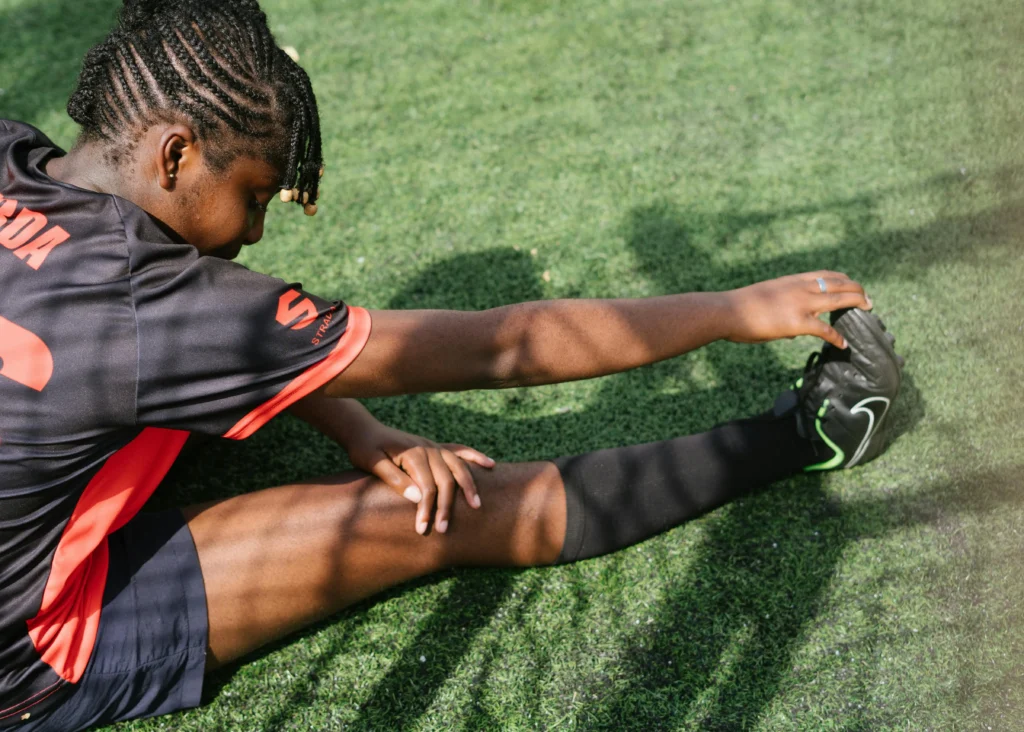
8. Seated Hamstring Stretch
Sit on the ground with both legs extended and reach forward towards the toes, keeping the back as flat as possible. Hold for 30 to 45 seconds. Given the prevalence of hamstring strains in football at every level, consistent post-activity hamstring stretching is among the most evidence-supported injury prevention habits a player can develop.
9. Kneeling Hip Flexor Stretch
Take a half-kneeling position with one knee on the ground. Drive the hips forward gently while keeping the torso upright. Hold for 30 to 45 seconds on each side. This targets the iliopsoas and rectus femoris, both of which tighten significantly during sustained running and repeated sprint efforts over a full match.
10. Wall Calf Stretch
Stand facing a wall with both hands flat against it. Step one foot back and press the heel firmly into the ground. Hold for 30 seconds on each leg. The gastrocnemius and soleus absorb repeated load during sprinting and jumping across a full ninety minutes. Neglecting calf mobility is a recognised contributor to Achilles tendinopathy in football players at all levels.
11. Butterfly Groin Stretch
Sit on the ground and bring the soles of the feet together. Let the knees drop outward and apply gentle downward pressure to the inner thighs. Hold for 30 to 45 seconds. Adductor strains are among the most common soft-tissue injuries in football, and regular groin stretching provides a straightforward and accessible layer of protection.
12. Knees-to-Chest Lower Back Stretch
Lie on your back and draw both knees towards the chest, wrapping the arms around the shins. Hold for 30 seconds. This releases the erector spinae and gluteal muscles, both of which accumulate compression during sustained high-intensity play. It also assists decompression of the lumbar vertebrae following the impact loading of a full match.
| Stretch Name | Type | Primary Muscles Targeted | Timing | Sets and Duration |
|---|---|---|---|---|
| Walking Lunges | Dynamic | Quadriceps and Hip Flexors | Pre-match warm-up | 2 sets of 10 reps each leg |
| Leg Swings (Forward and Back) | Dynamic | Hamstrings and Hip Flexors | Pre-match warm-up | 2 sets of 15 swings each leg |
| Hip Circles | Dynamic | Hip Abductors and Adductors | Pre-match warm-up | 2 sets of 10 circles each direction |
| High Knees | Dynamic | Hip Flexors and Quadriceps | Pre-match warm-up | 2 sets of 20 metres |
| Lateral Leg Swings | Dynamic | Groin and Hip Abductors | Pre-match warm-up | 2 sets of 15 swings each leg |
| Ankle Rotations | Dynamic | Ankle Stabilisers | Pre-match warm-up | 2 sets of 10 rotations each ankle |
| Standing Quad Stretch | Static | Quadriceps | Post-match cool-down | Hold 30 seconds each leg |
| Seated Hamstring Stretch | Static | Hamstrings | Post-match cool-down | Hold 30 to 45 seconds each leg |
| Kneeling Hip Flexor Stretch | Static | Hip Flexors and Iliopsoas | Post-match cool-down | Hold 30 to 45 seconds each side |
| Wall Calf Stretch | Static | Gastrocnemius and Soleus | Post-match cool-down | Hold 30 seconds each leg |
| Butterfly Groin Stretch | Static | Adductors | Post-match cool-down | Hold 30 to 45 seconds |
| Knees-to-Chest Lower Back Stretch | Static | Erector Spinae and Glutes | Post-match cool-down | Hold 30 seconds |
How to Structure Stretching for Footballers: A Session Framework
Sequencing matters as much as exercise selection. A practical and evidence-consistent structure for players at amateur and semi-professional level follows this order.
Begin with five to eight minutes of light cardiovascular activity such as jogging or cycling to raise core temperature before any mobility work begins. Then move through the six dynamic stretches above over eight to twelve minutes, keeping each movement controlled and deliberate rather than forced. The pre-match dynamic phase should feel activating, not fatiguing.
After the session or match, allow two to three minutes for the heart rate to settle. Then move through the six static stretches in sequence, dedicating at least 30 seconds to each hold. Total post-match stretching time should be 12 to 15 minutes. Players who consistently skip the cool-down report higher rates of next-day soreness and are more likely to suffer recurrent soft-tissue injuries across a season.
Youth players benefit from structured stretching education early. Movement habits formed before the age of 16 tend to persist into senior football. Coaches in academy and grassroots environments should treat the warm-up and cool-down as a teachable technical component rather than an administrative formality.
Common Mistakes When Using Stretches for Football Preparation
The most frequent error is performing static stretches as the primary warm-up. This was standard practice at grassroots level for decades but is clearly contradicted by the available evidence. Static holds before explosive activity can temporarily reduce muscle activation and force production, undermining both performance and injury protection at the same time.
The second error is omitting the post-match cool-down entirely. Static stretching after activity is not optional for players training and competing multiple times per week. Cumulative tightness in the hamstrings and hip flexors, when left unaddressed, is one of the leading contributors to the soft-tissue injury patterns seen most frequently in recreational and amateur football.
The third error is unilateral neglect. Most players have a dominant leg that receives higher load across training and matches. Stretching routines must address both sides equally and with attention to any asymmetry in flexibility or range. Pre-season screening by a physiotherapist or sports scientist can identify these imbalances and inform programme adjustments before the season begins.
Stretches for Football: Frequently Asked Questions
What are the best dynamic stretches for football?
The best dynamic stretches for football before a match or training session are walking lunges, leg swings, hip circles, high knees, lateral leg swings, and ankle rotations. These six exercises activate the primary muscle groups used in football and improve joint range of motion without reducing power output.
Should footballers use static or dynamic stretches for football warm-up?
Dynamic stretches should be used for the warm-up. Static stretches are most effective post-activity. Applying static holds before the game can temporarily reduce muscular force output, which is counterproductive for the explosive demands of football including sprinting, kicking, and change-of-direction performance.
How long should stretching for footballers take?
A pre-match dynamic stretching routine should take between eight and twelve minutes following five to eight minutes of light cardiovascular activity. A post-match static routine should take 12 to 15 minutes. Total preparation and recovery investment is approximately 25 to 35 minutes per session.
Are static stretches for football effective for injury prevention?
Yes. Regular post-activity static stretching reduces cumulative muscle tightness, restores resting muscle length, and lowers the likelihood of recurrent soft-tissue injuries, particularly in the hamstrings, groin, and hip flexors. Consistency across a full season produces the greatest protective effect.
Can dynamic stretching exercises for football improve performance as well as prevent injury?
Dynamic stretching before activity has been shown to improve sprint speed, power output, and joint mobility during play. Static stretching post-activity supports recovery quality, which sustains physical output across training cycles and multi-match weeks. Both types contribute to performance when applied in the correct sequence.