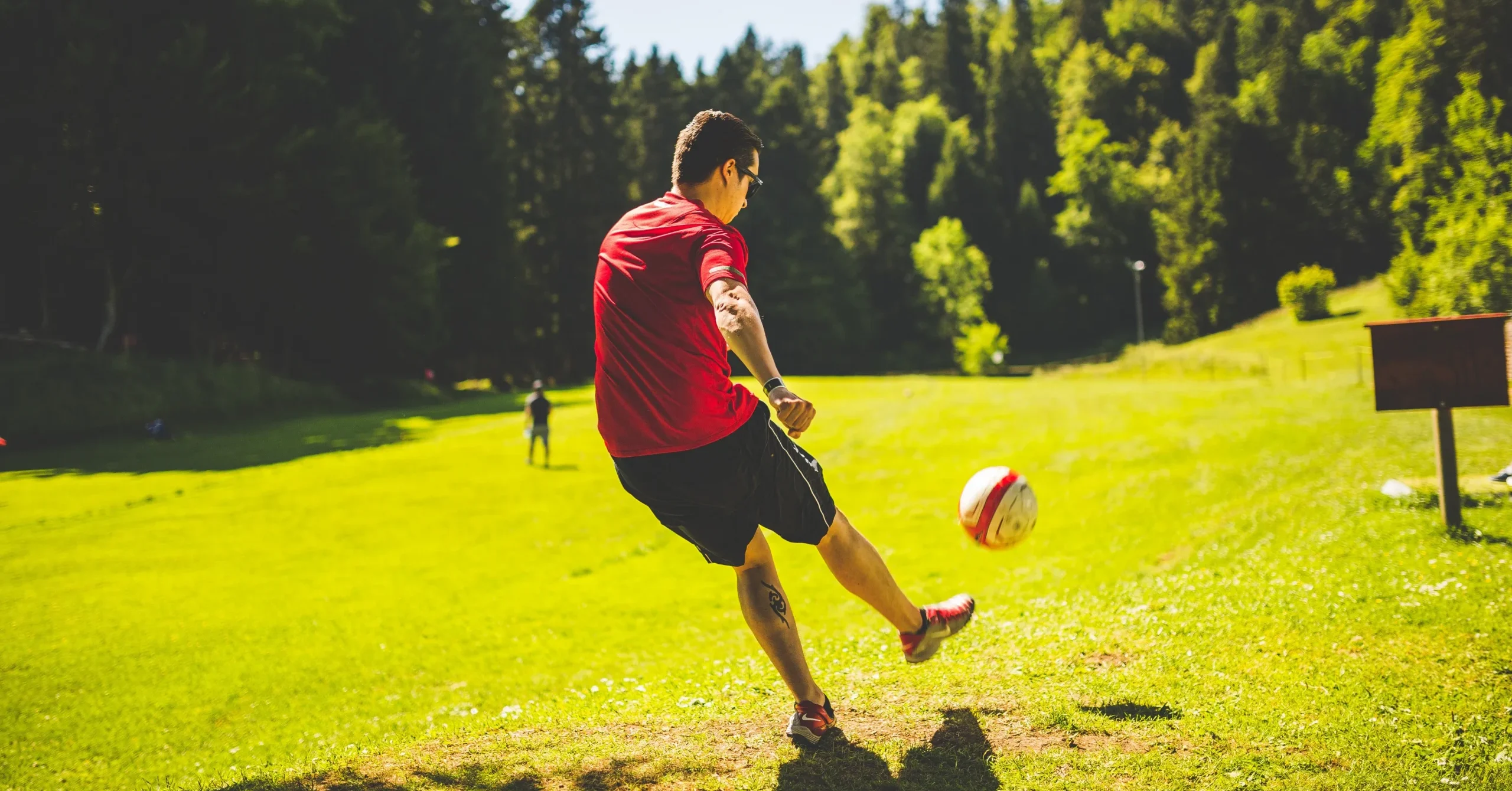
A five-iron is optional. Boots are not.
By David Findlay, Founder of KiqIQ.
Quick Answer: Footgolf is a sport that combines football and golf, played on a modified course using a standard size 5 football. Players kick the ball from a tee box into a 53 cm diameter cup in as few kicks as possible, following rules adapted from golf. A standard 9-hole round takes between 45 and 60 minutes.
Definition: Footgolf is a hybrid participation sport in which players use a standard size 5 football to complete a course of holes, each with a designated par, by kicking from a tee area into a 53 cm diameter cup set into the ground. Governed internationally by the Federation for International FootGolf, the sport follows a modified set of golf rules and is played on golf courses or dedicated footgolf venues worldwide.
Key point: Footgolf applies golf’s scoring framework to football’s physical demands, making it accessible to players of all abilities without specialist equipment beyond a standard football and appropriate outdoor footwear.
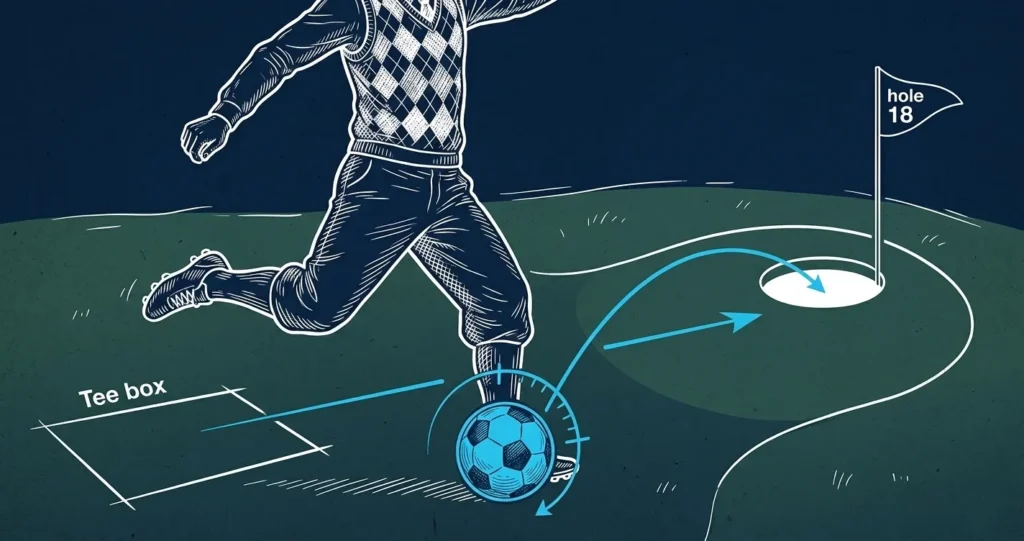
What Are the Rules of Footgolf?
Footgolf rules are adapted directly from golf, with modifications to account for kicking rather than striking with a club. The Federation for International FootGolf published the official rulebook, which forms the basis for affiliated courses in more than 35 countries.
The core rules are as follows.
- Players kick a size 5 football from a designated tee box at the start of each hole.
- Each subsequent kick must be taken from the spot where the ball came to rest.
- The hole is completed when the ball comes to rest inside the 53 cm diameter cup.
- Players must not touch the ball with their hands during play, except to retrieve it from the cup.
- Out-of-bounds rules apply in the same way as golf, with a one-shot penalty for balls kicked beyond the course boundary.
- Players must wait for the group ahead to clear the hole before kicking.
- The player with the lowest score on the previous hole plays first on the next tee.
- Deliberate obstruction of another player’s ball is prohibited and carries a penalty stroke.
Dress codes vary by venue, but studded football boots are typically prohibited to protect the course surface. Trainers or soft-ground footwear without metal or blade studs are the standard requirement at virtually all UK venues.
Footgolf Course Format and Scoring
Most footgolf courses offer either 9 holes or 18 holes, with par values assigned to each hole based on its length and difficulty. Par 3, par 4, and par 5 holes are all common, mirroring traditional golf course design principles.
Scoring terminology follows golf conventions exactly.
- Eagle: two under par on a hole
- Birdie: one under par
- Par: equal to the hole’s designated par score
- Bogey: one over par
- Double bogey: two over par
The player or team with the lowest total score across all holes wins. In competitive play, stroke play is the most common format. Match play is also used in tournaments organised under FIFG rules, where players compete hole by hole rather than on cumulative score.
The following table summarises the key format details for a standard footgolf round.
| Feature | Standard | Notes |
|---|---|---|
| Ball | Size 5 football | Provided by most venues or bring your own |
| Hole diameter | 53 cm | Set into the turf on each green |
| Typical course format | 9 or 18 holes | Par values assigned per hole |
| Par range | Par 3 to Par 5 | Based on hole length and difficulty |
| Round duration (9 holes) | 45 to 60 minutes | Varies by group size |
| Round duration (18 holes) | 90 to 120 minutes | Varies by group size and course length |
| Players per group | 2 to 4 recommended | Larger groups slow pace of play |
| Footwear | Trainers or moulded sole | Metal and blade studs prohibited |
| Scoring system | Stroke play standard | Match play available in competition |
How Long Does Footgolf Take?
A standard 9-hole footgolf round takes between 45 and 60 minutes for a group of two to four players. An 18-hole round typically takes between 90 and 120 minutes, depending on group size and the length of the course.
Footgolf plays faster than golf in most cases. There are no club selection decisions, no practice swings, and the ball is retrieved from the cup without requiring a full green routine. This makes it a practical leisure activity for families, corporate groups, and casual participants who want a structured sporting experience within a limited time window.
Many UK venues operate tee-time bookings in 15-minute intervals, similar to golf club protocols, to manage course flow and prevent congestion during peak periods.
Footgolf Equipment: What You Need
Footgolf requires minimal specialist equipment, which is one of the primary reasons the sport has grown quickly as a leisure activity across the UK and Europe.
- Football: A standard size 5 football is used in all official footgolf formats. Most venues provide balls as part of the green fee, though players are welcome to bring their own.
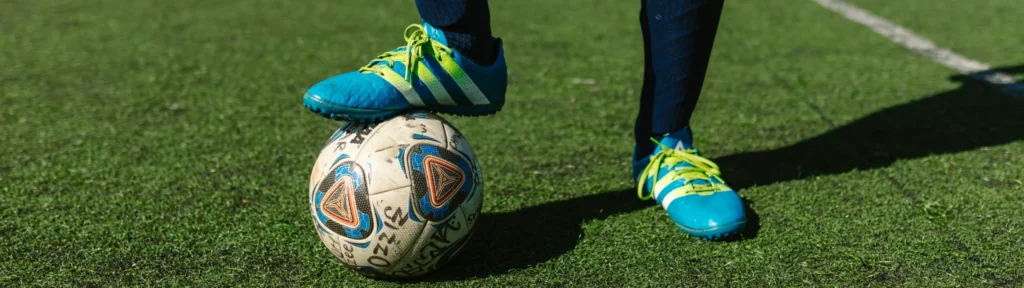
- Footwear: Trainers or moulded-sole footwear with no metal or blade studs. Most courses specify this clearly on their booking confirmation.
- Clothing: No formal dress code exists at most footgolf venues, though some golf clubs apply smart-casual guidelines consistent with their wider course policy.
- Scorecard: Provided by the venue on arrival at no additional cost.
No clubs, tees, or gloves are required. The simplicity of the equipment list is one of footgolf’s core advantages over traditional golf for new participants, reducing both cost and preparation time.
Where to Play Footgolf in the UK
Footgolf venues across the UK operate in several formats: standalone footgolf parks, golf clubs that have added dedicated footgolf holes alongside their main course, and leisure centres offering abbreviated layouts for casual groups. Brighton Footgolf and Celtic Manor in Wales are among the established venues offering structured footgolf experiences as part of a broader leisure offering.
The Federation for International FootGolf maintains a global venue directory for players seeking affiliated courses. In the UK, affiliated venues follow the FIFG rulebook and maintain the 53 cm hole standard required for official competitive play.
Some driving ranges and family leisure parks have also introduced shorter footgolf layouts as a walk-in activity, targeting families and casual groups who do not require a full-length course experience.
Is Footgolf an Officially Recognised Sport?
Yes. The Federation for International FootGolf was founded in 2012 and operates as the sport’s global governing body. The FIFG World Cup is held on a biennial cycle and attracts national teams from across Europe, the Americas, Asia, and Africa. The sport is not currently affiliated with FIFA or the R&A, but functions under its own independent governance structure with standardised rules, competitive rankings, and a professional circuit.
In the UK, footgolf participation has grown steadily since the early 2010s, supported by golf clubs seeking to diversify revenue streams and attract non-golfers to their facilities through a lower-barrier entry sport.
Frequently Asked Questions About Footgolf
What is footgolf?
Footgolf is a sport that combines elements of football and golf. Players kick a size 5 football around a modified course, aiming to complete each hole by getting the ball into a 53 cm cup in as few kicks as possible. The sport is governed internationally by the Federation for International FootGolf.
How long does footgolf take?
A 9-hole round of footgolf takes approximately 45 to 60 minutes for a group of two to four players. An 18-hole round typically takes between 90 and 120 minutes depending on group size and course length.
What ball is used in footgolf?
A standard size 5 football is used in all official footgolf formats. Most venues provide a ball as part of the green fee, though players may bring their own.
Can children play footgolf?
Yes. Most footgolf venues welcome players of all ages. Some venues offer adapted formats or shorter course layouts specifically designed for younger participants.
What footwear should you wear for footgolf?
Trainers or moulded-sole footwear without metal or blade studs are recommended at virtually all venues. Studded football boots are prohibited at most courses to protect the turf.
Is footgolf the same as golf?
No. Footgolf follows rules adapted from golf but uses a football and a larger 53 cm cup instead of a golf ball and standard golf hole. No clubs are used. The scoring system and hole format are derived from golf, but the physical technique is entirely football-based.