
Football is not decided by who runs furthest. It is decided by who applies force fastest when it matters most.
By David Findlay, Founder of KiqIQ.
Quick Answer: Power in football determines who wins headers, who accelerates clear of defenders, who beats opponents to second balls, and who wins physical duels. It is the product of force and velocity applied at match-critical moments. Every outfield position and the goalkeeper depends on power to execute the most decisive actions in the game.
Definition: Power in football is the capacity to produce maximum force in minimum time. Physiologically, it is expressed as Force multiplied by Velocity. It underpins every explosive action in the game, including sprinting, jumping, shooting, tackling, and direction changes. Power differs from raw strength because the velocity of force production is equally critical. A strong player who applies force slowly will lose explosive duels to a faster-applying opponent.
Key point: Power and strength are not interchangeable. Developing power requires training rate of force development, not just maximum load capacity, and this distinction shapes every stage of player development from academy to senior football.
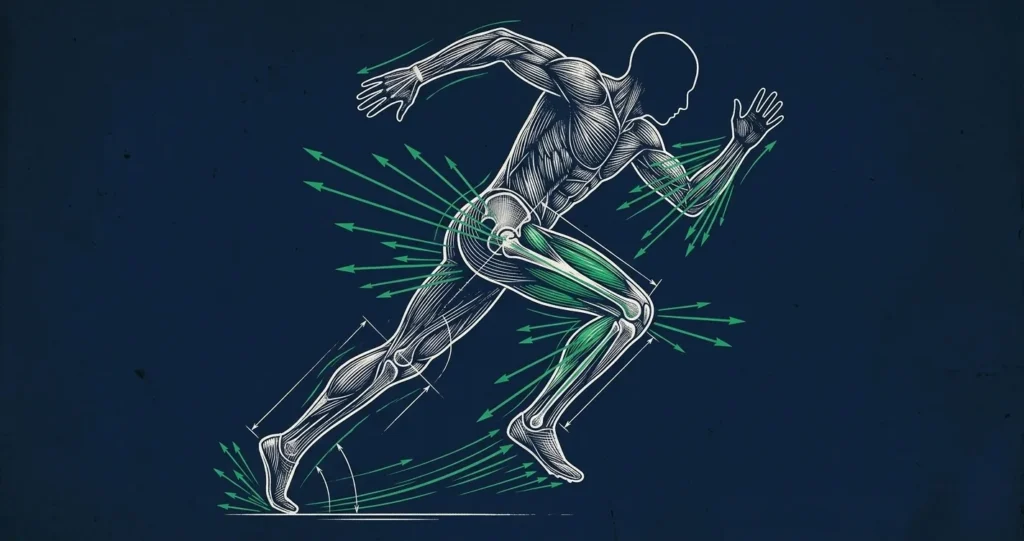
What Power Means in a Football Context
While the definition is straightforward, the distinction between training for maximum strength and training for rate of force development is where most football conditioning programmes fall short.
In sport science, power is the rate at which work is done. In football, this translates directly to how quickly a player can generate force during a match action. A striker does not need to be the strongest player on the pitch to win a header. They need to produce sufficient force fast enough to outperform the opposition at the moment of peak jump.
The physical actions that separate elite players from average players are overwhelmingly power-dependent. These include first-step acceleration, vertical jump height, kicking velocity, and the ability to hold off or overcome a physical challenge. Each relies on force applied at speed, which is the operational definition of power in sport.
Peer-reviewed research on strength and power in elite youth football identifies both qualities as central to athletic development and competitive performance from academy level upwards.
The six physical advantages that power directly produces in football are: first-step acceleration, vertical jump height, shooting velocity, aerial duel success, recovery sprint speed, and resistance to physical displacement in contact situations. Each is match-critical and each is trainable with appropriate programme design.

Why Leg Power Is Important in Football
Leg power is the single most important physical quality in football. The lower limb drives every key explosive action in the game. Without adequate leg power, a player’s ability to accelerate, jump, shoot, and recover defensively is significantly limited.
Sprinting in football is not primarily about top-end speed. The majority of decisive sprints in a match cover between 10 and 30 metres. Acceleration over short distances is determined primarily by rate of force development in the legs. Players with greater leg power reach peak sprint speed sooner and cover more ground per stride during these short, decisive bursts.
Jumping, whether for a headed clearance, an aerial challenge, or a goalkeeper’s reach, is entirely dependent on lower limb power. The vertical impulse generated through hip extension, knee extension, and plantarflexion determines how high a player rises. A player who has developed leg power through structured training will consistently outperform a player of equal height who has not.
Shooting velocity is also directly linked to leg power. The kinetic chain of a powerful shot moves from ground contact through the ankle, knee, and hip, culminating in the velocity of the striking leg. Greater lower limb power produces higher ball speed and, with technique, greater accuracy from range.
Evidence from football-specific power training interventions confirms that targeted leg power development produces measurable improvements in sprint performance, jump height, and on-pitch explosive output across different playing levels.
Why Power Is Important for a Defender in Football
For defenders, power is a protective and reactive quality. The most common defensive actions that require power are aerial duels, recovery sprints, one-on-one challenges, and physical contact during set pieces.
In aerial duels, a central defender must generate enough vertical force to reach the ball ahead of or above an opposition striker. This requires leg power for the jump and core stability to maintain position during contact. A technically sound defender who lacks leg power will lose aerial duels to a physically superior opponent regardless of their starting position.
Recovery sprints are a critical power demand for defenders at every level. When a defensive line is breached, the ability to close the gap between an attacker and goal in the shortest possible time is determined by acceleration. A defender with high leg power and a trained rate of force development can reach blocking positions that a weaker defender simply cannot.
Full-backs in modern systems face layered power demands. Covering ground forward into attacking phases and then recovering defensive position repeatedly across 90 minutes requires both explosive power and the muscular endurance to reproduce that output without significant degradation. This combination is increasingly central to the physical profile required of wide defenders at all levels.
Set-piece situations also demand upper body and core power. The ability to hold ground, resist displacement, and shield the ball against an opponent involves force through the trunk, shoulders, and arms, supported by a stable lower body base. Power is a full-body requirement in defensive contexts, not a leg-specific one.

Power and the Components of Fitness in Football
In physical education and performance science, power is classified as one of the core components of physical fitness. Understanding how it relates to the other components is essential for evaluating athletic capacity and designing effective training programmes for football.
The table below maps the primary fitness components to their role in football and their relationship to power output.
| Component | Definition | Role in Football | Relationship to Power |
|---|---|---|---|
| Power | Force produced per unit of time (Force x Velocity) | Sprinting acceleration, jumping, shooting and physical duels | The primary explosive quality. Underpins all decisive match actions. |
| Strength | Maximum force a muscle or muscle group can produce | Shielding, holding position, physical contact and set pieces | The foundation of power. High strength alone does not guarantee high power without velocity-specific training. |
| Speed | Maximum velocity achievable over a given distance | Counter-attack runs, recovery runs and wide attacking play | Enhanced by power in the acceleration phase. Short-distance speed is largely power-dependent. |
| Muscular Endurance | Ability to repeat sub-maximal muscular effort over time | Pressing, high work-rate roles and repeated sprint demands | Supports the capacity to reproduce power output across 90 minutes without significant drop-off. |
| Cardiovascular Endurance | Aerobic efficiency and recovery between high-intensity efforts | Match fitness, covering ground and tactical availability | Underpins recovery between explosive power efforts. Poor endurance reduces late-match power output. |
| Agility | Ability to change direction quickly and under control | Dribbling, pressing, marking and evasion of opponents | Combines power with coordination and balance. The first step in reactive agility is power-dependent. |
| Flexibility | Range of motion through joints and muscle groups | Injury prevention, reach and biomechanical efficiency in movement | Supports optimal force transfer in power movements. Restricted range limits the kinetic chain in kicking and jumping. |
| Balance | Postural control in static and dynamic positions | Set pieces, first touch and physical contact situations | Critical for power transfer in unstable positions. Without balance power cannot be efficiently expressed on the pitch. |
Power sits at the intersection of speed and strength. It is not a standalone quality but an integrated expression of neuromuscular capability. In football development programmes, this means that improvements in both strength training and speed training contribute to power output, but neither alone is sufficient to maximise it.
Why Strength Alone Does Not Produce Power in Football
A common assumption in football conditioning is that strength training directly produces power gains. This is partially accurate but incomplete. Sport science analysis of power development in athletic contexts makes clear that maximum strength and power are related but require different training stimuli to develop.
A player may significantly increase their maximum squat load and see only modest gains in vertical jump or sprint acceleration if the programme does not also develop rate of force development. Power-specific training requires high-velocity movements, plyometric methods, and loaded exercises performed at speed to build the neuromuscular pathways that convert strength capacity into explosive output.
Relative power matters more in football than absolute power. A heavier player who increases maximum strength without developing rate of force development may become slower and less explosive in match actions despite performing better in gym-based tests. Programme design that treats strength development and power development as distinct training goals with separate methods produces better competitive outcomes.
Why Is Power Important in Football: Key Takeaways
Power is a decisive physical quality at every level of football. It determines the outcome of explosive actions that appear briefly but define matches: the aerial duel, the acceleration away from pressure, the recovery sprint, the shot from distance. Whether for a striker, a full-back, or a central defender, power underpins the ability to execute these actions faster and more forcefully than an opponent.
Developing football power requires a structured programme that addresses both strength as a foundation and rate of force development as the performance expression of that foundation. Understanding how power integrates with other fitness components gives coaches, players, and students a precise framework for evaluating and improving physical capacity in the game.
For those approaching this topic through GCSE PE performance analysis frameworks, power is not a supplementary fitness component. It is a primary driver of the explosive actions that decide competitive outcomes.
Frequently Asked Questions
Why is power important in football?
Power determines the outcome of the most decisive physical actions in football, including sprinting, jumping, shooting, and physical duels. It is the product of force and velocity, meaning both the magnitude and speed of force production affect performance. Players with greater power output win more explosive actions and create larger physical advantages at match-critical moments.
Why is leg power important in football?
The lower limb drives every major explosive action in football. Leg power determines acceleration speed, jump height, and shooting velocity. Players with greater leg power accelerate faster over short distances, win more aerial duels, and generate higher ball speeds when shooting. Training leg power through plyometrics, weighted jumps, and high-velocity strength work produces measurable improvements in each of these areas.
Why is power important for a defender in football?
Defenders rely on power for aerial duels, recovery sprints, and physical challenges. A defender who cannot generate sufficient vertical force will lose headers to stronger attackers. A defender without trained acceleration will fail to close defensive gaps in time. Power training for defenders should prioritise lower limb explosiveness, core stability under contact, and upper body strength for physical duels.
Is power different from strength in football?
Yes. Strength is the maximum force a player can produce. Power is the rate at which they can produce it. In football, rate of force development often matters more than maximum strength because most decisive actions happen in under 200 milliseconds. A player who applies force quickly has a practical performance advantage over a player who applies greater force but more slowly.
What are the components of fitness in football?
The main components relevant to football include power, strength, speed, muscular endurance, cardiovascular endurance, agility, flexibility, and balance. Power is one of the most performance-critical components because it directly underpins explosive match actions. Strength provides the foundation for power. Speed and agility translate power output into decisive match actions. All components are interrelated in elite football performance.