Most clubs purchase a football tracker vest before deciding what they need to measure. That sequence is backwards, and it explains why most GPS data never reaches a coaching decision.
By David Findlay, Founder of KiqIQ.
Quick Answer: A football tracker vest positions a GPS pod between the shoulder blades to capture movement, speed, and load data during training and matches. To get genuine value, restrict your default dashboard to press-break rate, high-speed running distance, and acceleration load. Tracking more than seven metrics without dedicated analyst resource creates capture cost that eliminates the return on your hardware investment.
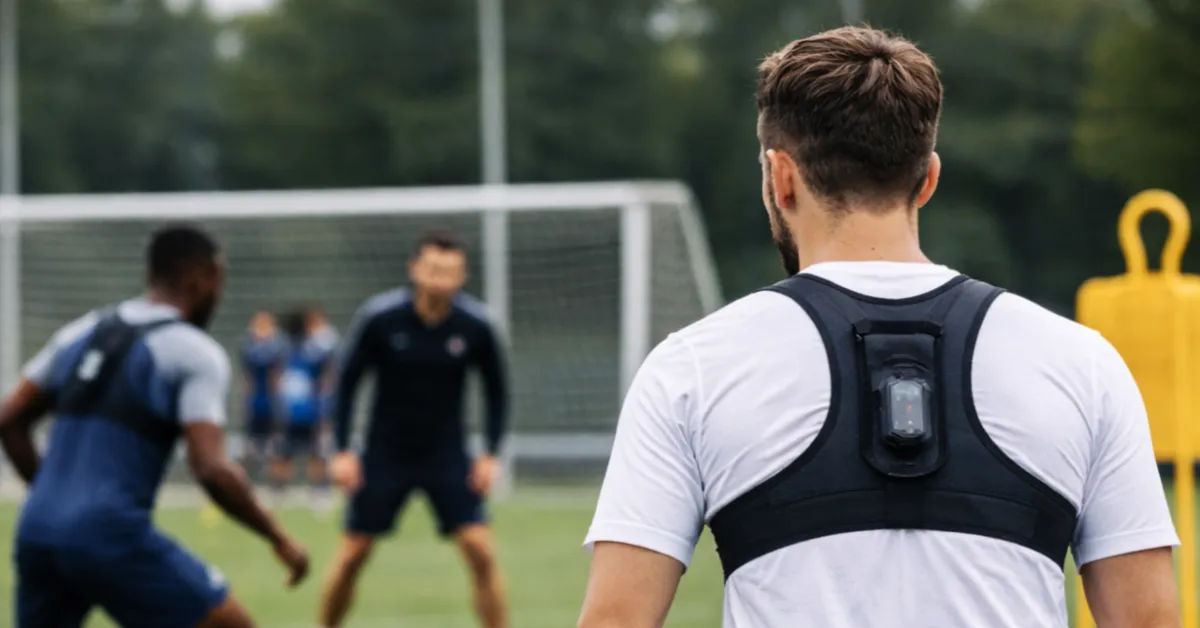
Definition: A football tracker vest is a compression garment engineered to hold a GPS tracking pod securely against the upper back during football activity. The vest maintains pod position to ensure accurate satellite signal acquisition and inertial measurement unit alignment. It forms the hardware layer of a GPS performance monitoring system and is used across professional clubs, academies, and community football environments.
While the definition is standard, the instrumentation friction is where most departments fail to find signal.
Key point: A football tracker vest creates value only when metric selection happens before the session begins, not after the download. Most clubs capture everything and act on nothing.

How a Football Tracker Vest Works
The vest functions as a stable housing unit for the GPS pod. Pod movement during activity introduces accelerometer noise that distorts sprint detection, collision counts, and distance outputs. A correctly fitted vest eliminates that movement by pressing the pod against the upper back, close to the body’s centre of mass.
The pod combines two data streams. GPS positioning captures location and speed data at frequencies between 10 Hz and 18 Hz depending on the provider. The inertial measurement unit, operating at between 100 Hz and 1000 Hz, captures acceleration, deceleration, and directional change at a resolution that GPS alone cannot achieve.
The vest performs no computation. All processing occurs inside the pod or on the provider’s cloud platform after the session ends. The vest’s only job is positional accuracy. If that fails, every metric downstream becomes unreliable.
What a Football GPS Tracker Vest Measures
Provider dashboards typically offer between 50 and 200 individual metrics. Fewer than ten of those reliably inform coaching or medical decisions at club level. The remainder contribute to what performance analysts describe as the Complexity Wall: a volume of outputs that delays rather than drives decision-making.
High-signal metrics that justify consistent tracking:
- Total distance per session: baseline load indicator and session comparison anchor
- High-speed running distance: metres covered above 5.5 metres per second, the primary physical performance indicator
- Sprint distance: metres covered above 7.0 metres per second, indicative of peak neuromuscular demand
- Acceleration and deceleration load: the joint stress proxy most relevant to soft tissue injury risk
- Press-break rate: the percentage of press actions that force a backward pass, turnover, or loss of possession, validated by GPS positioning against ball tracking or video
These five metrics form a defensible Minimum Viable Annotation set. They are trackable at academy level, interpretable by a coach without an analyst present, and sufficient to build a twelve-month longitudinal dataset.
The Five Leading Football Tracker Vest Providers
Five providers cover the majority of the football tracker vest market from grassroots to professional level. Selection should be driven by workflow fit ahead of hardware specification. A 10 Hz system operated consistently across a full season produces better longitudinal data than an 18 Hz system with a high-friction setup process that breaks down by November.
| Provider | Best For | Key Strength | Capture Cost Level |
|---|---|---|---|
| STATSports APEX Pro | Professional and national team squads | Elite software depth with validated load benchmarks and 18 Hz GPS | High - requires dedicated analyst resource to operate effectively |
| STATSports APEX Pod | Academy and semi-professional clubs | Strong brand credibility at a lower hardware price point than the APEX Pro | Medium - benefits from analyst support for full metric utilisation |
| Pitchero GPS | Grassroots and amateur clubs | Low setup friction with simplified reporting defaults designed for lean staffing | Low - built for clubs without full-time analyst resource |
| Catapult ONE | Academy and semi-professional clubs | Established brand trust and team management platform integration | Medium - requires consistent setup and session management process |
| PlayerMaker | All levels including grassroots | Boot-mounted sensor captures ball contact and foot movement data alongside GPS | High - non-standard positioning requires specific fit and calibration protocol |
For clubs at semi-professional and academy level, total cost of ownership across a full season, including hardware, software subscription, and analyst time, is a more accurate purchase criterion than GPS frequency alone.
Capture Cost and the Workflow Misfit Problem
Capture cost is the combined time, effort, and process friction required to collect, clean, and report a metric reliably. Every football tracker vest provider markets what the system can measure. None of them publish the cost of measuring it consistently across 40 weeks at u18 or lower-league level.
The Workflow Misfit problem occurs when a GPS system is purchased for its specification but operated by staff whose primary role is coaching or video analysis rather than data science. The result is inconsistent data collection, incomplete session coverage, and reporting that stops being produced before the end of the first semester.
At academy level, the practical solution is a Minimum Viable Annotation model. An analyst covering multiple age groups can sustain a five-metric dashboard. They cannot sustain a 150-metric export reviewed weekly alongside match preparation and video output.
Pitchero GPS is designed for clubs operating without a full-time analyst. Its default reporting layer surfaces fewer metrics and requires minimal post-session processing, which reduces capture cost and increases the probability that data is reviewed after every session rather than archived.
At the professional and national team level, STATSports provides the APEX Pro system with reporting depth appropriate for squads with dedicated performance science staff. Without that resource, the platform’s full metric suite becomes a friction source rather than a performance asset.
Signal vs. Friction: What Football Tracker Vest Data Actually Costs
The table below separates the easy-to-capture version of each metric from its high-value equivalent. The gap between those two versions is the capture cost that most clubs underestimate before purchasing their first football GPS tracker vest system.
| Metric | Easy to Track Version | High Value Version | Capture Cost | Include in MVA |
|---|---|---|---|---|
| Total distance | Session total in metres | Distance across defined speed zones with individual session baseline | Low for total; medium for speed zones | Yes - session total as standard |
| High-speed running distance | Raw HSR metres per session | HSR metres per 15-minute block with fatigue curve overlay | Low for session total; high for time-block breakdown | Yes - session total as standard |
| Acceleration load | Total acceleration event count | Efforts above 3 metres per second squared paired with deceleration count per session | Medium - requires threshold configuration per player | Yes |
| Press-break rate | Manual video tag only | GPS-validated press actions correlated with ball recovery and territorial gain data | High - requires video integration and analyst coordination | Only with dedicated analyst resource |
| Heart rate zones | Average HR per session | HR zones relative to individual lactate threshold or HR max | Medium - requires individual player calibration | Only once calibrated baselines are established |
| Metabolic power | Provider composite score | Validated against lab-based energy expenditure per player | High - no reliable field-validated football threshold exists | No - remove from default dashboard |
| Player load | Raw provider composite per session | Normalised to individual baseline across comparable session types | High - requires longitudinal baseline of twelve or more comparable sessions | No - remove until baseline is established per player |
In practical terms, most clubs should operate at the easy-to-track level for four or five metrics and invest analyst resource into one high-value metric that directly supports the primary coaching or medical question for that season.

What to Cut: Minimum Viable Annotation for Football GPS Vests
The most effective operational change most clubs can make after purchasing a football tracker vest is to remove metrics from their default dashboard. Adding metrics is instinctive. Removing them requires discipline. Removing them is what makes the remaining five defensible and consistently produced.
Metrics to remove from standard session reporting unless a specific research question requires them:
- Metabolic power estimates: high instrumentation sensitivity, low pitch-side interpretability, and no validated football-specific threshold for field use
- Dynamic stress load composites: combines multiple variables in a way that obscures individual signal and prevents single-variable interpretation
- Raw step count: adds volume to the dashboard without tactical or physical decision value
- Heart rate zones without individual thresholds: generates comparisons across players with different fitness profiles that cannot be meaningfully interpreted at group level
- Player load without a session baseline: a relative metric that requires longitudinal individual baselines before it carries any operational meaning
Clubs using Catapult or STATSports platforms can configure custom dashboards that suppress low-signal metrics from default outputs without deleting underlying captured data. This preserves data integrity for future retrospective analysis while protecting analyst capacity during the current season.
How to Choose a Football Tracker Vest: A Decision Framework
Before selecting a system, answer these four questions:
- Who will process and report the data after every session? If no named individual has protected time for this task, reduce the target metric count before purchase rather than after.
- What is the primary question the data must answer? Load management, injury prevention, and tactical validation each prioritise different metrics and require different reporting cadences.
- What is the total cost of ownership across a full season? Hardware, software subscription, pod replacement, and analyst time must all be factored into the comparison.
- Does the system allow raw data export? Closed platforms that prevent CSV or API export create long-term provider dependency that limits future analytical flexibility.
Entry-level football tracker vest options are available through the Amazon UK GPS vest football category, including consumer-grade pods from major providers at lower price points than direct provider channels. These are suitable for clubs in the early adoption phase who need to validate their workflow before committing to a full-season subscription.
Football Tracker Vest FAQ
What is a football tracker vest?
A football tracker vest is a tight-fitting compression garment that positions a GPS tracking pod between the shoulder blades during training and matches. It captures movement, speed, distance, and load data that forms the basis of a GPS performance monitoring system.
How accurate is a football GPS tracker vest?
Accuracy depends on pod sampling rate and satellite signal quality. Systems operating at 10 Hz or above provide sufficient accuracy for distance and speed metrics in open outdoor environments. Indoor conditions reduce GPS accuracy significantly, shifting the primary signal source to the inertial measurement unit.
Can grassroots and amateur clubs use a football tracker vest?
Yes. Entry-level systems are available through consumer channels and specialist providers designed for clubs without dedicated analyst resource. The key selection criterion is a reporting layer that a coach or part-time volunteer can operate consistently across a full season without specialist training.
What is the best football tracker vest for academy clubs?
There is no single best option. Academies with a full-time analyst can leverage the reporting depth of STATSports or Catapult. Academies without analyst resource should prioritise systems with low capture cost and simplified dashboards that a part-time operator can maintain reliably across 40 weeks.
How many metrics should a football tracker vest system report?
For most clubs, five to seven metrics reported consistently across a full season produce more defensible insight than 50 metrics reported intermittently. Total distance, high-speed running distance, sprint distance, acceleration load, and press-break rate represent a practical minimum viable metric set for clubs at academy and semi-professional level.
Sources