Competitive foosball is governed by the International Table Soccer Federation across 61 nations, operating a World Cup cycle and five certified table types. The ITSF, founded in 2002, holds no recognition from the International Olympic Committee.
By David Findlay, Founder of KiqIQ.
Quick Answer: Foosball, formally called table football or table soccer, is a competitive sport governed internationally by the ITSF. It is played on tables with mounted rod-controlled figures, under standardised rules, at national and world championship level.
Definition: Sport foosball refers to the competitive, rule-governed form of table football, as distinct from casual recreational play. Under ITSF regulations, matches are played in singles (two players) or doubles (four players), on one of five officially certified table types, with standardised ball specifications and a ban on spinning.
Key point: The ITSF was founded on 16 August 2002 in Oberwart, Austria, by eight founding member nations: Belgium, China, Denmark, France, Germany, Italy, the United Kingdom, and the United States. Its headquarters are in Nantes, France.
How Foosball Became a Competitive Sport
The origins of table football trace to several patents filed in the early twentieth century. Harold Searles Thornton filed the first recognised UK patent for a table football apparatus in 1921. In the 1930s, French inventor Lucien Rosengart developed “babyfoot” as a version for home use. In 1937, Galician inventor Alejandro Finisterre patented “futbolín,” a design that shaped the modern table layout.
The transition from bar game to organised sport came in 2002. Eight nations met in Oberwart, Austria, to establish the ITSF with a mandate to standardise rules, certify equipment, and develop a pathway toward international sports body recognition. The ITSF now covers 61 member nations across five continental regions: Europe, Asia-Oceania, Africa, North America, and Latin America.

ITSF Rules: How Competitive Foosball Works
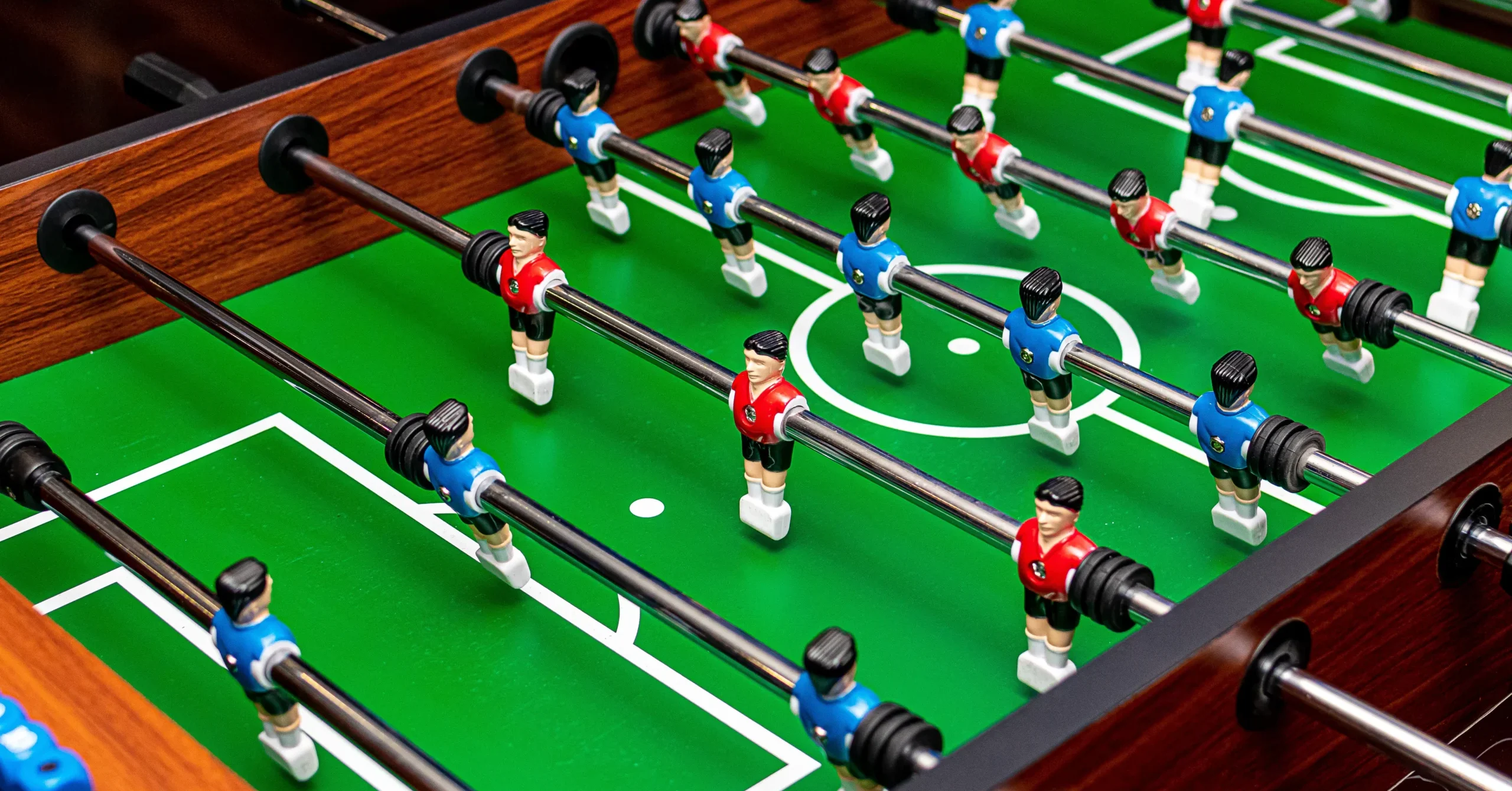
Under ITSF regulations, each side fields 11 figures across four rows: goalkeeper, defenders, midfielders, and attackers. Matches run in singles or doubles format. In doubles, partners divide rod responsibility: one controls the defensive rows, the other handles midfield and attack.
The rule that most separates competitive play from recreational foosball is the spinning ban. A full 360-degree rotation of any rod before or after ball contact is prohibited. Infractions result in possession transferring to the opposing team.
Ball specifications under ITSF standards set diameter at 34.5 to 35 millimetres. Regulation table dimensions are: length 140 centimetres, width 76 centimetres, height 90 centimetres. Scoring formats vary by competition, but matches commonly require a player or team to reach 5, 10, or 11 goals.
Five Official ITSF Table Types
Not all foosball tables are interchangeable in competition. The ITSF certifies five table types for use in World Championship Series events:
- Bonzini (French design, cork ball)
- Roberto Sport (Italian)
- Garlando (Italian)
- Tornado (American)
- Leonhart (German)
Each table type has its own World Championship Series event. The Tornado World Championships, held exclusively on Tornado tables, has run since 1986.
The ITSF World Cup and Major Competitions
The ITSF World Cup runs every four years in a country vs. country format, with national squads competing across multiple disciplines. World Championships operate on a separate annual or biannual cycle, covering each of the five certified table types. The ITSF also runs the World Champions League and a Gold Finals circuit for elite-ranked players.
Is Foosball an Olympic Sport?
Foosball is not an Olympic sport. The ITSF holds no recognition from the International Olympic Committee. The federation was established in part to pursue international sports body recognition, but as of 2023 no IOC status has been granted. Some sports hold IOC recognition without competing at the Olympic Games; table football is not currently in either category.
The search query “is foosball an Olympic sport” reflects a wider question about the classification of table and precision games. The ITSF’s operational structure, which includes certified officials, world rankings, and anti-doping frameworks, mirrors those of recognised international sports federations, though formal IOC recognition remains outstanding.
Frequently Asked Questions
What is sport foosball?
Sport foosball is competitive table football played under ITSF standardised rules. It involves certified tables, regulated ball specifications, official match formats, and an international tournament structure including world championships and a four-yearly World Cup.
Is foosball a sport or a game?
It functions as both. Recreationally, foosball is a bar or home game. Competitively, it operates as an organised sport with a governing body, certified equipment, an official rulebook, and international competition structures.
Is foosball an Olympic sport?
No. The ITSF governs foosball internationally but holds no IOC recognition as of 2023. Foosball does not feature at the Olympic Games.
What are the official foosball rules?
ITSF rules prohibit spinning (360-degree rod rotation before or after ball contact), set ball diameter at 34.5 to 35 millimetres, standardise table dimensions, and require play on one of five certified table types. Matches are played in singles or doubles format.
When was the ITSF founded?
The International Table Soccer Federation was founded on 16 August 2002 in Oberwart, Austria, by eight founding nations: Belgium, China, Denmark, France, Germany, Italy, the United Kingdom, and the United States.
Sources
- ITSF History and Founding, International Table Soccer Federation
- ITSF Official Rules Documentation, International Table Soccer Federation
- ITSF Member Nations, International Table Soccer Federation
- ITSF World Cup and World Championships, International Table Soccer Federation
- International Table Soccer Federation (ITSF), Official Website