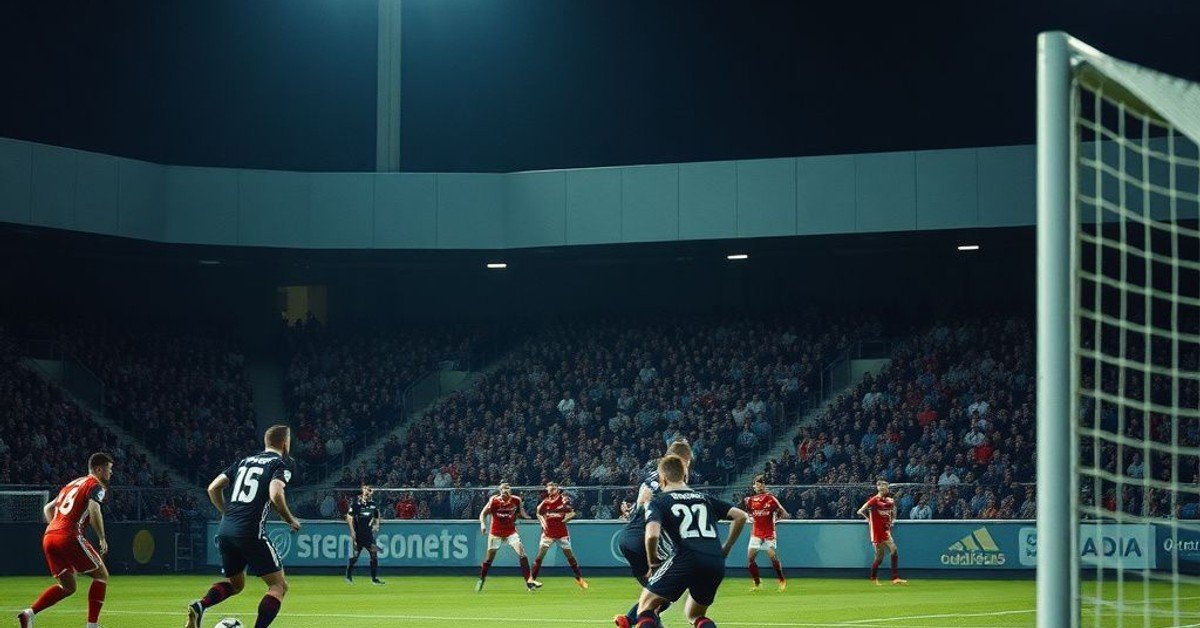
The most organised defending in football does not happen at the halfway line. It happens when a team retreats deliberately, compresses the space near their own goal, and forces opponents to break down a structure rather than find space behind it.
By David Findlay, Founder of KiqIQ.
Quick Answer: A low block in football is a defensive structure in which a team positions itself deep in its own half, keeping all lines compact near the goal to deny space behind the defence and limit the opponent’s ability to play through or over the defensive shape.
Definition: The low block is an out-of-possession strategy where a team’s defensive and midfield lines sit deep, typically within or close to the defensive third. According to Coaches Voice, the back line remains deep to eliminate the space behind the defence, with midfield and attacking units maintaining minimal distances between each line to create a compact, congested defensive structure.
Key point: The low block is a tactical choice, not a failure of ambition. Teams use it to neutralise opponents with superior quality, protect a lead, or exploit the counter-attacking space it creates in transition. The system trades territorial control for defensive solidity and speed on the break.
What the Low Block Means Tactically
Coaches Voice describes the low block as a strategy focused on the defensive third rather than the middle or attacking thirds. Players focus on protecting the area in and around their penalty box, keeping their shape compact and avoiding chasing the ball out of position. Any gap in the defensive structure compromises the system, so discipline in maintaining the shape is the primary organisational demand.
The low block differs from the mid-block, which defends the middle third, and from a high press, which targets the ball near the opponent’s goal. The low block accepts that the opponent will have possession and territorial control across large areas of the pitch. That concession is structural, not accidental. The team is inviting pressure in exchange for limiting the damage it can cause.
FourFourTwo identifies central lane congestion as the primary defensive mechanism: by packing players near the goal, the low block closes the through-ball options that would otherwise split the defence and cuts out the space over the top that a higher defensive line exposes.
How the Low Block Shapes Possession Play
When a low block team wins the ball, the distance to the opponent’s goal is considerable. According to Coaches Voice, this creates a counter-attacking dynamic: the opponent has moved forward to press and probe, leaving space in behind their own defensive line. The transition from defence to attack is the primary goalscoring opportunity for a low block side.
The FIFA Training Centre’s analysis of Al Ahly’s counter-attacking system identifies a key structural advantage of the low block in transition: when the team wins possession, players are in close proximity to each other and capable of moving the ball quickly to escape counter-pressing and unlock passing lanes. The first pass after winning the ball moves forward rather than sideways, denying opponents time to reorganise. Arsene Wenger, referenced in the FIFA Training Centre’s analysis, summarised the modern demand: “Quick transition, from defence to attack and attack to defence, using moments when opponents are disorganized.”
Coaches Voice identifies the practical requirements: quick, incisive actions in the transition, effective hold-up play from forward players who must retain the ball under pressure at distance from support, and direct passing rather than short sequences through the lines. The low block requires patience and discipline in defence, then speed and decision-making in attack.

The Coaches Most Associated with the Low Block
Coaches Voice identifies Diego Simeone at Atletico Madrid as the most prominent contemporary practitioner. Simeone uses a 4-4-2 structure with midfielders Koke and Marcos Llorente alongside defensive specialists to create narrow second lines capable of quick transitions. He has also incorporated back-five formations for additional defensive security in specific fixtures.
Jose Mourinho built low block systems at multiple clubs. Coaches Voice describes his approach at Tottenham: wingers track opposition fullbacks to create a six-player back line when out of possession, with a double pivot filling the gaps as the wingers narrow into a three-player midfield line. The result is a highly structured eight or nine-man defensive shape that is difficult to break down centrally.
Sean Dyche applied the system consistently at Burnley, using a narrow 4-4-2 in which wingers worked back to form a compact four-player midfield block. Fullbacks pressed aggressively outward, pushing opponents wide and relying on strong central defenders to win the aerial battles that followed. FourFourTwo also cites Tony Pulis and Antonio Conte as managers who regularly employed variations of the low block.
The Advantages of Defending Deep
Coaches Voice identifies several structural advantages. The low block creates conditions that Coaches Voice describes as “extremely difficult” for opponents to generate clear chances: defenders are close to the goal, space behind them is eliminated, and the central lanes are congested. Teams protecting a lead, or facing opponents of significantly higher quality, benefit most from these properties.
Physical recovery is a secondary benefit. The system demands less high-intensity pressing across the pitch and concentrates effort near the goal, where players cover shorter distances. This can be a practical advantage over a full match or across a congested fixture schedule.
The Costs and Vulnerabilities
The low block concedes possession and territory. Coaches Voice notes that opponents often dominate two-thirds of the pitch when facing a low block, restricting the defending team to short periods of counter-attacking possession. For forward players, this means long periods in defensive roles with limited contact with the ball in advanced areas.
Individual errors carry greater consequence than in a high-press system. When a pressing team loses the ball, the structure is already moving to re-press. When a low block defender loses a duel or misreads a run, there is little recovery space between the mistake and the goal. Coaches Voice identifies concentration as a sustained requirement throughout the match, not only in set-piece or transition moments.
The KiqIQ Angle
The low block has a reputation problem in football discourse. It is consistently framed as negative, reactive, or limited: the system of teams that cannot compete in open play. That framing misses the tactical logic. A team that executes a low block well does not merely survive: it actively shapes the match by dictating where the opponent attacks, compressing the spaces that matter, and waiting for the transition moment that the opponent creates by committing bodies forward. Simeone has built one of the most competitive sides in European football on this foundation. The question is not whether the low block is a legitimate approach but whether the team executing it has the quality to exploit the counter-attacking opportunities it generates. A low block without a counter-attack is a defence with no attack. A low block with clinical counter-attacking is a system that can beat anyone.
Frequently Asked Questions
What is a low block in football?
A low block is a defensive structure in which a team sits deep in its own half with all lines compact near the goal. According to Coaches Voice, the back line remains deep to limit space behind the defence, with midfield and attacking units keeping minimal distances between each line to form a compact, congested defensive shape.
What is the difference between a low block and a mid-block?
A low block defends within or close to the defensive third, sitting deep near the goal. A mid-block defends the middle third of the pitch, pressing higher up when triggered. A high press pushes pressure toward the opponent’s goal. The three systems differ primarily in where the team concentrates its defensive effort and how much territory it concedes.
Which managers use the low block?
Coaches Voice identifies Diego Simeone at Atletico Madrid, Jose Mourinho, and Sean Dyche at Burnley as prominent low block practitioners. FourFourTwo also cites Tony Pulis, Antonio Conte, and Nuno Espirito Santo. Each applies the system with distinct formations and pressing triggers, but all share the core principle of defending deep and compact.
What are the advantages of a low block?
The low block limits the space behind the defence, congests central passing lanes, and creates counter-attacking space in transition. Coaches Voice notes it creates conditions that are extremely difficult for opponents to generate clear chances, and it reduces physical demands compared to high-pressing systems by concentrating effort near the goal.
What are the weaknesses of a low block?
The low block concedes possession and territorial control. Coaches Voice identifies the recovery distance to goal when counter-attacking as a structural limitation, the demand for sustained concentration from all players, and the restricted attacking involvement for forward players who spend much of the match in defensive positions.