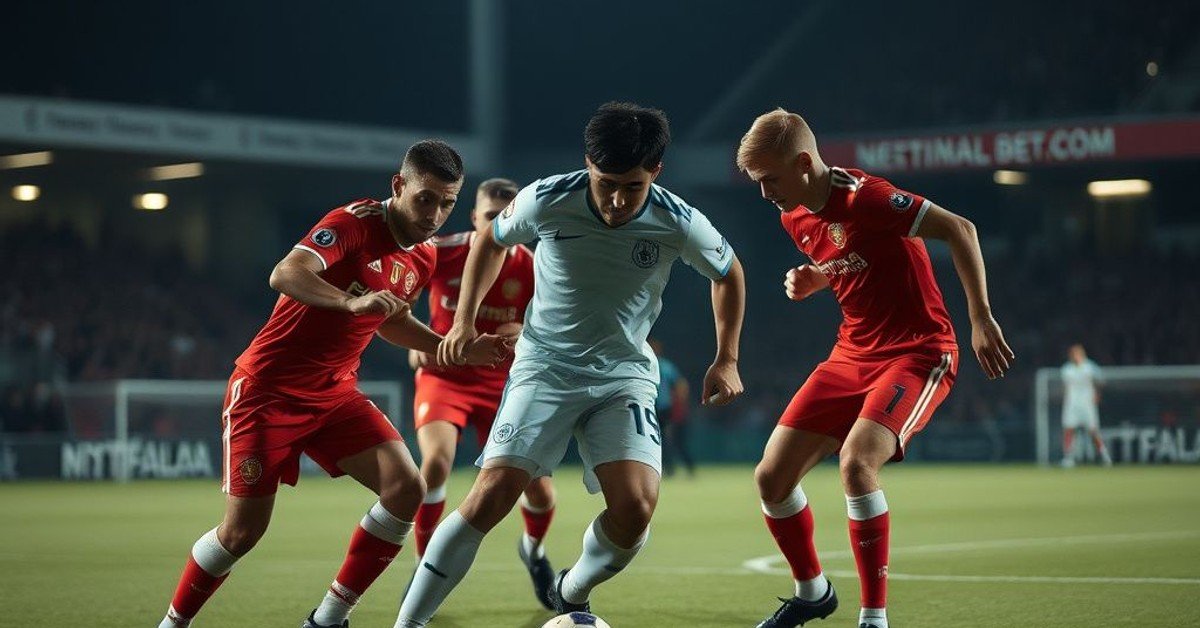
Elite teams do not wait to defend. The moment possession is lost, the most consequential decision of the transition phase has already been made.
By David Findlay, Founder of KiqIQ.
Quick Answer: Counter-pressing in football means immediately applying coordinated pressure on the opponent after losing the ball, with the aim of winning possession back before the opposition can organise an attack. The press is triggered the moment a team loses the ball, not when the opponents have settled into a shape.
Definition: Counter-pressing is the tactical action of a team pressing collectively and immediately after losing possession, targeting the ball-carrier and nearby opponents to regain the ball during a high-risk transition window. The term is closely associated with the German word “Gegenpressing,” popularised through German coaching culture according to Coaches Voice.
Key point: Counter-pressing is not the same as a general pressing system. It is specifically a transition response, applied in the seconds immediately after possession is lost. England Football’s coaching guidance identifies the target recovery window as within five seconds of losing the ball.
What Counter-Pressing Means in a Match Context
Analytics FC defines counter-pressing as “the act of actively pursuing the ball in a coordinated manner with the aim of regaining possession quickly after ball-loss.” The critical word is coordinated: it is not one player chasing the ball but a collective trigger applied simultaneously by multiple players.
The FIFA Training Centre describes the objective as taking advantage of the opponent’s disorganisation in the few seconds just after they have regained possession. Opponents who have just won the ball are typically not yet in their intended shape, their scanning is incomplete, and their decision-making window is narrow. Counter-pressing targets that window directly.
England Football’s coaching guidance identifies pressing broadly as pressure applied on the player or team in possession, with counter-pressing as the immediate application of that pressure following a loss of the ball. The principle requires communication, speed of recovery, and a “one in, all in” collective trigger from the team.
The Five-Second Window
England Football’s official coaching resources identify the target recovery window for counter-pressing as within five seconds of losing the ball. Within that window, opponents have not yet moved the ball with purpose, their spacing is typically compressed, and a coordinated press can isolate the ball-carrier with numerical advantage.
Beyond that window, the opponent has had time to play forward, create space, and disengage from the transition. At that point, the counter-press has failed and the team must shift into an organised defensive shape. The five-second window defines the tactical moment: teams that recover possession within it avoid a defending phase entirely, according to England Football’s guidance.
Attacking Counter-Press vs Defensive Counter-Press
Analytics FC identifies two structurally distinct forms of the counter-press, each serving a different tactical purpose.
The attacking counter-press is a pre-meditated, high-risk strategy targeting transition wins in the opponent’s final third or attacking areas. Analytics FC describes Klopp’s Liverpool as a practitioner of this model: players in advanced positions took deliberate possession risks knowing that a successful counter-press would create an immediate goalscoring opportunity, creating what Analytics FC describes as “no-loss scenarios” when the press succeeds.
The defensive counter-press prioritises structural protection over immediate ball recovery. It relies on compact rest defence structures, positioning players close to the ball to apply quick pressure while maintaining defensive shape. Analytics FC cites Roberto De Zerbi’s Brighton as a practitioner of this model, using the defensive counter-press to allow centre-backs to attempt ambitious passes from deep positions without catastrophic defensive exposure.
The Coaches Associated with Counter-Pressing
Coaches Voice traces the popularisation of counter-pressing through German coaching culture, crediting Wolfgang Frank and Ralf Rangnick as early developers of Gegenpressing principles. Jürgen Klopp, Thomas Tuchel, and Julian Nagelsmann are identified as subsequent practitioners who refined and spread the approach.
Jürgen Klopp is the coach most closely associated with counter-pressing at elite level, having applied it at Borussia Dortmund and Liverpool. The FIFA Training Centre attributes to Klopp the framing of counter-pressing as “the best playmaker,” a description that captures the tactical logic directly: winning the ball back in dangerous positions removes the need for extended build-up sequences entirely.
Pep Guardiola merged counter-pressing principles with possession-based systems at Barcelona, Bayern Munich, and Manchester City, according to Coaches Voice. Marcelo Bielsa applied aggressive pitch-wide pressing with constant positional rotation at Leeds United. Ralph Hasenhüttl built his counter-pressing from a 4-4-2 midfield shape at RB Leipzig and Southampton.
The Costs and Risks
Counter-pressing carries structural risk. Coaches Voice identifies the primary vulnerability: a team pressing intensely in one area of the pitch vacates space elsewhere. If the press is bypassed, opponents can exploit that vacated space through a direct counter-attack. The risk scales with the aggression of the press and the positional discipline of the players involved.
The system also demands sustained physical output. Coordinated pressing across multiple players, repeated throughout a match, requires high aerobic capacity and consistent positional discipline under fatigue. Coaches Voice notes that teams must maintain exceptional organisation to prevent the press from becoming disorganised individual efforts that create rather than close gaps.
The KiqIQ Angle
Counter-pressing is one of the few tactical concepts that moved from specialist coaching discussion into general football vocabulary within two decades. The reason is straightforward: it produces visible, immediate results in high-profile matches, and it is closely associated with some of the most successful club sides of the modern era. What gets lost in the popular framing is that counter-pressing is not a system in itself. It is a transition response, a tactical decision made in under five seconds, applied collectively. Teams that execute it well do not do so because of a general commitment to pressing. They do it because every player understands the trigger, the shape, and the consequence of failing to react. That precision is what separates a functional counter-press from a group of players running at the ball.

Frequently Asked Questions
What does counter-pressing mean in football?
Counter-pressing means applying immediate, coordinated pressure on an opponent after losing possession, with the aim of winning the ball back before the opposition can organise. England Football’s coaching guidance identifies the target window as within five seconds of losing the ball.
What is the difference between pressing and counter-pressing?
Pressing is a general tactical approach of applying pressure on opponents in possession. Counter-pressing is a specific transition response triggered the moment a team loses the ball, not when opponents have already settled into a shape. Counter-pressing targets the disorganised transition phase directly.
What does Gegenpressing mean?
Gegenpressing is the German term for counter-pressing. According to Coaches Voice, the concept was developed and popularised through German coaching culture, associated with coaches including Wolfgang Frank, Ralf Rangnick, Jürgen Klopp, Thomas Tuchel, and Julian Nagelsmann.
Which coaches are most associated with counter-pressing?
Jürgen Klopp is the coach most closely associated with counter-pressing at elite level, having applied it at Borussia Dortmund and Liverpool. Pep Guardiola, Marcelo Bielsa, and Ralph Hasenhüttl are also identified by Coaches Voice as key practitioners who developed distinct versions of the system.
What are the risks of counter-pressing?
The primary risk is vacated space. A team pressing intensely in one area leaves space elsewhere on the pitch. If the press is bypassed, opponents can exploit that space through a direct counter-attack. Coaches Voice identifies sustained fitness and positional discipline as requirements for managing this risk.