
Over 13 professional football clubs compete across London, yet most fans cannot accurately place them on a map or understand how geography shapes local rivalries.
By David Findlay, Founder of KiqIQ.
Quick Answer: London hosts 13 professional football clubs across the Premier League and English Football League, distributed across north, south, east, and west regions. These clubs range from Arsenal and Chelsea in the top flight to lower-league sides like Leyton Orient and AFC Wimbledon.
Definition: A London football clubs map is a geographical representation showing the locations of professional football teams operating within Greater London, typically organised by region (north, south, east, west) and league tier. These maps illustrate proximity between clubs, historical rivalries rooted in geography, and the density of professional football within the capital.
Key point: London’s football landscape spans four distinct geographical regions, with club density creating unique local derbies and travel patterns that influence fixture scheduling and supporter culture.
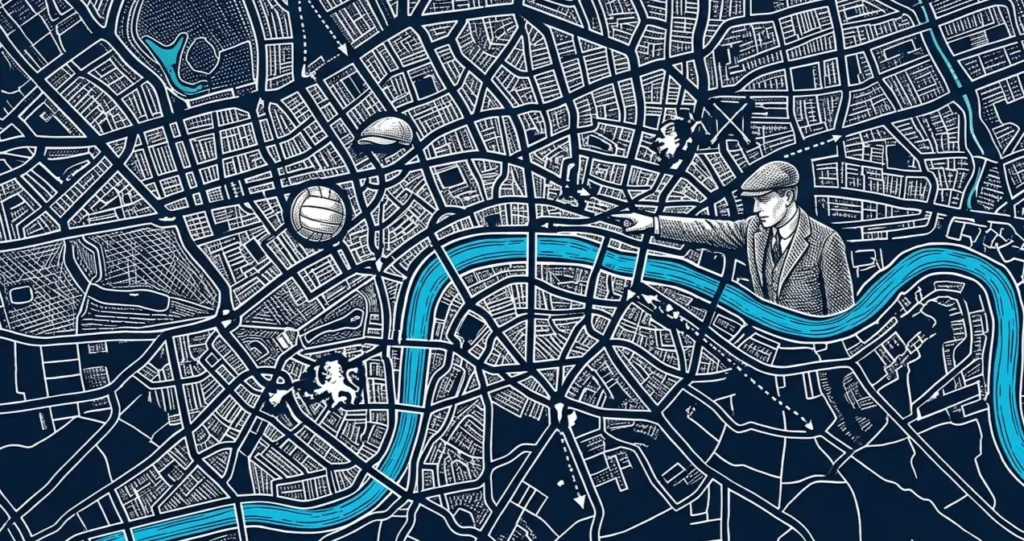
London Football Clubs Map: Complete Regional Breakdown
Greater London contains the highest concentration of professional football clubs in any single metropolitan area globally. Understanding their geographical distribution requires dividing the capital into four traditional compass regions, each with distinct football identities and competitive hierarchies.
The current professional landscape includes six clubs competing in the Premier League during the 2024-25 season, with additional representation across the Championship, League One, and League Two. This distribution shifts annually through promotion and relegation but maintains London’s status as England’s most represented city across all four professional tiers.
North London Football Clubs
North London contains the capital’s most famous rivalry and three professional clubs. Arsenal, based in Holloway since 1913, and Tottenham Hotspur in N17 form the North London Derby, one of English football’s most intense local competitions. Both clubs maintain Premier League status and European competition ambitions.
Barnet, located further north in High Barnet, operates in the National League after relegation from League Two in 2018. The Bees play at The Hive Stadium, representing the northernmost professional club within Greater London boundaries.
South London Football Clubs
South London hosts the greatest concentration of professional clubs, with five teams distributed across the region. Crystal Palace in Selhurst represents the Premier League tier, whilst Charlton Athletic (The Valley, SE7) and Millwall (The Den, SE16) compete in the Championship.
AFC Wimbledon, based in Plough Lane, SW17, returned to their historical home borough in 2020 after two decades of exile. Sutton United, located in SM1, achieved Football League status in 2021, representing the southernmost professional club in the capital.
The South London Derby between Crystal Palace and Millwall carries particular intensity, rooted in geographical proximity and contrasting supporter demographics. Charlton and Millwall also maintain a fierce rivalry despite both clubs experiencing periods outside the top flight.
East London Football Clubs
East London contains three professional clubs with distinct identities. West Ham United, now based at London Stadium in Stratford, maintains strong connections to its Upton Park heritage despite relocating in 2016. The Hammers compete in the Premier League and represent East London at the highest level.
Leyton Orient, based at Brisbane Road in E10, operates in League One and claims status as the oldest professional club in the London area, founded in 1881. Orient’s geographical position creates natural rivalries with West Ham and fellow East London neighbours.
Dagenham & Redbridge, located in RM10, represents the easternmost professional club. The Daggers compete in the National League after dropping out of the Football League in 2023.
West London Football Clubs
West London hosts three professional clubs including two Premier League sides. Chelsea, based at Stamford Bridge in Fulham, and Fulham itself at Craven Cottage create the West London Derby, characterised by proximity of less than three miles between grounds.
Queens Park Rangers, located at Loftus Road in Shepherd’s Bush, competes in the Championship. QPR maintains rivalries with both Chelsea and Fulham, though geographical closeness to Chelsea produces particularly intense encounters.
Brentford, whilst historically associated with West London, sits in the borough of Hounslow and represents the western boundary of professional football in Greater London. The Bees’ Gtech Community Stadium opened in 2020, ending 116 years at Griffin Park.
| Region | Club | League Tier | Home Ground | Nearest Station |
|---|---|---|---|---|
| North London | Arsenal | Premier League | Emirates Stadium | Arsenal (Piccadilly) |
| North London | Tottenham Hotspur | Premier League | Tottenham Hotspur Stadium | White Hart Lane (Overground) |
| North London | Barnet | National League | The Hive Stadium | Canons Park (Jubilee) |
| South London | Crystal Palace | Premier League | Selhurst Park | Selhurst / Norwood Junction |
| South London | Charlton Athletic | League One | The Valley | Charlton (Southeastern) |
| South London | Millwall | Championship | The Den | South Bermondsey (Southeastern) |
| South London | AFC Wimbledon | League Two | Plough Lane | Earlsfield / Haydons Road |
| South London | Sutton United | League Two | Gander Green Lane | West Sutton (Thameslink) |
| East London | West Ham United | Premier League | London Stadium | Stratford (Central/Jubilee/Elizabeth) |
| East London | Leyton Orient | League One | Brisbane Road | Leyton (Central) |
| East London | Dagenham & Redbridge | National League | Chigwell Construction Stadium | Dagenham East (District) |
| West London | Chelsea | Premier League | Stamford Bridge | Fulham Broadway (District) |
| West London | Fulham | Premier League | Craven Cottage | Putney Bridge (District) |
| West London | Brentford | Premier League | Gtech Community Stadium | Kew Bridge (Overground) |
| West London | Queens Park Rangers | Championship | Loftus Road | White City (Central/Elizabeth) |
Understanding London’s Football Geography
The distribution of London football clubs reflects historical industrial development, transport infrastructure, and working-class community formation during the late 19th and early 20th centuries. Most clubs originated in areas with strong manufacturing bases, dockyard employment, or railway connectivity.
Arsenal’s relocation from Woolwich to North London in 1913 represents the most significant geographical shift in London football history, creating the conditions for the North London Derby whilst leaving South East London without top-tier representation for decades.
Travel Distance Between London Football Grounds
The compact nature of London’s geography means several derby matches involve travel distances of under five miles. Fulham and Chelsea sit just 2.1 miles apart, creating one of England’s closest top-flight rivalries when both clubs compete in the Premier League simultaneously.
Conversely, matches between Barnet and Sutton United can involve journeys exceeding 25 miles across Greater London, presenting logistical challenges for supporters using public transport. These distances influence away attendance figures and contribute to fixture scheduling considerations by the Football League.
Transport Infrastructure and Match Day Access
London’s extensive Underground and Overground network provides direct access to most professional football grounds. Ten of the 13 clubs operate within walking distance of Underground or Overground stations, with only Barnet, Sutton United, and Dagenham & Redbridge requiring bus connections from rail terminals.
This connectivity influences attendance patterns, with clubs on major Underground lines typically experiencing higher away supporter numbers than those requiring multiple transport changes. The Elizabeth Line’s opening in 2022 improved access to West Ham’s London Stadium, reducing journey times from West London and Heathrow Airport.
Map of Football Clubs in London by League Tier
League tier distribution demonstrates London’s competitive diversity. During the 2024-25 season, six London clubs compete in the Premier League: Arsenal, Tottenham Hotspur, Chelsea, Fulham, West Ham United, Brentford, and Crystal Palace when all maintain top-flight status.
The Championship typically contains between two and four London representatives, with Charlton Athletic, Millwall, and Queens Park Rangers frequently operating at this level. League One and League Two contain rotating London representation based on promotion and relegation outcomes.
This tier distribution affects derby frequency. North London Derbies occur twice annually with guaranteed regularity, whilst South London encounters between Crystal Palace and Millwall depend on both clubs competing in the same division, an occurrence that has become less frequent since Palace’s Premier League consolidation.
| League Tier | Club Count | Teams Included |
|---|---|---|
| Premier League | 7 | Arsenal, Brentford, Chelsea, Crystal Palace, Fulham, Tottenham Hotspur, West Ham United |
| EFL Championship | 3 | Charlton Athletic, Millwall, Queens Park Rangers |
| EFL League One | 2 | AFC Wimbledon, Leyton Orient |
| EFL League Two | 2 | Barnet, Bromley |
| National League | 2 | Sutton United, Dagenham & Redbridge |
Historical Context of London Football Club Locations
The formation period of London football clubs (1880-1905) established geographical patterns that persist today. Clubs emerged from church organisations, factory teams, and community initiatives in areas with concentrated working-class populations.
Woolwich Arsenal’s foundation in 1886 by munitions workers at the Royal Arsenal demonstrates typical club origins. Similarly, Thames Ironworks (later West Ham United) emerged from industrial employment in 1895, whilst Fulham formed from a church cricket club in 1879.
Stadium Relocations and London’s Changing Geography
Several London clubs have relocated significantly from original grounds. Arsenal’s 1913 move from Plough Lane to Highbury, then to Emirates Stadium in 2006, represents multiple generational shifts. West Ham’s 2016 departure from Upton Park to London Stadium marked the end of 112 years at their spiritual home.
Charlton Athletic returned to The Valley in 1992 after seven years of groundshare exile, demonstrating the importance of geographical identity to supporter culture. AFC Wimbledon’s 2020 return to Plough Lane completed a 28-year journey back to their original borough after forced relocation and eventual fan-led reformation.
South London Football Clubs: The Densest Region
South London’s five professional clubs create the capital’s most complex derby network. Crystal Palace, Charlton Athletic, Millwall, AFC Wimbledon, and Sutton United operate within roughly 12 miles of each other, with multiple overlapping rivalries based on geographical proximity and historical encounters.
The Palace-Millwall rivalry intensified during the 1970s and 1980s when both clubs competed regularly in the same divisions. Geographical proximity of approximately 7.5 miles between Selhurst Park and The Den, combined with contrasting supporter identities, produces particularly intense atmospheres during encounters.
Charlton and Millwall’s rivalry predates modern football culture, rooted in dockyard employment patterns and South East London territorial identity. Despite both clubs experiencing extended periods outside the Premier League, their encounters consistently generate higher attendance figures than average fixtures.
East London Football Clubs and Industrial Heritage
East London’s football identity connects directly to dockyard employment, manufacturing, and post-war reconstruction. West Ham United’s historical association with Thames Ironworks established the club’s working-class identity, reinforced through generations of supporters from Newham, Tower Hamlets, and surrounding boroughs.
Leyton Orient’s location in E10 places the club between West Ham’s traditional territory and Tottenham’s northern reach, creating natural rivalries with both. Orient’s relative lack of top-flight history (one season in 1962-63) distinguishes the club from London’s established elite, fostering distinct supporter culture focused on community connection rather than trophy expectations.
Dagenham & Redbridge represents East London’s outer boundary, formed through merger in 1992. The club’s National League status and limited historical success create different supporter dynamics compared to West Ham’s Premier League profile, despite geographical proximity of approximately 8 miles.
West London Football Clubs: Riverside Rivalries
West London’s Thames-side geography influences club identities and rivalries. Chelsea, Fulham, and Brentford all originated within three miles of the river, with Fulham’s Craven Cottage maintaining its riverside location since 1896.
The Chelsea-Fulham rivalry, whilst lacking the intensity of North London or South London derbies, carries significance due to geographical proximity and contrasting club trajectories. Chelsea’s financial transformation since 2003 created vast resource disparities, yet derby encounters maintain competitive unpredictability.
Queens Park Rangers’ position in Shepherd’s Bush places the club equidistant between Chelsea and Brentford, creating multiple West London derby possibilities depending on divisional alignment. QPR’s Loftus Road, with a capacity of just 18,439, represents one of England’s most compact top-tier venues when the club achieves Championship status.
North London Football Clubs: Arsenal and Tottenham Dominance
North London’s football landscape centres entirely on the Arsenal-Tottenham rivalry, one of English football’s most significant derbies. The geographical and competitive intensity of this fixture overshadows Barnet’s presence in the National League, creating a two-tier structure within the region.
Arsenal’s historical dominance in terms of trophy count (13 league titles to Tottenham’s 2) contrasts with recent competitive parity in league positions. Between 2010 and 2024, both clubs regularly competed for Champions League qualification, with neither achieving consistent superiority.
The North London Derby’s fixture scheduling often receives preferential television slots, reflecting broadcaster recognition of its commercial value and guaranteed competitive intensity. Police resources for these matches significantly exceed standard fixtures due to historical incidents and ongoing security considerations.
| Derby | Distance (Miles) | Clubs | Current Divisional Status |
|---|---|---|---|
| West London Derby | 2.1 | Chelsea vs Fulham | Both Premier League |
| West London Derby | 3.8 | Chelsea vs QPR | Different divisions |
| West London Derby | 4.5 | Brentford vs QPR | Different divisions |
| North London Derby | 4.7 | Arsenal vs Tottenham | Both Premier League |
| East London Derby | 6.5 | West Ham vs Leyton Orient | Different divisions |
| South London Derby | 7.5 | Crystal Palace vs Millwall | Different divisions |
| South London Derby | 8.2 | Millwall vs Charlton | Both Championship/L1 |
| East London Derby | 8.8 | West Ham vs Dagenham & Redbridge | Different divisions |
| South London Derby | 9.4 | Crystal Palace vs Charlton | Different divisions |
| Cross-Region Derby | 11.2 | Tottenham vs West Ham | Both Premier League |
| Cross-Region Derby | 12.8 | Arsenal vs Chelsea | Both Premier League |
Using a London Football Clubs Map for Match Planning
Practical applications of London football club mapping extend beyond geographical interest to match attendance planning, derby identification, and understanding fixture congestion periods.
Away supporters travelling to London can use regional mapping to identify optimal accommodation locations. Staying in central zones with Underground connectivity to multiple grounds allows attendance at fixtures across different regions without extensive cross-city travel.
Derby identification through mapping reveals fixtures beyond traditionally recognised rivalries. Proximity between Brentford and QPR (approximately 4.5 miles) creates natural local interest despite less media coverage than Chelsea-Fulham encounters. Understanding these geographical relationships enhances appreciation of historical context during less prominent fixtures.
Fixture Congestion and London Clubs
The concentration of London clubs creates unique fixture scheduling challenges, particularly regarding police resource allocation. Metropolitan Police protocols typically prevent multiple high-risk London derbies occurring simultaneously, influencing kick-off time selections.
European competition participation by London clubs compounds scheduling complexity. When Arsenal, Chelsea, Tottenham, and West Ham compete in UEFA tournaments simultaneously, domestic fixture congestion intensifies, requiring coordination between Premier League schedulers, broadcasters, and security services.
Frequently Asked Questions
How many professional football clubs are in London?
Greater London contains 13 professional football clubs competing across the Premier League, Championship, League One, League Two, and National League during the 2024-25 season. This number fluctuates annually due to promotion and relegation but typically ranges between 12 and 14 clubs.
Which London football club is furthest north?
Barnet represents the northernmost professional football club in Greater London, located in High Barnet, approximately 10.5 miles from central London. The club currently competes in the National League at The Hive Stadium.
What is the closest distance between two London football grounds?
Fulham’s Craven Cottage and Chelsea’s Stamford Bridge sit just 2.1 miles apart, representing the shortest distance between two professional football grounds in London. This proximity creates one of England’s geographically tightest derbies when both clubs compete in the same division.
Which region of London has the most football clubs?
South London contains the highest concentration with five professional clubs: Crystal Palace, Charlton Athletic, Millwall, AFC Wimbledon, and Sutton United. This distribution creates the capital’s most complex network of local rivalries and derby fixtures.
Do all London football clubs have Underground stations nearby?
Ten of the 13 professional London clubs operate within walking distance of London Underground or Overground stations. Barnet, Sutton United, and Dagenham & Redbridge require bus connections from nearby rail terminals, presenting additional travel considerations for match attendance.
Why did Arsenal move from South to North London?
Arsenal relocated from Woolwich to Highbury in 1913 due to financial difficulties and poor attendance at their South East London location. The move to North London provided access to larger populations, better transport links, and ultimately established one of English football’s greatest rivalries with Tottenham Hotspur.