
Most coaches can draw the 3-5-2 formation on a whiteboard. Far fewer track the press-break rate that determines whether that shape holds under sustained transition pressure.
By David Findlay, Founder of KiqIQ.
Quick Answer: The 3-5-2 formation fields three central defenders, five midfielders including two attacking wing-backs, and two central forwards. It works when wing-backs sustain press recovery runs across repeated transitions and the central midfield controls progression lanes. To evaluate it accurately, track press-break rate and progression success rate rather than possession percentage.
Definition: The 3-5-2 formation is a tactical system in association football in which a team fields three central defenders, five midfielders including two wide-operating wing-backs, and two central forwards. The structure allows a back five in defence and an attacking shape that can reach a back three in possession, providing numerical superiority in central midfield and width through the wing-back positions rather than through dedicated full-backs.
While the definition is standard, the instrumentation friction is where most departments fail to find signal.
Key point: The 3-5-2 formation’s effectiveness depends on wing-back press recovery and midfield compactness in transition, not on the back-three structure alone.
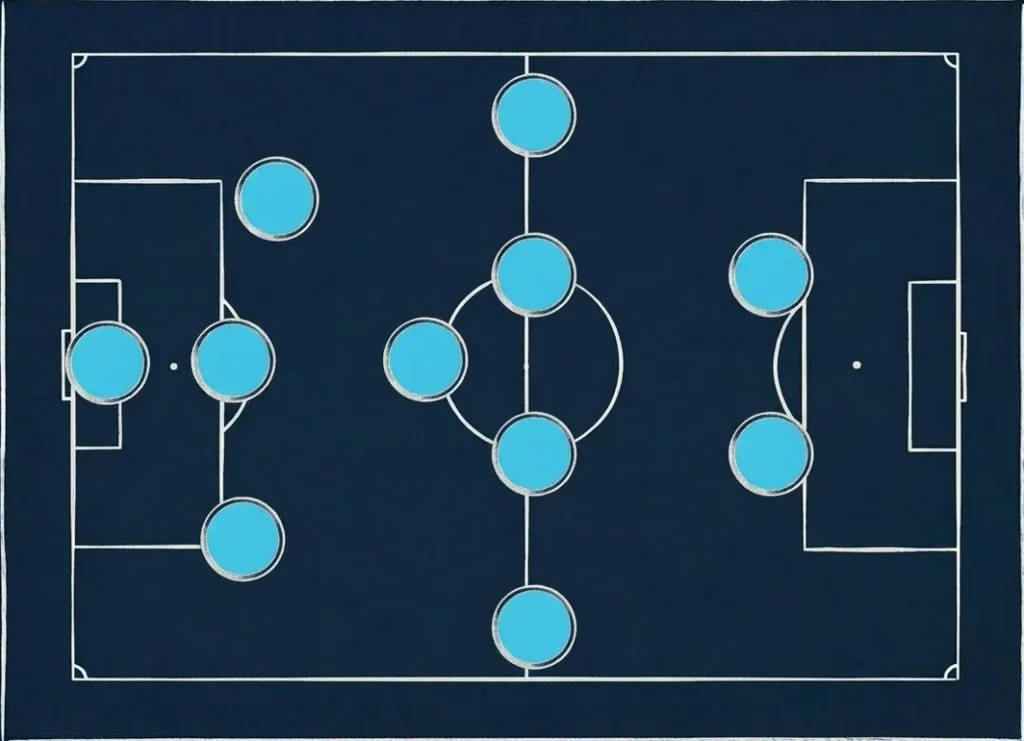
How the 3-5-2 Formation Is Structured
The 3-5-2 organises a team into three horizontal lines that shift shape depending on game state.
The back three consists of three central defenders. The central centre-back acts as the primary organiser and last line of communication across the defensive shape. The two wide centre-backs cover the flanks when wing-backs advance and provide a wide outlet during build-up from deep positions.
The midfield five includes two wing-backs and three central midfielders. Wing-backs operate as the system’s primary width providers in attack. In defence, they drop alongside the three centre-backs to create a back five. The central midfield trio typically includes one holding midfielder and two more progressive central players, though a double pivot with one advanced midfielder is equally common depending on the opposition match-up.
The two forwards function as a pressing unit from the front line and as a combination pair in the final third. Their pressing discipline sets the direction and timing of the team’s first line of pressure, which determines how the rest of the press structure operates behind them.
In possession, the 3-5-2 frequently reshapes into a 3-2-5 or 3-4-3, depending on how high the wing-backs push and how the advanced central midfielders position relative to the forwards. This positional fluidity is a structural advantage but requires clear positional discipline to avoid defensive exposure on the counter.
Wing-Back Roles: The Physical Demand Most Teams Underestimate
Wing-backs are the most physically demanding position in the 3-5-2 formation. They are required to cover the full length of the flank across both attacking and defensive phases, with no full-back providing cover behind them.
In attack, wing-backs provide width, deliver crosses, support forward combinations, and create numerical overloads in wide areas. In defence, they must recover to their position in the back five, track opposing wide players, and communicate with the wide centre-back to manage the defensive channel behind them.
Press-break rate is the primary indicator of wing-back structural effectiveness. When the opposition breaks the 3-5-2 press through the wide channel, the distance the wing-back must cover to recover shape is greater than in any four-defender system. Teams using this formation at non-elite level should monitor this metric specifically rather than relying on possession totals or general activity data to evaluate wing-back performance.
A wing-back who lacks the athletic profile to sustain repeated high-intensity recovery runs will expose the wide centre-back to one-versus-one situations that the back-three structure is not designed to manage without collective recovery support from elsewhere in the shape.
Pressing and Rest Defence in the 3-5-2 Formation
Pressing in the 3-5-2 is triggered by the two forwards. Their movement sets the direction of the press, cutting passing lanes to the opposing centre-backs and forcing the ball into pre-defined wide or backward channels.
The midfield block compresses immediately when the press triggers. The three central midfielders shift collectively toward the ball side, reducing the space available to progress centrally. Wing-backs push higher on the ball-near side to add a pressing overload in the wide channel and prevent easy switch play.
Rest defence is the system’s most demanding organisational requirement. When wing-backs advance in the attacking phase, the holding midfielder drops toward the back line to protect the space between the lines. The three centre-backs hold their defensive positions. Clear recovery trigger lines for wing-backs must be defined before a match and rehearsed in training rather than left to individual reading of play.
Antonio Conte’s implementation of the 3-5-2 at Inter Milan and Chelsea established specific recovery trigger points for wing-backs linked to where the ball was played rather than where it ended up. This structured approach to rest defence is the reason those teams produced clean sheets rather than conceding consistently into the wide space behind advancing wing-backs.
Progression success rate is the second metric to monitor. If opposition teams consistently progress the ball through the 3-5-2’s midfield block, the press trigger is either delayed or the midfield is failing to maintain horizontal compactness in transition.
Build-Up Play and Progression Through the Lines
The three-defender structure provides a stable starting point for build-up. The wide centre-backs can step into midfield positions when the wing-backs push higher, creating a numerical overload in the middle third that a four-defender system cannot replicate without full-backs inverting.
The most common build-up shape in possession is a 3-2-5, with the holding midfielder and one central midfielder forming a double pivot while the wing-backs advance to create five attacking options in the final third. Variation is possible through the wide centre-backs stepping forward or the holding midfielder dropping between the three defenders to create a temporary back four in build-up.
The holding midfielder’s ability to receive under pressure and distribute quickly is the most critical individual requirement in the 3-5-2 build-up structure. If this player cannot manage ball receipt under a press, the back three will revert to long passes and the system loses its central structural advantage.
At sub-elite level, the recommended evaluation approach is to track the percentage of build-up sequences that successfully progress from the defensive third to the middle third without loss of possession. If this figure is consistently below 50 percent, the holding midfielder profile is likely mismatched to the system’s demands rather than the formation itself being unsuitable.
What to Stop Measuring in the 3-5-2
Several metrics appear in standard post-match reports but produce low signal when evaluating the 3-5-2 specifically.
- Total possession percentage. Does not indicate whether the team controlled dangerous progression zones or held the ball in low-risk areas away from the opposition press.
- Pass completion rate. Inflated by short build-up exchanges that do not test press resistance or progression quality through the central third.
- Number of crosses. Counts deliveries without evaluating wing-back recovery rate or the press-break context that produced the crossing opportunity in the first place.
Replace these with press-break rate and progression success rate. Both metrics directly address the two structural risks the 3-5-2 creates and are defensible in any performance review conversation.
3-5-2 vs 4-4-2, 4-3-2-1, and 3-4-2-1: A Tactical Comparison
The following table compares the 3-5-2 with three formations coaches commonly use as alternatives or opposition systems, clarifying structural differences, press trigger points, and primary risk areas for each.
| Formation | Defensive Structure | Width Provider | Press Trigger | Build-Up Shape | Primary Risk |
|---|---|---|---|---|---|
| 3-5-2 | Back-three with wing-backs dropping to form a back five | Wing-backs cover the full flank without a full-back behind | Front two cut passing lanes to opposing centre-backs | Reshapes to 3-2-5 or 3-4-3 in possession depending on wing-back positioning | Wide channel behind advanced wing-backs on opposition counter |
| 4-4-2 | Flat back-four with two dedicated wide midfielders | Wide midfielders with full-backs providing defensive cover behind | Forwards press in coordinated pairs to force direction | 4-2-4 or 4-3-3 with full-backs advancing in wider positions | Central overloads from opposition three-midfielder systems through the middle |
| 4-3-2-1 | Flat back-four with compact central midfield | Wide midfielders or inverting full-backs providing width | Lone striker triggers press and forces pass direction | Diamond or triangle midfield shape built through central zones | Lone striker isolation and limited natural width in attacking transitions |
| 3-4-2-1 | Back-three with narrow midfield four and two attacking players behind a lone forward | Wide midfielders provide width without full-back cover behind | Lone striker and wide players press in narrow combined zones | Wide centre-backs step into midfield during build-up to create numerical superiority | Limited width in wide zones and vulnerability when the narrow midfield four is overloaded centrally |
When the 3-5-2 Formation Breaks Down
The 3-5-2 has four specific vulnerabilities that become structural problems when not addressed in preparation and training.
Wing-back fatigue is the most common cause of breakdown. When wing-backs lose the capacity to recover across repeated transitions, the wide channel between them and the wide centre-back becomes a predictable attacking route. Opposition teams that score early will deliberately exploit this by playing quickly into the space before recovery is complete.
Midfield overloading through a three-midfielder system can isolate the double pivot and use the third central midfielder to progress between the lines repeatedly. The 3-5-2’s midfield block depends on horizontal compactness, and one midfielder who is out of position removes that collective protection entirely.
Poor press synchronisation between the front two is a frequent problem at youth and semi-professional level. When the forwards do not trigger from the same cue, the midfield block receives disorganised shape signals and cannot press with collective confidence. This renders the press ineffective and allows the opposition to progress with ease through central areas.
Wing-back profile mismatch is the fourth structural failure point. Deploying central midfielders as wing-backs, or using wing-backs who lack defensive reading in wide one-versus-one situations, produces a back five in name only. The three centre-backs cannot cover wide defensive failures without creating central gaps the formation cannot manage.
Coaches Known for the 3-5-2 Formation
Several high-profile coaches have used the 3-5-2 as a sustained primary system rather than an occasional tactical variant.
Antonio Conte is the most consistently associated coach with the modern 3-5-2. His use of it at Juventus, with the Italian national team, at Chelsea, Inter Milan, and Tottenham Hotspur produced consistent results, with wing-back roles defined precisely and rest defence structured to protect the wide channels across all contexts.
Jose Mourinho deployed the 3-5-2 as a pragmatic defensive framework at Inter Milan during the 2009 to 2010 season, using a highly structured midfield block and defined pressing triggers from Samuel Eto’o and Diego Milito at the front to support a treble-winning campaign.
Pep Guardiola has used back-three variants at Barcelona, Bayern Munich, and Manchester City, particularly in contexts where the wide centre-backs advance into midfield positions to create numerical superiority in build-up. His version frequently shifts into a 3-2-5 rather than remaining static in a traditional 3-5-2 shape.
Thomas Tuchel applied three-defender structures with attacking wing-back mechanics at Chelsea and Paris Saint-Germain, emphasising transition speed and high rest defence positioning to control vertical space.
Frequently Asked Questions
What is the 3-5-2 formation in football?
The 3-5-2 formation is a tactical system that fields three central defenders, five midfielders including two wing-backs who cover the full flank without full-back support behind them, and two central forwards. It provides a compact back five in defence and a fluid attacking structure when wing-backs advance to join the front line.
How does the 3-5-2 differ from the 4-4-2?
The primary structural difference is the removal of full-backs and the reassignment of wide defensive and attacking responsibility to wing-backs. In a 4-4-2, two wide midfielders share the flank with full-backs covering behind them. In the 3-5-2, wing-backs cover the entire flank independently, which increases their physical load significantly and removes the defensive cover a full-back would provide.
What metrics best evaluate the 3-5-2 formation?
Press-break rate and progression success rate are the two primary indicators for evaluating the 3-5-2 formation. Press-break rate measures how often the opposition escapes a press attempt through the midfield or wide channel. Progression success rate tracks the percentage of sequences in which the team moves the ball successfully from the defensive third to the attacking third without loss of possession.
Which coaches have used the 3-5-2 formation most effectively?
Antonio Conte is the coach most consistently associated with the 3-5-2 formation, using it at Juventus, the Italian national team, Chelsea, Inter Milan, and Tottenham Hotspur with structured rest defence and defined wing-back roles. Jose Mourinho’s treble-winning Inter Milan side also used the system with disciplined midfield pressing triggers and a compact rest defence structure.
What is the main weakness of the 3-5-2 formation?
The main structural weakness is the wide channel behind the wing-backs when they advance. When the opposition breaks the press quickly, the distance between the wide centre-back and the touchline becomes difficult to cover before the wing-back recovers. Rest defence organisation and clearly defined recovery trigger lines are the specific structural solutions to this risk.