
Aggregate Score in Football: Two-Legged Ties Explained
Aggregate score is the combined score across two legs of a knockout tie. UEFA abolished the away-goals rule in 2021, but the legacy still shapes the modern game. Rules and edge cases.
 Tap to enlarge
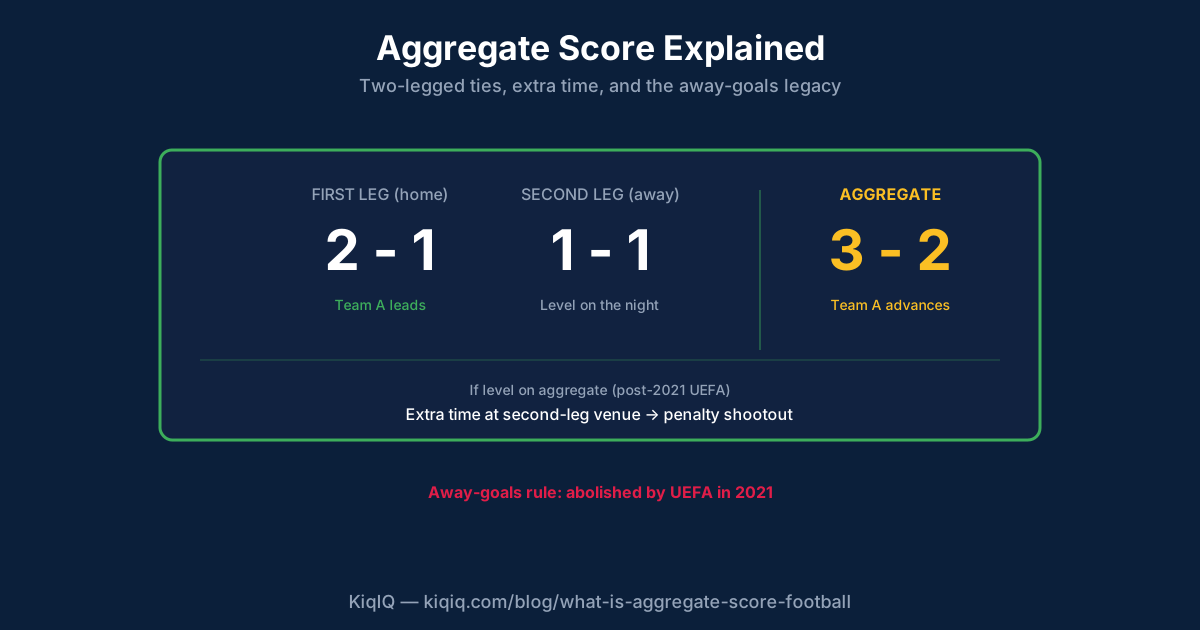
Aggregate score is the combined score across two legs of a knockout tie, used to determine which team advances. If both legs end with the same combined goals (for example, 2-1 in the first leg and 1-2 in the second), the tie is level on aggregate and proceeds to extra time and then penalties. The away-goals rule, which used to break level ties in favour of the team that scored more away from home, was abolished by UEFA in 2021.
How aggregate scores work
A two-legged tie consists of one match at each team's home ground, with the order of the two legs typically decided by the competition draw. The aggregate score is simply the sum of the two final scores: Team A wins 2-1 at home and loses 0-1 away, the aggregate is 2-2 with Team A having scored two and Team B having scored two. If the aggregate is uneven, the team with the higher total advances to the next round and the tie is over at the final whistle of the second leg.
If the aggregate is level at the end of the second leg, the tie used to be decided immediately by the away-goals rule. From 2021 onwards in UEFA competition (and from 2022 in CONMEBOL), level aggregates go to 30 minutes of extra time at the second-leg venue, and then a penalty shootout if extra time itself ends level. The second-leg host therefore has the structural advantage of playing the extra-time period at home, which is one of the reasons UEFA cited for abolishing the away-goals rule.
The aggregate ladder in modern UEFA competition: combined score over two legs, then 30 minutes of extra time, then a penalty shootout. Away goals no longer count double.
Try it
Work out a two-legged tie
Leg one is at Team A. Leg two is at Team B. Enter the four scorelines and see who progresses, under both the modern rule and the old away-goals rule.
Aggregate score, Team A to Team B
3 - 3
Level on aggregate. UEFA scrapped the away-goals rule in 2021, so this tie now goes to extra time and, if needed, penalties. Historically it was level on away goals too, so the tie goes to extra time and penalties.
Try 2-1 then 2-1 to see the tie that used to be settled by away goals and now goes to extra time.
The away-goals rule and why UEFA dropped it
The away-goals rule was introduced by UEFA in 1965 to encourage attacking football away from home and to reduce the number of replays needed at neutral venues. The rule stated that if the aggregate score was level after both legs, the team that had scored more goals away from home advanced. If away goals were also equal, the tie went to extra time, and away goals scored in extra time counted at higher value than home goals.
UEFA's Football Committee voted unanimously to abolish the rule in June 2021, citing two main arguments. First, the original rationale (away travel was difficult, fans rarely travelled, away teams played defensively) was outdated: travel and ticketing had transformed since 1965, and away sides increasingly tried to win matches outright. Second, the rule perversely discouraged scoring in the first leg at home, because a 0-0 home leg was tactically equivalent to a 1-1 home leg under the away-goals weighting. The 2021-22 Champions League was the first major UEFA competition without the rule, and the 2022-23 final between Manchester City and Inter Milan was a direct beneficiary of the cleaner format.
Extra time, golden goal and silver goal
Extra time is two periods of 15 minutes added to the end of a knockout match (or, in two-legged ties, to the end of the second leg) when the score is level after 90 minutes. The current IFAB rules require both 15-minute periods to be played in full regardless of when goals are scored: the team in the lead at the end of the second 15 minutes wins. Penalty shootouts follow only if extra time itself ends level.
The golden-goal rule, used at the 1998 and 2002 World Cups and Euro 1996 and Euro 2000, allowed the first team to score in extra time to win the match immediately. It was scrapped by IFAB in 2004 on the grounds that it encouraged defensive play in extra time and produced too many shootouts despite its original intent to reduce them. The silver-goal rule, briefly trialled at Euro 2004, ended extra time at the first half-time break if one team led: also scrapped, on the same grounds.
- 1965-2021. Away-goals rule active in UEFA competition. Goals scored away counted double in the event of an aggregate tie.
- 2021. UEFA abolish the away-goals rule for all competitions from the qualifying rounds onwards.
- Extra time. Two 15-minute halves at the second-leg venue. Played in full; no golden goal.
- Penalty shootout. Five rounds of penalties, then sudden death. The team with more conversions wins.
Where the away-goals rule still applies
UEFA scrapped the rule, but not every confederation has followed. CONMEBOL (the South American confederation) maintained the away-goals rule through 2021 and then abolished it for the 2022 Copa Libertadores onwards, aligning with the European reform. CAF (Africa) and AFC (Asia) have continued to apply some form of the rule in their continental competitions through 2024, with periodic reviews. CONCACAF dropped the rule from the Champions Cup in 2018.
Domestic cup competitions are a separate question. The League Cup in England is single-leg from the quarter-finals onwards, so the rule never applied. The Copa del Rey in Spain went single-leg in 2019. The Coppa Italia is single-leg throughout. The major remaining two-legged domestic competition in the top European tier is the German DFB-Pokal semi-final, which has historically been single-leg. In practice, the away-goals rule today is mostly a CAF and AFC concern.
| Confederation / competition | Away-goals rule | Since |
|---|---|---|
| UEFA (Champions League, Europa, Conference) | Abolished | 2021-22 |
| CONMEBOL (Copa Libertadores) | Abolished | 2022 |
| CONCACAF (Champions Cup) | Abolished | 2018 |
| CAF (Africa) | Still applied in some competitions | Through 2024 |
| AFC (Asia) | Still applied in some competitions | Through 2024 |
How aggregate ties used to swing on a single goal
The most famous away-goals-rule swing was Barcelona's 6-1 second-leg win over Paris Saint-Germain in March 2017, overturning a 4-0 first-leg deficit on aggregate 6-5. PSG's single away goal in the second leg would have been decisive under the rule had Barcelona not scored late: Sergi Roberto's 95th-minute goal made it 6-1 on the night, eliminating the away-goal arithmetic and sending Barcelona through outright.
Manchester City's elimination by Tottenham in the 2018-19 Champions League quarter-final ran the other way: a 4-3 second-leg win at the Etihad left both legs aggregate-level at 4-4, with Tottenham advancing on three away goals to one. That tie is sometimes cited as the marquee case for abolishing the rule, because the City side that won the home match outscored the visiting side and still went out on a tiebreaker. With the post-2021 rule, the same scoreline would have gone to extra time at the Etihad.
Frequently asked questions
- What is the aggregate score in football?
- Aggregate score is the combined score across two legs of a knockout tie. If Team A wins 2-1 at home and loses 1-2 away, the aggregate is 3-3 and the tie is level. If aggregates are uneven, the team with the higher total advances. If level, the tie goes to extra time at the second-leg venue and then a penalty shootout if needed.
- When did UEFA abolish the away-goals rule?
- UEFA's Football Committee voted unanimously to abolish the away-goals rule in June 2021, with effect from the 2021-22 season qualifying rounds onwards. The rule had been in place since 1965. CONMEBOL followed for the 2022 Copa Libertadores. CAF and AFC have continued to apply some version of the rule in their continental competitions.
- What happens if a two-legged tie is level on aggregate?
- In UEFA competition since 2021, the second leg goes to 30 minutes of extra time at the home of the team hosting that leg, played in full as two 15-minute halves. If extra time ends level, the tie is decided by a penalty shootout. Away goals are no longer used as a tiebreaker in UEFA competition.
- Why was the away-goals rule scrapped?
- UEFA cited two reasons. First, the original 1965 rationale (difficult travel, defensive away teams) was outdated. Second, the rule discouraged scoring in the first leg at home, because a 0-0 home leg was tactically equivalent to a 1-1 home leg under the away-goals weighting. Manchester City's 2019 elimination by Tottenham on away goals was a marquee case.
- Does the away-goals rule still apply anywhere?
- It is no longer used in UEFA competitions (since 2021-22) or CONMEBOL competitions (since 2022). CAF and AFC continue to apply some form of the rule in their continental knockout competitions through 2024, with periodic reviews. Most domestic cups are now single-leg from the quarter-finals onwards, which makes the question moot.
References
- UEFA: abolition of the away-goals rule announcement · UEFA (jun 2021)
- IFAB Laws of the Game: extra time and penalty shootouts · International Football Association Board
- The Athletic: why UEFA scrapped the away-goals rule · The Athletic (jun 2021)
- BBC Sport: explainer on the away-goals rule abolition · BBC Sport (jun 2021)
- FIFA: archive of golden-goal and silver-goal usage · FIFA
Ask KiqIQ a follow-up
Get a live, data-driven answer powered by our live data feeds + KiqIQ's Poisson model. Try one of these prompts or write your own.
Part of pillar
Fundamentals
See every article in this knowledge pillar →
Related
Reviewed by a KiqIQ editor before publication. Spotted an error? Email editor@kiqiq.com. We follow our Corrections Policy.