
What Is Stoppage Time in Football? How the Referee Calculates It
Stoppage time is the extra minutes added at the end of each half to compensate for delays. We explain how the fourth official calculates it, what counts, and why injury time has grown sharply since 2022.
 Tap to enlarge
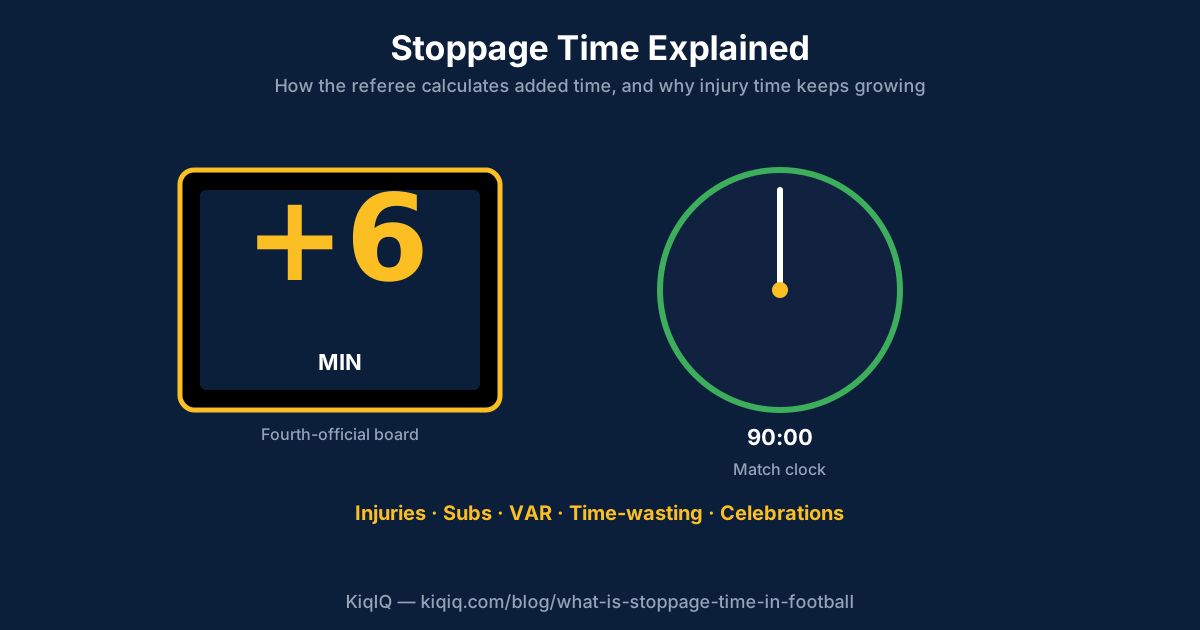
Stoppage time, also called injury time or added time, is the extra period at the end of each half added by the referee to compensate for time the ball was not in play. It is announced by the fourth official via an electronic board roughly thirty seconds before the regulation 45 or 90 minutes elapse, but it is not a hard cap: the referee is entitled to add more time during stoppage time itself if further delays occur. Since FIFA's directive at the 2022 World Cup in Qatar, average stoppage time in elite men's football has roughly doubled, with eight to twelve minutes now common at the end of a half.
What the laws of the game actually say
Law 7 of the IFAB Laws of the Game covers the duration of the match. The relevant clause states that the referee must add time at the end of each half to compensate for time lost during that half through substitutions, assessment or removal of injured players, wasting time, disciplinary sanctions, medical stoppages, drinks breaks, VAR checks and reviews, goal celebrations, and any other cause. The clause is deliberately open-ended: the referee has sole discretion over how much time to add and is not required to publish a minute-by-minute accounting.
The fourth official displays a minimum figure on the electronic board, but the referee can extend that figure if delays occur during stoppage time itself. A goal scored in the 92nd minute of a 4-minute stoppage may add a further 60-90 seconds for the celebration and restart. A VAR check during stoppage time will add the duration of the check. The board figure is therefore best understood as a minimum, not a maximum (IFAB Laws of the Game, Law 7).
The fourth official's board shows the minimum stoppage time, not the total. Further delays during stoppage time itself extend the half. Referees are not required to publish a minute-by-minute accounting.
What counts and how it is calculated in practice
In practice, the referee or the fourth official tracks delays in real time during the half. The mental model used in elite matches is roughly: 30 seconds per substitution, 60-90 seconds per goal celebration, the duration of the actual VAR review for any VAR check, 60-180 seconds for any serious injury treated on the pitch, and a discretionary amount for repeated time-wasting. These figures are guidelines rather than mandates, and the referee can adjust them based on circumstances. PGMOL, the body running professional referees in England, has published broadly similar internal guidance.
The major change since 2022 is the FIFA directive at the men's World Cup in Qatar, which instructed referees to add the actual time lost rather than the historical convention of 3-5 minutes regardless of delays. Match averages at Qatar 2022 ran above 10 minutes of stoppage time per match compared to roughly 6 minutes at Russia 2018, and the directive has since been carried over to UEFA competitions and to most domestic leagues. The Premier League stoppage-time average rose from roughly 4.5 minutes per half in 2021-22 to roughly 7-8 minutes per half in 2022-23, the largest single-season change in the modern era (Opta, Premier League stoppage-time data 2022-23).
Try it
Estimate the added time
Feed in the delays from a half and see roughly what the fourth official would put on the board.
Estimated minimum added time
9 min
Guideline maths: 30 seconds a substitution, 60-90 seconds a goal celebration, the full length of any VAR review, 60-180 seconds for a serious injury. The board shows a minimum, so the real figure is usually higher.
These are the guideline durations elite referees work to, not a formula in the Laws. The referee has full discretion and can extend the half further if delays continue during added time itself.
Why the increase happened and what it changed
The motivation behind the FIFA directive was a long-running concern that effective playing time, the period the ball is actually in play, had been declining across European leagues. Multiple studies put the effective playing time at around 55-58 minutes of the 90-minute clock by the late 2010s, with the gap absorbed by goal celebrations, substitution delays and routine time-wasting (UEFA technical reports). By directing referees to add the actual time lost, FIFA aimed to push the effective playing time closer to 60 minutes without changing the underlying match duration.
The downstream effects have been significant. Cardiff University's sports-science group, alongside multiple club performance departments, has noted that the longer halves measurably increase total player load, particularly in the final ten minutes of stoppage time, with high-speed running distance and acute-chronic workload exposure rising relative to pre-2022 norms. The Professional Footballers' Association raised concerns about injury risk during the 2023-24 season. From a tactical perspective, the longer stoppage windows have changed late-game management, with sides leading by a single goal facing far longer defensive periods than under the old convention.
How stoppage time differs from extra time
Stoppage time and extra time are different. Stoppage time is the added period at the end of each regular half (after 45 minutes in the first half, after 90 minutes in the second half) to compensate for delays. Extra time is two additional 15-minute halves played at the end of a 90-minute knockout match that finishes level, used in cup ties to determine a winner before a penalty shootout. Each half of extra time has its own stoppage time at the end.
A drawn knockout fixture therefore typically runs 90 minutes plus first-half stoppage and second-half stoppage, then 30 minutes of extra time plus stoppage time in each half of extra time, then potentially a penalty shootout. The full clock duration of a tie like that can run beyond 130 minutes, which is why match scheduling in cup competitions allows a 150-minute window per fixture.
- What counts toward stoppage time. Substitutions, goal celebrations, VAR checks, injury treatment, time-wasting, disciplinary sanctions, drinks breaks.
- Who decides. The referee. The fourth official's board shows the minimum; the referee can extend it during stoppage time itself.
- Typical durations. First half: 1-5 minutes. Second half: 4-12 minutes post-2022, was typically 2-5 minutes pre-2022.
- Different from extra time. Stoppage time = added to a regular half. Extra time = two 15-minute halves at the end of a level knockout fixture.
Quick question
The number on the fourth official's board is best understood as what?
Why injury time has changed name three times
The British convention used "injury time" for decades, on the assumption that injuries were the dominant source of delay. IFAB and FIFA prefer "additional time" or "added time" as the technically correct term, recognising that delays come from many causes, not just injuries. "Stoppage time" is the American English variant. All three refer to the same thing under Law 7.
Broadcasters and pundits use the terms interchangeably, but the IFAB Laws of the Game and UEFA documentation have standardised on "additional time" since around 2019. The fourth official's electronic board displays a number with no label, leaving the terminology to the broadcast team. For consistency with British football convention, "stoppage time" remains the most widely used term in the UK and Ireland press and the most-searched form on UK search engines.
Frequently asked questions
- How is stoppage time calculated in football?
- The referee tracks delays in real time during each half: roughly 30 seconds per substitution, 60-90 seconds per goal celebration, the duration of any VAR check, 60-180 seconds per serious injury, and a discretionary amount for time-wasting. The fourth official displays the minimum figure on an electronic board, but the referee can extend it during stoppage time itself if further delays occur.
- Why is there so much stoppage time now?
- FIFA directed referees at the 2022 World Cup in Qatar to add the actual time lost rather than the historical convention of 3-5 minutes regardless of delays. The directive aimed to push effective playing time closer to 60 minutes of the 90-minute clock. UEFA and most domestic leagues including the Premier League adopted the same approach in 2022-23.
- What is the difference between stoppage time and injury time?
- They are the same thing under different names. "Injury time" is the older British term, "additional time" or "added time" is the IFAB technical term, and "stoppage time" is the American English variant. All refer to the period added at the end of each half by the referee under Law 7 of the IFAB Laws of the Game.
- Can a referee end a match before the announced stoppage time?
- No. The referee can extend stoppage time if delays continue, but cannot shorten it below the announced figure. Law 7 requires the referee to allow the full duration of added time. The exception is if the ball is in a clear scoring position at the moment the announced time elapses, in which case the referee will typically allow the phase of play to conclude.
- What is the longest stoppage time ever in football?
- Stoppage time of over 20 minutes was recorded in several 2022 World Cup matches in Qatar, with the England vs Iran group game producing 27 minutes across both halves. Individual halves of 14-18 minutes are now occasionally seen in the Premier League and Champions League when VAR reviews, multiple injuries and substitutions accumulate in a single half.
References
- IFAB Laws of the Game, Law 7: The Duration of the Match · IFAB
- FIFA: 2022 World Cup referee directives on added time · FIFA
- The Athletic: Why stoppage time has grown so much · The Athletic
- Opta: Premier League stoppage-time data 2022-23 · The Analyst (Opta)
- UEFA technical reports on effective playing time · UEFA
Key terms in this article
Ask KiqIQ a follow-up
Get a live, data-driven answer powered by our live data feeds + KiqIQ's Poisson model. Try one of these prompts or write your own.
Part of pillar
Fundamentals
See every article in this knowledge pillar →
Related
Reviewed by a KiqIQ editor before publication. Spotted an error? Email editor@kiqiq.com. We follow our Corrections Policy.