
Rangers Football Club, History, Ibrox, 2012, Old Firm
Rangers Football Club, founded in 1872 by four Glasgow teenagers, plays at the 50,817-capacity Ibrox Stadium in Govan, Glasgow. Joint-record holders of the Scottish league title with Celtic, winners of the 1972 European Cup Winners' Cup, contestants of the Old Firm derby, and the club at the centre of Scottish football's most consequential financial crisis in 2012.
 Tap to enlarge
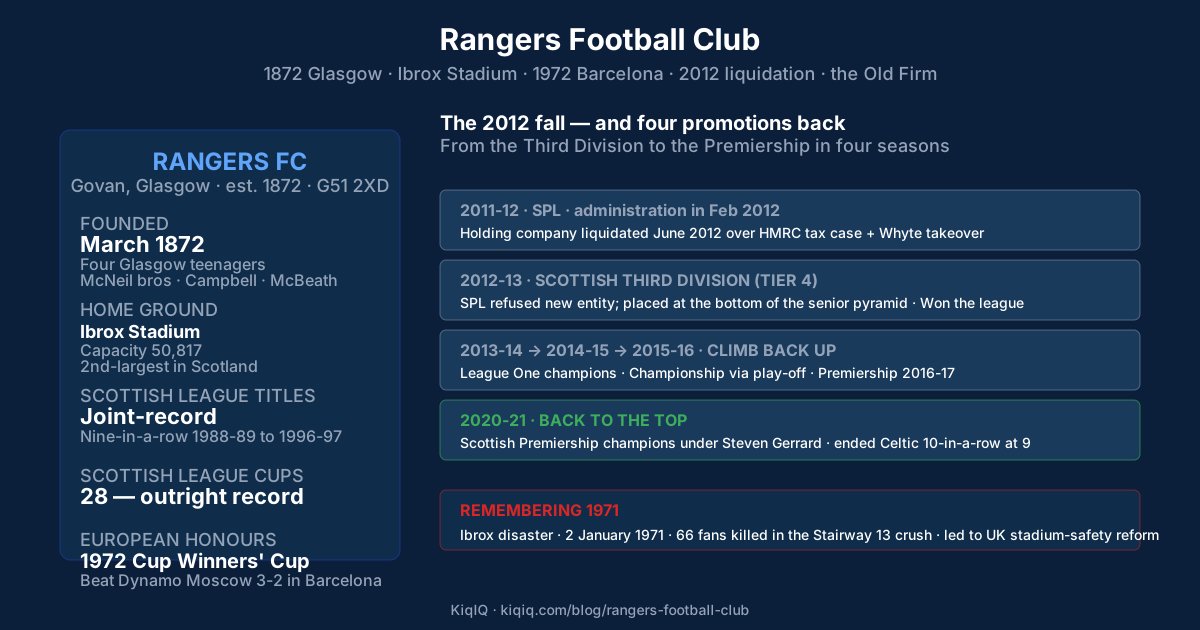
Rangers Football Club is a professional football club based in Govan, Glasgow, Scotland, founded in 1872 by four teenage friends, Peter Campbell, William McBeath, and brothers Peter and Moses McNeil. Rangers play home matches at Ibrox Stadium (capacity 50,817), are joint-record holders of the Scottish league title with Celtic, won the 1972 European Cup Winners' Cup, and famously were liquidated in 2012 following a tax-tribunal verdict and ownership crisis, re-entering Scottish football's bottom tier and climbing back to the Premiership over four seasons.
Where is Rangers Football Club
Rangers play their home matches at Ibrox Stadium on Edmiston Drive in the Govan district on the south bank of the River Clyde in Glasgow (G51 2XD). Ibrox has a capacity of 50,817 and is the second-largest football stadium in Scotland, behind Celtic Park (60,411).
Ibrox is roughly two miles south-west of Glasgow city centre and is served by Ibrox subway station (Glasgow Subway, ~5 minutes' walk to the stadium) and by frequent buses along Paisley Road West. The current Ibrox has been Rangers' home since 1899, though the ground has been substantially rebuilt, most significantly the 1980s reconstruction under chairman David Murray that produced today's bowl-style stadium.
Ibrox Stadium · capacity 50,817 · second-largest football stadium in Scotland · home of Rangers since 1899.
An 1872 founding: four Glasgow teenagers
Rangers was founded in March 1872 by four teenagers rowing on the River Clyde: brothers Peter and Moses McNeil, Peter Campbell, and William McBeath. The McNeil brothers had been playing pickup football on Glasgow Green; the group decided to formalise a club. Moses McNeil is generally credited with suggesting the name 'Rangers', taken from a borrowed English rugby club's title.
Rangers played their first competitive match in May 1872: a 0-0 draw against Callander on Flesher's Haugh on Glasgow Green. The club moved through several early grounds before settling on the Ibrox area in 1887, then to the current Ibrox site in 1899 after a Celtic Park-style expansion programme was deemed structurally unsound. The 1899 Ibrox is broadly the footprint of today's stadium.
Quick question
Who founded Rangers in 1872?
Scottish league titles: joint-record
Rangers are tied with Celtic for the most Scottish league titles in history. The exact count varies depending on whether you treat Rangers' post-2012 re-entry from the Third Division as continuous club history (the SFA does; some accounting disputes whether the post-liquidation entity is the 'same' club). Under the SFA's continuity recognition, Rangers and Celtic are joint top of the Scottish league honours board.
- Nine-in-a-row, 1988-89 to 1996-97: Rangers won nine consecutive Scottish Premier Division titles under Graeme Souness and Walter Smith. Equal to Celtic's 1965-66 to 1973-74 record and never bettered by either club.
- Scottish Cup: 34 wins.
- Scottish League Cup: 28 wins (Rangers hold the record outright in this competition).
- Unbeaten league season: 1898-99, when Rangers won all 18 matches of the league campaign. That perfect record is unique in top-tier British football history.
European success, the 1972 Cup Winners' Cup
Rangers' major European honour is the 1971-72 European Cup Winners' Cup, won on 24 May 1972 at the Camp Nou in Barcelona. The opponents were Dynamo Moscow; Rangers won 3-2 with goals from Colin Stein and a Willie Johnston brace.
The trophy presentation never happened on the pitch. Rangers supporters had streamed onto the pitch at full-time, the match coincided with the political tension of a Soviet team in Spain, and pitch-side security collapsed in the celebrations. UEFA presented the trophy in the dressing room afterwards. Rangers received a one-year European ban for the crowd-control failure (later reduced to one year and to home-ground matches only).
Beyond the 1972 Cup Winners' Cup, Rangers' best European runs include the 1960-61 Cup Winners' Cup final (lost to Fiorentina), the 1966-67 Cup Winners' Cup final (lost to Bayern Munich), and the 2007-08 UEFA Cup final (lost to Zenit Saint Petersburg in Manchester).
The 2012 financial crisis and liquidation
Rangers' modern history is dominated by the 2012 financial crisis. The crisis had two components: a long-running dispute with HM Revenue & Customs over the club's use of Employee Benefit Trusts (EBTs) to pay player wages while reducing income-tax liability, and the 2011 acquisition of the club by Craig Whyte under terms that proved unsustainable.
By February 2012 Rangers had entered administration. The club's debts and HMRC tax assessment were too large for any incoming buyer to absorb. In June 2012 the holding company that operated Rangers was placed into liquidation. A new company (Sevco Scotland Ltd, later The Rangers Football Club Ltd) bought the club's assets and applied for SPL membership. The SPL clubs (by 10-1 vote) refused to admit the new entity; the SFA also refused a Division One placement; the Scottish Football League placed the club in the Third Division (the fourth tier).
Rangers played the 2012-13 season in the Scottish Third Division, the bottom of the senior Scottish pyramid. The club won that division and the Second Division the following season, then promotion via the Championship play-offs in 2015-16, and was back in the Premiership for 2016-17: four seasons from the bottom to the top. The 2020-21 Premiership title under Steven Gerrard ended Celtic's 10-in-a-row attempt at 9.
The UK Supreme Court ultimately ruled against Rangers on the EBT case in 2017, confirming HMRC's tax assessment was correct. The financial-history aspect of the case continues to be litigated by various creditors of the original company.
The 1971 Ibrox disaster
Rangers' most significant non-footballing chapter is the 2 January 1971 Ibrox disaster. After an Old Firm derby (a 1-1 draw, with Colin Stein equalising in the final minute), departing supporters collapsed on Stairway 13 at the south-east corner of the ground. Sixty-six fans died in a crush; over 200 were injured.
The disaster prompted the Wheatley Report (1972) into stadium safety, the Safety of Sports Grounds Act 1975, and ultimately (combined with the later 1985 Bradford fire and 1989 Hillsborough disaster) the Taylor Report that mandated all-seater top-flight stadiums in Britain.
Rangers commissioned a comprehensive Ibrox redevelopment after the 1971 disaster, completing the modern bowl-style stadium in the 1980s under David Murray. A statue of John Greig (then Rangers captain) outside the Bill Struth Main Stand commemorates the 66 victims; an annual memorial service is held at the disaster site each January.
The Old Firm: Rangers vs Celtic
Rangers' deepest rivalry is the Old Firm derby with Celtic, contested since 1888 (Celtic's first competitive match was a 5-2 loss to Rangers). The two Glasgow clubs have met over 425 times in competitive football, Scotland's longest-running derby and one of the most-watched fixtures in world football.
Rangers historically represents Glasgow's Scottish-Protestant heritage; Celtic historically represents the city's Irish-Catholic immigrant heritage. Both clubs have made sustained public efforts to move beyond sectarianism in their stands, but the cultural roots of the rivalry remain part of the fixture's identity. UEFA and the Scottish FA have intermittently sanctioned both clubs over sectarian chanting; both publicly distance themselves from it.
All-time competitive head-to-head sits very close to even. The 2012 liquidation produced a four-season gap in Old Firm fixtures (2012-2016) while Rangers climbed back to the Premiership. Old Firm fixtures since 2016-17 have been competitive and high-profile, with the title trading back and forth between the two clubs in successive seasons.
Honours and notable history
Beyond the headline trophies, Rangers carry several distinctions worth noting:
- Scottish League Cup record: 28 wins, the most of any club in the competition's history.
- Perfect league season: 1898-99: 18 played, 18 won, no draws, no losses. The only club to manage a 100% record over a complete top-tier league season in British football history.
- Souness revolution (1986-1991): under player-manager Graeme Souness, Rangers signed major English internationals (Terry Butcher, Chris Woods, Trevor Steven) and broke the Scottish-Protestant-only signing convention with the 1989 transfer of former Celtic forward Maurice Johnston. Souness's tenure transformed the financial and recruitment scale of Scottish football.
- Walter Smith era: manager in two spells (1991-98 and 2007-11), winning 10 league titles between them and taking Rangers to the 2008 UEFA Cup final.
- Steven Gerrard 2020-21: first league title since the 2012 liquidation, ending Celtic's nine-in-a-row at 9.
How to visit Ibrox
Three practical visit tips:
- Subway. Ibrox station is on the Glasgow Subway and sits about 5 minutes' walk from the Bill Struth Main Stand. The subway runs in a circle around central Glasgow; from Glasgow Central, walk to St Enoch subway station (~5 minutes) and the journey is ~10 minutes from there.
- Match-day demand. Like Celtic Park, Ibrox runs at near-capacity for most Premiership and European fixtures. Season tickets are sold to a long waiting list; individual fixtures (especially Old Firm and Champions League nights) sell out via the membership scheme.
- Tour Ibrox. The Ibrox Stadium Tour visits the Trophy Room, the home and away dressing rooms, the tunnel, and the Bill Struth Main Stand (Grade-A listed). The Rangers Football Club Museum sits within the tour route and holds the 1972 Cup Winners' Cup and other historical memorabilia.
Frequently asked questions
- Where is Rangers Football Club based?
- Rangers Football Club plays home matches at Ibrox Stadium on Edmiston Drive in the Govan district of Glasgow, Scotland (G51 2XD). Ibrox has a capacity of 50,817 and is the second-largest football stadium in Scotland, behind Celtic Park. The stadium has been Rangers' home since 1899 and is served by Ibrox subway station on the Glasgow Subway, roughly 5 minutes' walk from the Bill Struth Main Stand.
- When was Rangers Football Club founded?
- Rangers Football Club was founded in March 1872 by four teenage friends: brothers Peter and Moses McNeil, Peter Campbell, and William McBeath. The group had been playing pickup football on Glasgow Green and decided to formalise a club. Moses McNeil is credited with suggesting the name 'Rangers' from a borrowed English rugby club's title. Rangers played their first competitive match in May 1872, a 0-0 draw against Callander on Glasgow Green.
- What happened to Rangers in 2012?
- In February 2012 Rangers entered administration over a long-running tax dispute with HMRC over Employee Benefit Trust payments and unsustainable financial terms under owner Craig Whyte. In June 2012 the holding company was liquidated. A new company bought the club's assets but was refused entry to the Scottish Premier League and was placed in the Scottish Third Division (fourth tier). Rangers won four promotions in four seasons to return to the Premiership in 2016-17. The UK Supreme Court ultimately ruled against Rangers on the EBT tax case in 2017.
- What was the Ibrox disaster?
- The Ibrox disaster occurred on 2 January 1971, after an Old Firm derby (1-1) between Rangers and Celtic. Departing supporters collapsed in a crush on Stairway 13 at the south-east corner of Ibrox. Sixty-six fans died and over 200 were injured. The disaster led directly to the 1972 Wheatley Report on stadium safety, the Safety of Sports Grounds Act 1975, and contributed to the later Taylor Report (1990) that mandated all-seater top-flight stadiums in Britain. An annual memorial service is held at the disaster site.
- What major European trophy have Rangers won?
- Rangers won the 1971-72 European Cup Winners' Cup, beating Dynamo Moscow 3-2 in the final on 24 May 1972 at Camp Nou in Barcelona. Colin Stein and a Willie Johnston brace scored the Rangers goals. Pitch invasions by Rangers supporters at full-time prevented an on-pitch trophy presentation; UEFA presented the cup in the dressing room afterwards. Rangers received a one-year European ban for the crowd-control failure. Rangers have also reached the 1961, 1967 and 2008 European finals, losing each.
References
- Rangers FC, Official Site · Rangers FC
- SPFL, Rangers club page · Scottish Professional Football League
- BBC Sport, Rangers coverage archive · BBC Sport
- UEFA, 1971-72 Cup Winners' Cup history · UEFA
- Historical Scottish League Tables, RSSSF · RSSSF
Key terms in this article
Ask KiqIQ a follow-up
Get a live, data-driven answer powered by our live data feeds + KiqIQ's Poisson model. Try one of these prompts or write your own.
Part of pillar
Football Culture
See every article in this knowledge pillar →
Related
Reviewed by a KiqIQ editor before publication. Spotted an error? Email editor@kiqiq.com. We follow our Corrections Policy.