
How Premier League Prize Money Works: TV Share, Merit, and Facility Fees
A mechanics-first guide to Premier League prize money: equal TV share, merit ladder, facility fees, international pool, parachute compounding, and why finishing top six is worth so much more than mid-table.
 Tap to enlarge
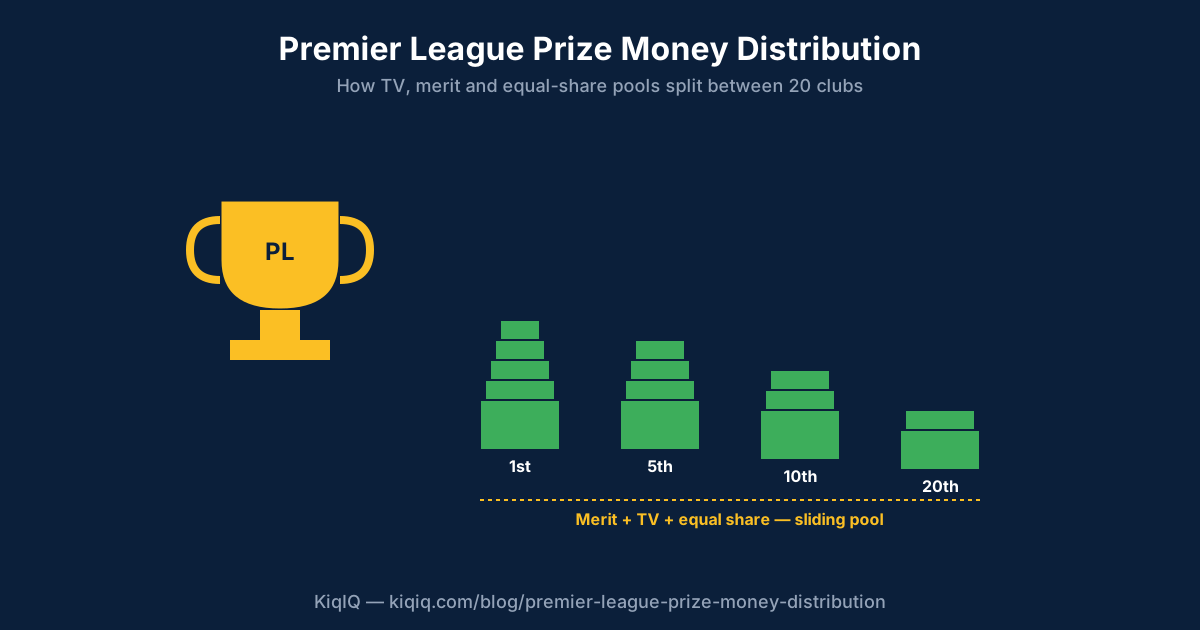
The Premier League does not pay prize money in the simple "1st gets this, 2nd gets that" sense most fans imagine. It pays out a structured share of three different revenue pools (UK domestic TV, international TV, and central commercial) through four mechanical components. Two are flat across all 20 clubs, two scale with league position and TV exposure. Across the 2024-25 monitoring season, central distributions totalled around £1.64bn against 20 clubs, with the published top-to-bottom ratio sitting near 1.6:1 (Premier League, 2024). The arithmetic explains why finishing 5th is worth materially more than finishing 12th once facility fees and parachute-payment exposure compound.
The four-component formula at a glance
Premier League central distributions are governed by a formula written into the league shareholder agreement and described in the published annual handbook (Premier League, 2024). The mechanics break into four buckets. The first is the equal share of the UK domestic broadcast pool, distributed identically across all 20 clubs. For the 2024-25 season this component sat at roughly £33m per club. The second is the merit payment, a sliding ladder where the champion banks 20 shares and the bottom club banks one, with each share worth approximately £3.2m for the season just completed.
The third is the facility fee, paid per UK live broadcast appearance above a floor of ten guaranteed picks. Each televised appearance is worth roughly £1.0m to £1.2m to the club involved, with top-six sides routinely picking up 25 or more appearances a season and the bottom three rarely clearing the floor. The fourth is the equal share of the international broadcast pool, again split identically across all 20 clubs and sitting around £55m per club for 2024-25 (BBC Sport, 2024). A small central commercial bucket from league-level sponsors tops up the total by a few million per club, evenly divided.
Two components (equal share domestic + international pool) are flat across all 20 clubs at roughly £88m a season combined. Two components (merit + facility fees) scale with where the club finishes and how often it is televised.
Why the merit ladder is linear, and what that does to incentives
The merit ladder pays the champion 20 shares and the bottom club one, in single-share increments. There is no diminishing return at the bottom of the table, and no acceleration at the top. The gap between 17th and 18th is exactly the gap between 1st and 2nd: one share, approximately £3.2m. That structure is unusual by European standards. La Liga, in its pre-collective-bargaining era, operated closer to a 4:1 top-to-bottom ratio with much steeper falls outside the top two. The Premier League ratio of around 1.6:1 across the central distribution is the product of the linear merit ladder combined with the two flat equal-share components stacked underneath it.
The linear ladder has direct in-season consequences. A team sitting 14th in early May faces every-position-matters incentives all the way to the bottom of the table, because climbing one place banks the same £3.2m as climbing from 2nd to 1st. The "Survival Sunday" fixture set is loaded for the same reason: not only does dropping out of the top flight forfeit roughly £88m of next-season equal-share buckets, but the merit-bucket difference between 17th and 18th sits on top. The cumulative value of staying up versus going down, parachute payments notwithstanding, was independently valued at around £100m in present-value terms across a typical season (The Athletic, 2024).
Quick question
What does a linear merit ladder mean for a club sitting 14th in May?
Facility fees and why a Champions League finish compounds
Facility fees are the component most often overlooked in public commentary about Premier League prize money. The mechanic is straightforward: each time a club is selected for UK live broadcast (Sky, TNT, Amazon for the prior cycle), the club banks an appearance fee somewhere in the £1.0m to £1.2m range. There is a guaranteed floor of ten appearances for every club. Above that, broadcaster pick orders favour clubs with higher domestic audience pull, which in practice means the top six plus whichever side is in the title hunt or relegation battle that month.
For a typical top-six side picking up 25 to 28 UK live appearances a season, facility-fee revenue runs in the £25m to £33m range. For a typical mid-table side at the broadcast floor with 10 to 12 appearances, the same line sits at £10m to £14m. The £15m-to-£20m differential is consequential on its own. It also compounds with the merit ladder, because the same clubs that pick up the most televised appearances are typically the ones banking the most merit shares.
Now layer Champions League finishing on top. UEFA pays a league-phase entrant approximately €18.6m in starting fees plus performance payments per win and a market-pool share scaled to the value of the UK domestic broadcast market (UEFA, 2024). For an English club in the league phase, the UK market-pool weighting produces one of the largest single-market shares in European football. A deep run can add €40m to €80m of UEFA prize money on top of Premier League central distributions. Once you add merit (top-six bracket), facility fees (high-pick volume), and Champions League entry, the financial gap between finishing 5th and finishing 7th in a Premier League season is comfortably over £10m a season, and over £20m in years where the 5th-placed side reaches a Champions League quarter-final.
Parachute payments: the cliff-edge engineered into the bottom of the table
Relegation collapses a club from a £110m-plus central distribution to roughly £8m to £10m of EFL central distributions in the Championship. The parachute payment system is the league's structural answer to that cliff. The published structure pays a relegated club approximately 55% of the equal-share UK domestic baseline in year one after relegation, 45% in year two, and 20% in year three (Premier League Handbook, 2024). Converted into 2024-25 figures, that produces roughly £49m, £40m and £18m across three seasons, a total parachute envelope of around £100m, payable in addition to Championship central distributions.
Parachute payments are the single largest financial advantage in Championship football. A parachute-receiving side typically operates on a revenue base several times that of a non-parachute Championship rival, which inflates the wage market across the division. Brighton, Bournemouth, Brentford and Luton all reached the Premier League without parachute revenue at the start of their promotion seasons, but the structural advantage of recently-relegated sides in promotion races is visible in the data and has been challenged by the EFL on competitive-balance grounds (Deloitte Annual Review, 2024).
The compounding effect with the merit ladder is what makes the bottom of the Premier League so financially loaded. A club finishing 18th not only loses the £88m equal-share floor for the following season, it also moves from full facility-fee exposure to almost none, and gives up two further years of Premier League merit-bucket eligibility before parachute payments taper out.
- Equal share domestic. Roughly £33m per club, flat across all 20.
- International pool. Roughly £55m per club for 2024-25, also flat.
- Merit payment. Single-share ladder, approximately £3.2m per share, linear from 1st to 20th.
- Facility fees. Roughly £1.0m to £1.2m per UK live broadcast appearance, floor of ten.
- Parachute payments. Three-year taper at 55%, 45% and 20% of equal-share domestic baseline.
Worked example: a 6th-placed club vs a 13th-placed club
Take two hypothetical 2024-25 sides. Club A finishes 6th with 27 UK live broadcast appearances and qualifies for the Champions League league phase. Club B finishes 13th with 12 UK appearances and no European football. Equal-share components are identical: roughly £88m each, before merit or facility fees. Merit diverges: Club A banks 15 shares (around £48m), Club B banks 8 shares (around £25.6m). Facility fees diverge sharply: Club A picks up roughly £30m, Club B roughly £13m. Central commercial: identical at around £8.5m each.
Domestic central distributions before any European money: roughly £174m for Club A, roughly £135m for Club B. The structural gap is £39m, built almost entirely from merit and facility fees stacking. Layer Champions League prize money on top for Club A (a conservative £35m for league-phase entry with two wins) and the gap widens to £74m a season before any improvement in commercial sponsorship terms that typically accompany top-six finishes. That £74m differential against a single domestic mid-table neighbour is why the top-six bracket compounds: it both reflects sporting outcomes and reinforces the financial base that produces the next year's outcomes.
How the formula has evolved and where it might next move
The current formula is a product of the 1992 founding agreement and successive shareholder votes that have nudged distribution mechanics across cycles. The 2010s saw the international pool overtake domestic in growth terms, with international rights surpassing domestic for the first time during the 2019-22 cycle. The Premier League distributes the international pool equally, which has compressed the top-to-bottom ratio in real terms even as headline numbers have grown.
Two pressures are likely to shape the next iteration. The first is the EFL's long-running argument for solidarity payments to be restructured at a higher rate; the New Deal proposals tabled in 2023-24 sought a step-change in transfer of central revenue down the pyramid, with the Premier League so far holding to a counter-offer that protects parachute payments. The second is the independent regulator created by the Football Governance Act 2025, which is empowered to mediate where the league and the EFL cannot agree a financial-distribution settlement (UK Parliament, 2025). The mechanical components described above are robust to either outcome; the relative weights are exactly what is up for negotiation.
Frequently asked questions
- How does Premier League prize money work?
- Premier League central distributions are built from four mechanical components: an equal share of the UK domestic broadcast pool, a merit payment scaled by final league position, a facility fee paid per UK live broadcast appearance, and an equal share of the international broadcast pool. A small central commercial bucket tops up the total. Two components are flat across all 20 clubs; two scale with sporting performance and TV pick.
- How much is each merit-payment share worth?
- For the 2024-25 season, each merit share was worth approximately £3.2m. The champion banks 20 shares (around £64m), the bottom club banks 1 share (around £3.2m). The ladder is linear, with no diminishing return at the bottom or acceleration at the top, so every place climbed in the table is worth the same £3.2m.
- What are facility fees in the Premier League?
- Facility fees are appearance payments tied to UK live broadcast pick. Each televised match is worth approximately £1.0m to £1.2m to the club involved, with a guaranteed floor of ten appearances per club. Top-six clubs typically pick up 25 or more appearances a season, while clubs at the floor bank materially less. The component meaningfully widens the financial gap between top-six and mid-table.
- How do parachute payments compound with relegation?
- A relegated club receives approximately 55% of the equal-share UK domestic baseline in year one after relegation, 45% in year two and 20% in year three. Converted into 2024-25 figures that is roughly £49m, £40m and £18m, totalling around £100m across three seasons. The cushioning is substantial but the EFL has consistently argued it distorts Championship competitive balance.
- Why is a Champions League finish worth so much more than mid-table?
- Three sources of differential compound. UEFA league-phase entry pays approximately €18.6m in starting fees plus performance payments and a UK-weighted market-pool share. Top-six clubs simultaneously bank more merit shares and substantially higher facility-fee revenue. Across all three, the gap between a Champions League side and a mid-table neighbour clears £40m a season before commercial sponsorship terms are factored in.
References
- Premier League broadcast rights: 2025-28 cycle · Premier League
- Premier League Handbook: central distributions structure · Premier League
- UEFA Champions League: distribution to clubs · UEFA
- Premier League TV money: how the formula works · BBC Sport
- Annual Review of Football Finance 2024 · Deloitte Sports Business Group
- Survival Sunday: the £100m fixture · The Athletic
Key terms in this article
Ask KiqIQ a follow-up
Get a live, data-driven answer powered by our live data feeds + KiqIQ's Poisson model. Try one of these prompts or write your own.
Related
Reviewed by a KiqIQ editor before publication. Spotted an error? Email editor@kiqiq.com. We follow our Corrections Policy.