
How Football Clubs Make Money: The Revenue Model Explained
Broadcast, commercial, matchday and player trading. A walk-through of the four revenue lines every football club runs on, with current numbers from UEFA, Deloitte and the Premier League.
 Tap to enlarge
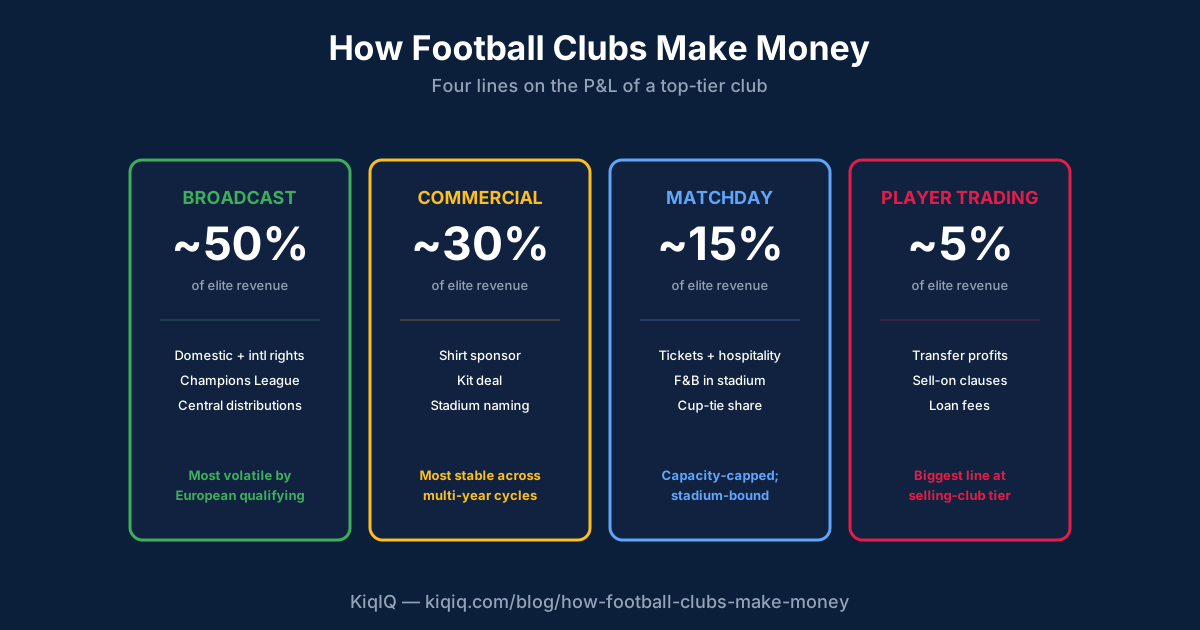
A football club's income statement is simpler than the noise around it suggests. Almost every professional club, from Real Madrid down to a League Two side fighting relegation, runs on four revenue lines: broadcast, commercial, matchday and player trading. The share each line contributes is where the differences sit. Deloitte's Football Money League 2026 puts aggregate top-20 revenue at €12.4 billion across the 2024-25 season, with commercial having just overtaken broadcast as the single largest source for the cohort. Walk down a division and the mix inverts. Walk down two and player trading often carries the model.
Broadcast: the biggest line for most professional clubs
Broadcast revenue is the share of domestic and continental TV rights paid through to a club. In England, the Premier League's 2025-28 domestic rights cycle is worth about £6.7 billion across three seasons (Sky, TNT, Amazon and the BBC), with international rights pushing the total package above £12 billion (Premier League, 2024). That pot is distributed using a three-part formula. Each club takes an equal share of the domestic baseline, a merit-payment share scaled by final league position, and a facility-fee share weighted by how often the club appears on UK live broadcast.
The arithmetic matters because it explains a structural feature of English football: even the bottom Premier League club banks somewhere in the region of £100m a season in central distributions, which is materially more than the top Championship club generates in total revenue. UEFA layers on top. A Champions League group stage entry alone is worth around €18.6 million in starting fees plus performance payments and a market-pool share (UEFA, 2024). For clubs at the European level, the broadcast line is the single biggest swing factor in their financial year.
Outside England, the same structure holds with weaker numbers. La Liga's domestic deal is roughly €1bn a season and distributes more evenly than English audiences sometimes assume. The Bundesliga is closer to €1.1bn a season. Serie A and Ligue 1 sit lower and are more volatile, with the French league's 2024 rights process forcing a downward reset that materially affected club budgets in the 2024-25 cycle.
Quick question
What is the largest revenue line for most professional clubs?
Commercial: sponsorship, kit and stadium estate
Commercial revenue covers shirt sponsorship, kit-supplier deals, training-ground naming, sleeve sponsors, regional partner activations, merchandising, museum and tour income, hospitality outside matchday, and non-football use of the stadium estate (concerts, conferences, retail). Most modern elite clubs treat the stadium as year-round commercial real estate and book the income against the commercial line rather than matchday.
Real Madrid's 2024-25 commercial revenue of roughly €594m, on its own, would place them inside the Money League top 10 (Deloitte, 2026). That figure reflects two structural choices: a rebuilt Bernabéu engineered for non-matchday yield, and a sponsorship architecture that sells region-specific partner slots rather than a single master shirt deal. At the group level, City Football Group's long-term Puma partnership is reportedly valued at around £650m across 13 clubs — leverage that no individual club in CFG's network could land standalone.
For clubs outside the European elite, commercial revenue is harder to scale. Shirt sponsorship and kit-supplier deals are usually the two biggest lines, and both are heavily influenced by recent on-pitch results, broadcast exposure and the geographic reach of the club's fanbase. A mid-table Premier League shirt deal sits in the £15m-£25m a season range. A top-six side commands multiples of that.
Across the 2024-25 Money League cohort, commercial revenue passed broadcast as the largest single source for the first time: €5.3 billion vs €4.7 billion. The shift reflects saturating domestic TV markets and clubs converting stadium estate into year-round income.
Matchday: the smallest line, but the most direct
Matchday revenue is what most fans picture when they think about club income, and at the elite level it is the smallest of the three primary lines. The 2024-25 Money League aggregate split was €5.3bn commercial, €4.7bn broadcast and €2.4bn matchday (Deloitte, 2026). Even at clubs with the strongest matchday brands, ticketing rarely accounts for more than a quarter of total revenue.
The composition matters as much as the headline. Hospitality and premium seating typically generate two to four times the per-seat yield of general admission, which is why every major stadium build of the last decade has expanded the hospitality footprint disproportionately. Tottenham's stadium, opened in 2019, was designed around exactly this maths and is the highest matchday-revenue venue in the Premier League per fixture.
Outside the elite, the picture inverts. For a League One or Championship club, matchday income (tickets, food and beverage, club-shop sales on a match Saturday) frequently sits at 30%-50% of revenue. The lower the broadcast share, the higher the relative importance of bums on seats. That dependency is why fixture congestion, kick-off scheduling and weather sensitivity hit lower-league P&Ls more visibly than they hit Premier League ones.
Player trading: the line that balances most P&Ls
Player trading sits in a different accounting bracket from the three operating revenue lines, but at most clubs below the European elite it is the single most important driver of whether the financial year closes in profit or loss. Profit on player sales is booked as the sale price minus the unamortised book value of the player at the date of sale. Because most transfer fees are amortised over the length of the player's contract, a young academy product sold for £30m can generate close to the full £30m as profit, while a £30m signing with two years left on a four-year deal generates £30m minus £15m of remaining book value.
The implication is structural. Selling clubs that produce academy graduates or sign at modest fees and develop on book the largest gains. Brighton's recent trading record (Cucurella, Caicedo, Mac Allister, Mitoma) generated the cumulative profit that funded squad investment and infrastructure, with limited reliance on owner cash injections. Benfica, Ajax and Porto run a similar model at the European level, where consistent six- to nine-figure outgoing fees offset modest broadcast share.
The Bosman ruling (1995) reshaped this line by removing transfer fees from out-of-contract players (Court of Justice of the European Union, 1995). Free agency at contract expiry means clubs that fail to sell or extend before the final 12 months lose the asset value entirely. Reading the financial accounts of clubs that consistently let contracts run down is reading the financial accounts of a player-trading model that has stopped working.
- Broadcast — domestic + continental TV rights distributed through league formulas. Equal share + merit + facility components.
- Commercial — shirt, kit, sleeve, naming rights, partnerships, retail, non-matchday stadium use.
- Matchday — tickets, hospitality, food and beverage, programme and in-stadium retail.
- Player trading — sale price minus unamortised book value, booked separately from operating revenue.
- UEFA prize money — Champions League / Europa League starting fees plus performance and market-pool payments, paid into the broadcast line.
Why the revenue mix changes the operating model
The proportions are not just accounting curiosities. They drive the strategic choices a club can make. A broadcast-heavy revenue base (typical of mid-table Premier League) is stable because central distributions are contractually fixed for the cycle, but the upside is capped at where the league's rights deal sits. A commercial-heavy base (Real Madrid, Manchester United historically) is scalable but tied to brand strength, which means a poor cycle of on-pitch results can compound through reduced sponsorship renewals as well as reduced merit income.
A player-trading-heavy base (Brighton, Benfica, Sporting CP) generates the highest variance: a single sale can swing the financial year by more than the entire commercial line, but the model relies on the recruitment and development pipeline producing reliably year on year. The clubs that survive ownership disputes, relegations and broader macro shocks tend to be the ones whose revenue mix has at least two healthy lines, not the ones leaning entirely on one.
Profit and Sustainability Rules (PSR) and UEFA's squad-cost ratio sit on top of all of this. The Premier League's current PSR threshold permits cumulative losses of £105m over three seasons, and recent decisions against Everton and Nottingham Forest demonstrated that breach penalties are real points deductions, not financial fines (Premier League, 2024). UEFA's squad-cost ratio caps player wages, transfers and agent fees at 70% of revenue from the 2025-26 season onwards. Both rules reward clubs with diversified revenue mixes and penalise clubs that scale spending faster than they scale income.
Frequently asked questions
- How do football clubs make most of their money?
- Four revenue lines: broadcast rights (the share of TV deals distributed by the league and by UEFA), commercial (shirt and kit deals, sponsorships, stadium estate), matchday (tickets and hospitality), and player trading (profit on sales). At elite level, commercial recently overtook broadcast as the biggest source. Lower down the pyramid, matchday and player trading carry more of the model.
- How much do Premier League clubs earn from TV rights?
- The 2025-28 Premier League domestic rights cycle is worth about £6.7 billion across three seasons, with international rights pushing the total package above £12 billion. Distribution combines an equal share of the domestic baseline, a merit payment based on final position, and a facility fee weighted by how often a club appears on UK live broadcast.
- What is matchday revenue?
- Matchday revenue is the money a club earns directly from staging home games: ticket sales, hospitality and premium seating, in-stadium food and beverage, and matchday retail. At elite Premier League clubs it sits around 15%-20% of total revenue. At Championship and League One clubs it can run as high as 40%-50%, where broadcast income is much lower.
- How does profit on player sales work?
- A transfer fee is booked as the sale price minus the unamortised book value of the player. Because incoming transfer fees are amortised straight-line over a player's contract, an academy graduate sold for £30m generates close to £30m of accounting profit, while a recent £30m signing on a four-year deal with two years remaining generates only around £15m. This is why academy production sits at the centre of sustainable trading models.
- How much does Champions League qualification add?
- A Champions League league-phase entry is worth around €18.6 million in starting fees plus performance payments per win and a market-pool share scaled to the value of the club's domestic TV market. A deep run to the latter stages can add €40m-€80m on top. For clubs outside the European elite, qualifying for one season changes the budget envelope for the next two.
References
- Football Money League 2026 · Deloitte
- Premier League broadcast rights · 2025-28 cycle · Premier League
- UEFA Champions League · distribution to clubs · UEFA
- Profit and Sustainability Rules · Premier League handbook · Premier League
- Annual Review of Football Finance 2024 · Deloitte Sports Business Group
- Union Royale Belge des Sociétés de Football Association v Bosman · Court of Justice of the European Union (dic 1995)
Key terms in this article
Ask KiqIQ a follow-up
Get a live, data-driven answer powered by our live data feeds + KiqIQ's Poisson model. Try one of these prompts or write your own.
Related
- Premier League prize money: TV share, merit, facility fees →
- Richest football clubs: Deloitte Money League 2026 →
- How Financial Fair Play and PSR actually work →
- How Premier League prize money is distributed →
- How Premier League prize money works →
- Football TV rights deals explained →
- Premier League PSR + squad-cost ratio explained →
- Multi-club ownership: the financial reality →
- How football transfer windows work →
- Transfermarkt market values explained →
- What is the Bosman ruling →
Reviewed by a KiqIQ editor before publication. Spotted an error? Email editor@kiqiq.com. We follow our Corrections Policy.