
Old Trafford: 116 Years of Manchester United's Theatre of Dreams
From Archibald Leitch's 1910 design to Bobby Charlton's "Theatre of Dreams" coinage, the story of the largest club ground in the UK and the renovations that lie ahead.
 Tap to enlarge
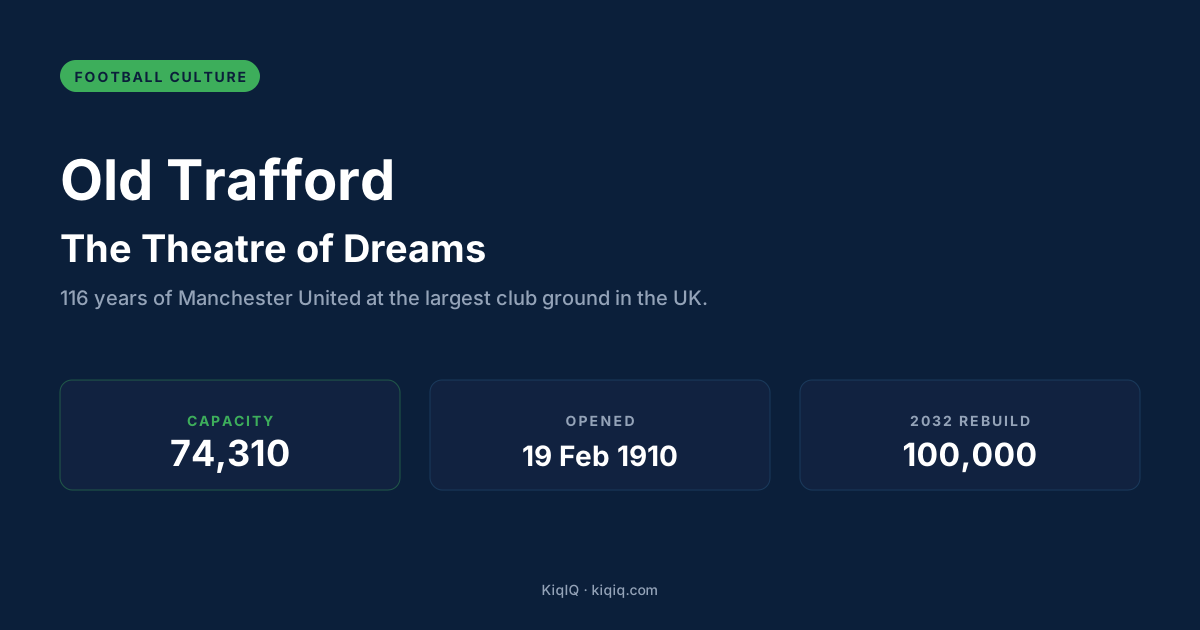
Old Trafford has been Manchester United's home since 19 February 1910. Designed by Archibald Leitch at a cost of £60,000 (£8 million in 2026 terms), the ground opened with an 80,000-capacity Main Stand on the southern side and earth-bank terracing on the other three. World War II German bombing destroyed the south stand and much of the pitch in March 1941; United played their home fixtures at Maine Road (Manchester City's ground) for eight seasons while Old Trafford was rebuilt. The modern stadium, with a capacity of 74,310, is the largest club football ground in the United Kingdom. Sir Bobby Charlton coined the phrase "Theatre of Dreams" in 1987 and the name has been the ground's official secondary title since.
The 1910 build and the Leitch design
Manchester United moved from Bank Street, Clayton to Old Trafford stadium on 19 February 1910, two years after Charles E. Green's investment turned Newton Heath into Manchester United and funded the ambition to build the largest club ground in England. The site, a half-mile from Manchester docks on the southern bank of the Manchester Ship Canal, cost £6,000. Archibald Leitch — by then established as the dominant British football architect after his Ibrox, Stamford Bridge and Goodison Park commissions — designed the ground at a total cost of £60,000.
The original 1910 layout placed a single 80,000-capacity grandstand on the south side (the side facing Sir Matt Busby Way) with raised earth banks on the other three sides. Leitch's Main Stand brick facade with its pitched gable and central pediment matched his Ibrox and Stamford Bridge work. Capacity at opening was 80,000, the largest in England at the time. The opening match on 19 February 1910 was a 4-3 defeat to Liverpool in front of 50,000 supporters.
The 1941 bombing and the Maine Road exile
On 11 March 1941, two waves of German bombing during the Manchester Blitz destroyed Old Trafford's Main Stand, half of the pitch and the dressing rooms. United had no usable home ground for the remainder of the war and the immediate post-war period. The club arranged to play home fixtures at Maine Road, Manchester City's ground, paying City £5,000 per season plus a share of gate receipts. The arrangement ran from 1941 until United's return to Old Trafford on 24 August 1949.
The rebuild was funded partly by the War Damage Commission (£22,278 awarded in 1949) and partly by club investment. The new Main Stand opened in 1949 was a scaled-down version of the Leitch original, with capacity reduced to 56,000 to bring the ground in line with the post-war financial reality. The Maine Road exile, eight seasons sharing Manchester City's ground, became part of the cross-Manchester rivalry's historical record — at the time it was a practical arrangement between two clubs whose grounds had both been damaged in different ways during the war.
Manchester United played all home fixtures at Manchester City's Maine Road from 1941 to 1949 after the Old Trafford Main Stand was destroyed in the March 1941 Manchester Blitz.
The Theatre of Dreams: Bobby Charlton, 1987
The "Theatre of Dreams" name dates to 1987, coined by Sir Bobby Charlton in a programme note ahead of a testimonial fixture. Charlton wrote: "There are stadiums where you go to watch football, and there is Old Trafford, which is the Theatre of Dreams." The phrase entered common usage in the late 1980s and was formally adopted by the club as a secondary stadium designation in 2001, when it was added to the external signage and the official tour branding.
The phrase captures a particular cultural moment: the late-1980s United squad under Alex Ferguson that would dominate the 1990s, the rebuilt North Stand that pushed capacity over 60,000 (1994), and the Premier League era that turned Old Trafford into one of the most-watched ground silhouettes in world football. The phrase is now woven into the club's commercial identity — it appears on official replica programmes, the Old Trafford Megastore, and the stadium-tour audio guide.
Quick question
Where does the phrase "Theatre of Dreams" come from?
The post-1994 expansions and the current 74,310 capacity
The Taylor Report (1990) required all-seater conversion, completed at Old Trafford in 1993. The first major expansion came in 1995 with the rebuild of the North Stand (Sir Alex Ferguson Stand from 2011) into a three-tier 25,000-seat structure, the largest single stand at any English ground. Further expansions in 1999 (the South Stand quadrants) and 2006 (the corner infills) brought capacity to the current 74,310.
The current Sir Bobby Charlton Stand (south side, the original Leitch position) houses the dressing rooms, press box, dugouts and the directors' suite. The Stretford End (west) is the traditional home-supporter singing section, distinct from the equivalent end at Anfield (the Kop) only in its design — both are tall single-tier stands that concentrate noise toward the pitch. The east stand was rebuilt in stages between 1973 and 2000 and now houses the club museum and the megastore. The North Stand, the Sir Alex Ferguson Stand, includes the Tunnel Club premium hospitality offering opened in 2018.
The 2025 renovation announcement and the brick-set culture
In March 2025 Manchester United announced a £2 billion full stadium renovation programme, with a target of redeveloping Old Trafford into a 100,000-seat venue by 2032. The plan, designed by Foster + Partners (the same firm responsible for Wembley's 2007 rebuild), would demolish the current Sir Bobby Charlton Stand and rebuild it as a new four-tier structure, expand the North and East stands, and add a single continuous roof spanning all four sides. Construction is scheduled to start in 2027 with the club playing home fixtures in a temporary on-site stand during the demolition phase.
For supporters wanting to preserve the current 1995-2006 era silhouette of Old Trafford in scale model form, officially licensed brick-built kits capture the four-stand layout that has stood since the 2006 corner infills — and become historical artefacts in their own right once the 2027 demolition begins.
Frequently asked questions
- When did Manchester United move to Old Trafford?
- 19 February 1910. The ground was designed by Archibald Leitch at a total cost of £60,000 (£8 million in 2026 terms) with an opening capacity of 80,000. The opening match was a 4-3 defeat to Liverpool in front of 50,000 supporters. United had previously played at Bank Street in Clayton (1893-1910).
- Why did United play at Maine Road in the 1940s?
- Old Trafford's Main Stand was destroyed by German bombing during the Manchester Blitz on 11 March 1941. The ground was unusable for the remainder of the war and the immediate post-war reconstruction period. United played home fixtures at Manchester City's Maine Road from 1941 to 1949, paying City £5,000 per season plus a share of gate receipts.
- Who coined the "Theatre of Dreams"?
- Sir Bobby Charlton, in a programme note ahead of a 1987 testimonial fixture. He wrote: "There are stadiums where you go to watch football, and there is Old Trafford, which is the Theatre of Dreams." The phrase entered common usage in the late 1980s and was formally adopted as a secondary stadium designation in 2001.
- What is the current capacity of Old Trafford?
- 74,310 — the largest club football ground in the United Kingdom and the second-largest stadium overall after Wembley (90,000). The capacity is split across the Sir Bobby Charlton Stand (south, 22,000), the Sir Alex Ferguson Stand (north, 25,000), the Stretford End (west, 12,000) and the East Stand (15,000) plus corner infill seating.
- Is Old Trafford going to be rebuilt?
- Yes. In March 2025 Manchester United announced a £2 billion renovation programme designed by Foster + Partners, with a target of expanding to 100,000 seats by 2032. Construction is scheduled to start in 2027 with home fixtures continuing on-site in a temporary stand during the demolition phase. The current 1995-2006 silhouette will be substantially replaced.
References
- Manchester United: official history of Old Trafford · Manchester United FC
- Engineering a Football Stadium: Archibald Leitch and the Modern Game · English Heritage Press (jun 2018)
- The Munich Air Disaster and Old Trafford rebuild · Manchester United FC
- Foster + Partners: Old Trafford 2025 renovation project · Foster + Partners (mar 2025)
- Maine Road and the Manchester ground-share, 1941-49 · Manchester City FC
Ask KiqIQ a follow-up
Get a live, data-driven answer powered by our live data feeds + KiqIQ's Poisson model. Try one of these prompts or write your own.
Part of pillar
Football Culture
See every article in this knowledge pillar →
Related
Reviewed by a KiqIQ editor before publication. Spotted an error? Email editor@kiqiq.com. We follow our Corrections Policy.