
The Champions League Anthem, Starball and the Cultural Rituals of European Football
Tony Britten's 1992 anthem commission, the starball logo's Handel-inspired symmetry, the Adidas Finale ball tradition. How UEFA built football's most distinctive matchday choreography.
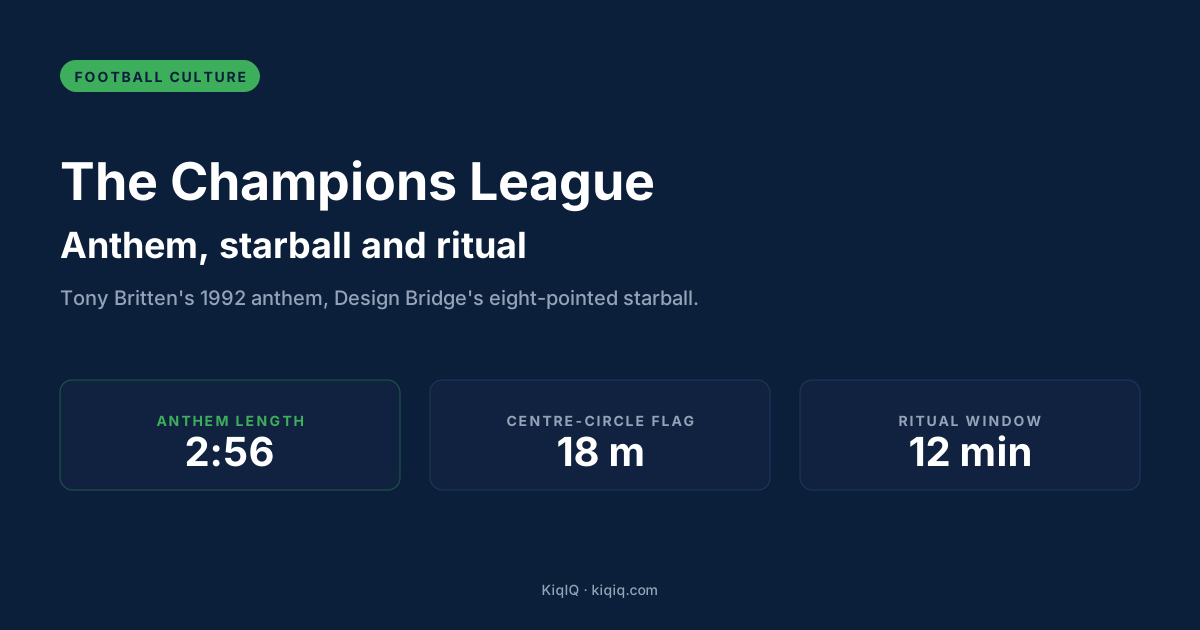 Tap to enlarge
The Champions League anthem, composed by British classical conductor Tony Britten in 1992, is performed at every match kickoff by a 90-piece orchestra and a 40-voice chorus, with lyrics in English, French and German rotating across the verses. The eight-pointed starball logo was designed by London agency Design Bridge in 1991 ahead of the competition's 1992-93 rebrand from the European Cup. The Adidas Finale ball, the official match ball since 2001, has rotated through 24 versions with the star-pattern panels as the only constant. Together, these four elements — anthem, starball, centre-circle flag, official ball — form UEFA's deliberately constructed matchday ritual that distinguishes a Champions League fixture from any domestic match.
The 1992 rebrand and the anthem commission
The European Cup, founded in 1955, ran for 37 years with no formal anthem, logo system or visual identity beyond the Hans Tinguely Champions League trophy itself. UEFA's 1992 decision to rebrand the competition as the UEFA Champions League, expanding from a knockout tournament to a group-stage format, came with a parallel decision to build a cultural identity that could function as a broadcast asset. UEFA marketing director Pierre Bayrouni commissioned the anthem in spring 1992 from Tony Britten, a British composer whose previous work included television scores and choral arrangements.
Britten's brief specified an anthem in the style of Handel's Zadok the Priest (the coronation anthem performed at every British monarch's crowning since 1727), with lyrics referencing the three founding languages of UEFA (English, French, German). The final composition runs 2 minutes 56 seconds, with the opening 16-bar choral entry — "Die Meister, die Besten, les grandes équipes, the champions" — designed to be played in the 90 seconds before kickoff, ending exactly as the referee signals the start of play. Britten was paid £75,000 for the commission and retains no royalty rights; UEFA owns the anthem outright.
The starball logo and Design Bridge's 1991 brief
The Champions League starball was designed by London agency Design Bridge in 1991, ahead of the 1992-93 rebrand. The brief was a logo that combined the football itself (the universally recognisable centre-of-attention shape) with the star (the international football symbol for excellence). Design Bridge's solution was an eight-pointed star with the points arranged as overlapping panels around a central football silhouette. The eight points reference the eight original European footballing nations that founded the European Cup in 1955.
The starball appears on the centre-circle flag laid out before every Champions League match (a 18-metre-diameter circular flag placed by stewards in the centre circle during the 90 seconds before the anthem). It also appears on the match ball, the substitution boards, the wristbands worn by ball-bearers, and the goal-line markers. The visual saturation is deliberate: UEFA's 1992 brief from Design Bridge explicitly called for the starball to be visible in 80%+ of broadcast frames during a typical Champions League match.
The Champions League starball flag laid out in the centre circle before every match is 18 metres in diameter. The flag is the same size as the centre circle itself, designed to occupy the entire space.
The Adidas Finale ball and the 2001 tradition
Adidas has been UEFA's official ball supplier since the 1996-97 season, but the "Finale" naming convention — a new ball design every season carrying the Champions League starball pattern — dates from 2000-01. Each year's Finale design varies the underlying colour palette but maintains the constraint of incorporating the starball panel pattern: the ball's outer surface is divided into eight panels each carrying a portion of a star, with the panels combining to form complete stars across the seam lines.
The most-recalled Finale designs are: Finale 5 (2003-04, used in the Porto-Monaco final), Finale 11 (2009-10, the silver-and-black UCL final ball at Madrid), Finale 16 (2014-15, the Berlin final between Juventus and Barcelona) and Finale 19 (2017-18, used in the Kiev final between Liverpool and Real Madrid). Each ball is now a collector's item, with original match balls from finals reaching £200-800 in subsequent auctions. Some Finale balls — particularly the 2002-03 (Manchester United-Bayer Leverkusen final) — have appreciated significantly above their original retail price.
The matchday choreography: 12 minutes of constructed ritual
UEFA's broadcast protocol mandates a specific 12-minute pre-kickoff window choreographed identically at every Champions League fixture. T-minus 12 minutes: teams emerge from the tunnel and line up. T-minus 8 minutes: the starball flag is unfurled in the centre circle by 22 stewards in white uniform, taking exactly 90 seconds. T-minus 6 minutes: the anthem begins, lasting 2:56. T-minus 3 minutes: the flag is folded and removed (another 90-second operation). T-minus 1 minute: captains exchange pennants and the referee approaches the centre circle. T-zero: kickoff.
The same 12-minute sequence has run at every Champions League group-stage and knockout fixture since the 1992-93 season, with only minor adjustments to accommodate broadcast advertising breaks. The deliberate repetition is what gives the Champions League its cultural distinctiveness — domestic league matches have no equivalent matchday ritual, and the gap between a Premier League fixture's pre-kickoff and a Champions League fixture's is one of the most-cited reasons supporters describe Champions League nights as feeling "different" to league weekends.
The commemorative ornament market
The Champions League's cultural saturation has built a specific commemorative-ornament market: scale models of the trophy, framed photographs of starball flags being unfurled, commemorative ball replicas, season-by-season ornament sets. UEFA licenses a small number of official producers (typically Adidas for ball replicas, individual auction houses for match-ball provenance certificates, and a rotating short-list of European silversmiths for trophy replicas). Beyond the licensed market, unlicensed commemorative collections at scale-model price points (£20-80) sell at much higher volumes.
Commemorative ornament collections sit in the eye-level secondary band of a well-designed fan display, capturing the trophy silhouette and the starball motif that define the competition's visual identity.
Frequently asked questions
- Who composed the Champions League anthem?
- Tony Britten, a British classical composer and conductor, commissioned by UEFA in 1992 for the rebrand from European Cup to Champions League. Britten was briefed to write in the style of Handel's Zadok the Priest, with lyrics in English, French and German. The 2:56 anthem is performed at every match by a 90-piece orchestra and 40-voice chorus. Britten was paid £75,000 outright and retains no royalty rights.
- What does the starball represent?
- The eight-pointed starball logo combines a football silhouette with a star (the international football symbol for excellence). The eight points reference the eight European footballing nations that founded the European Cup in 1955. Designed by London agency Design Bridge in 1991 ahead of the 1992 rebrand, it appears on the centre-circle flag, the match ball, substitution boards, ball-bearer wristbands and goal-line markers.
- How big is the centre-circle flag?
- 18 metres in diameter — the same as the centre circle itself, designed to occupy the entire space. The flag is unfurled by 22 stewards in white uniform exactly 8 minutes before kickoff, taking 90 seconds to lay out. It is removed by the same 22 stewards 3 minutes before kickoff, also taking 90 seconds. The choreography is identical at every Champions League fixture worldwide.
- Why is the Adidas Finale ball different every year?
- Adidas redesigns the ball each season as a marketing exercise, but the constraint is structural: every Finale ball incorporates the starball panel pattern, with eight panels each carrying a portion of a star, combining across seam lines to form complete stars. The first Finale was 2000-01; the 2025-26 design is the 25th in the series. Match balls from finals (particularly Finale 11 from 2009-10) reach £200-800 in subsequent auctions.
- How long is the pre-kickoff ritual?
- 12 minutes, choreographed identically at every match. T-minus 12: teams emerge. T-minus 8: flag unfurled (90 sec). T-minus 6: anthem (2:56). T-minus 3: flag removed (90 sec). T-minus 1: captains exchange pennants. T-zero: kickoff. The deliberate repetition is the source of the Champions League's cultural distinctiveness — no domestic league has an equivalent matchday ritual.
References
- UEFA: Champions League brand and anthem history — UEFA
- Tony Britten: composer biography and Champions League anthem commission — Tony Britten Music
- Design Bridge: Champions League brand identity case study — Design Bridge London
- Adidas Finale: the Champions League official match ball history — Adidas
- Handel: Zadok the Priest (HWV 258) — Handel Hendrix House
- UEFA Champions League broadcast protocol manual — UEFA
Ask KiqIQ a follow-up
Get a live, data-driven answer powered by api-football + KiqIQ's Poisson model. Try one of these prompts or write your own.
Part of pillar
Football Culture
See every article in this knowledge pillar →
Related
Reviewed by a KiqIQ editor before publication. Spotted an error? Email editor@kiqiq.com — we follow our Corrections Policy.