
How to Run a Grassroots Football End-of-Season Presentation Evening
A working guide to running an end-of-season presentation evening for a grassroots youth football team: venue, awards, speeches, parents, timing and the small details that make it land.
 Tap to enlarge
A presentation evening at the end of a grassroots youth football season is the ritual that turns 30 weeks of muddy Saturdays into something the players remember. Done badly, it drags. Done well, it gives every child a moment, sends parents home feeling the season was worth it, and seeds enough goodwill to make signing-on for next year a formality. This guide covers the running order, the awards mix, the parent-side admin, and the small details new coaches tend to miss.
Set the date six weeks out and lock the venue
The single biggest source of stress in running a presentation evening is leaving the venue booking too late. Local community halls, scout huts and pub function rooms get block-booked for May and June by other grassroots clubs running the same ritual on the same weekends. Set a provisional date the week the season ends in March, confirm with the venue by the start of April, and announce to parents at least four weeks before the event so they can plan around it.
A typical U7 to U11 evening runs 90 minutes to two hours, which sits comfortably in a 6:30pm to 8:30pm window on a Friday or a Sunday afternoon slot. Older age groups (U12 upwards) tolerate a slightly longer evening, but past two hours the younger siblings unravel and parents start checking the time. Keep it tight.
A small parent committee of two or three is worth its weight in trophies. One handles the venue and refreshments, one handles ordering the awards (more on which below), and one handles the slide deck or photo loop if you are running one. The coach does the speaking. Trying to do all four jobs alone is how presentation evenings end up scrappy.
Quick question
How should awards be handled at a grassroots presentation evening?
Awards: every child gets something, and the named awards matter
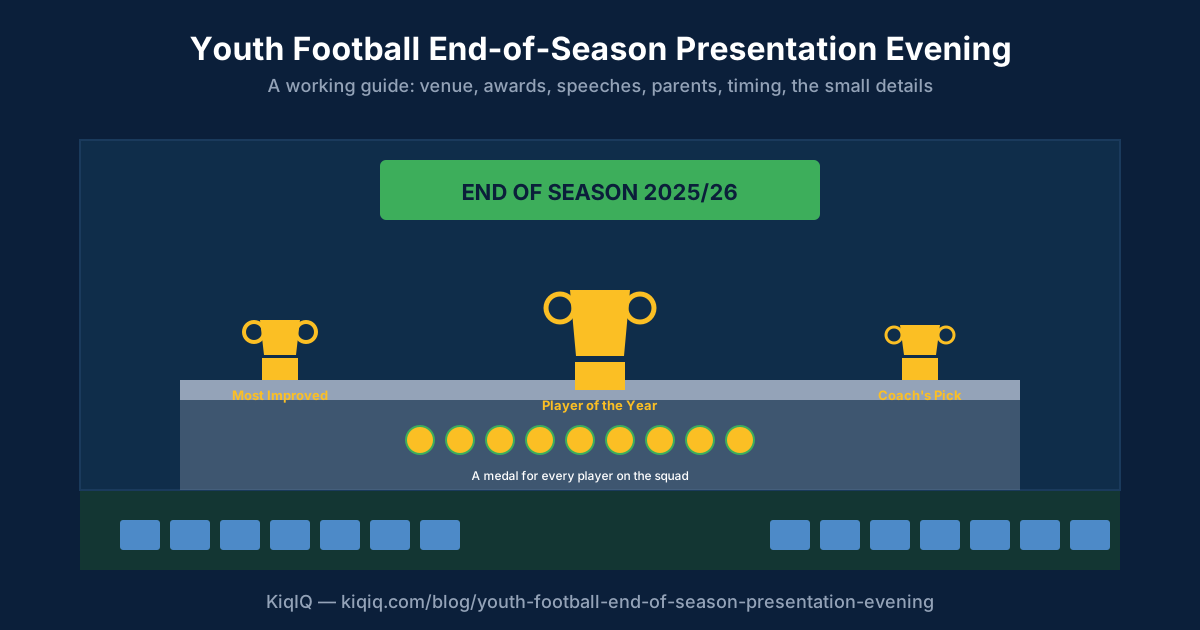
The non-negotiable rule of grassroots presentation evenings, at least up to U13, is that every player gets a trophy or a medal. The point of the evening is to mark the season, not to anoint a top three. Past U13 the convention shifts towards a participation medal plus a smaller set of named awards, but at the younger ages the visible reward of a trophy in the hand is most of the point of being there.
For the standard player-of-the-season, players-player, most-improved and managers-player awards, a small set of named trophies adds gravitas that medals alone cannot. A typical UK grassroots supplier carries a football trophies and awards range with cup-and-figurine trophies in the £6 to £15 range that suit a team budget, plus engraving plates that turn a generic trophy into a season-specific keepsake. Order three weeks out at the latest, engraving turnaround is usually 7 to 10 working days and the supplier queue thickens in May.
A workable mix for a typical squad of 12 to 14 players: a generic participation trophy or large medal for every player, plus four named awards (player of the season, players-player, most-improved, managers-player) on slightly larger trophies with engraving. The total spend usually lands between £80 and £160 depending on size, which is well within a normal subs-funded season pot. If the club has a sponsor, this is exactly the kind of line they will happily pick up in exchange for a logo on the certificate.
- Participation trophy or large medal for every player.
- Named: Player of the Season (coach picks).
- Named: Players-Player (players vote anonymously).
- Named: Most Improved (coach picks, easiest to land emotionally).
- Named: Managers-Player (coach picks, often a quiet workhorse).
- Optional: Top Scorer and Top Assists if you have kept the records honestly.
The running order: short, structured, every child named
A presentation evening is fundamentally a sequence of named moments. The structure that lands most reliably is: arrival and food (20 minutes), a 10-minute season highlights reel or slide deck on a wall projector, an individual award and one-line tribute for every player in shirt-number order (40 to 50 minutes for a squad of 14), the four named awards last (10 minutes), and a closing thank-you to parents, referees, the venue and any volunteers (5 minutes).
The single line per player is where new coaches over-prepare or under-prepare. Aim for one specific concrete sentence, not a generic compliment. "Olivia scored our first ever goal in a competitive fixture, against Hartshill in October" lands. "Olivia worked hard all season" does not. Twelve to fourteen specific one-liners means writing them down in advance and not trusting yourself to wing it on the night, the temptation to ad-lib is what produces the seventh consecutive variant of "great attitude" by the middle of the squad.
Have the named awards last because the room knows they are coming and the build-up carries the evening. Resist the urge to surprise-stack named awards on the same one or two players, three trophies handed to the same child while ten others get a single medal is the easiest way to undo all the goodwill the evening is meant to build. Spread the named awards across at least three different recipients wherever the coaching judgement allows.
The small things that make it land
Three small details consistently separate a presentation evening that parents remember from one they politely sit through. First, a printed certificate for every player alongside the trophy, named, dated and signed by the coach. It costs £3 in card and ink and ends up framed on a child's bedroom wall, which is the photograph a parent shares for years afterwards. Templates are widely available, the FA Boot Room has free downloadable certificate stock.
Second, a season photo. Either a posed team shot from the last training session of the year, or a montage of action shots from across the season. Print one copy per family at A5 size, hand it out at the door on the way in. If a parent has taken action photos through the season, ask them to email a folder a fortnight in advance and stitch the best ten into a slow slideshow that runs on a loop during arrival.
Third, a touchline-essentials acknowledgement. A grassroots season runs on the parents who run the line, the parent who washes the bibs, the parent who carries the touchline first-aid kit every Saturday. A proper touchline-grade football first aid range is the kind of upgrade most clubs eventually find when they realise the basic plasters-and-ice-pack kit needs a replacement, and a small thank-you trophy or gift card to the parent who has been carrying that bag every weekend is the kind of detail that gets noticed and remembered.
Speeches: keep them short, keep them grateful
The coach speaks twice: a 60-second welcome at the start, and a 3 to 4 minute close at the end. The welcome covers what the evening is for, the running order and the practical (toilets are over there, food is at the back, please put phones on silent during the awards). The close is where the season gets summarised and the volunteers get thanked.
Two rules for the closing speech. Do not list match results, the parents were there. Do tell one or two specific stories from the season that show what the team learned or how it grew, the away game where the team came back from 3-0 down, the week the U9s decided to run their own warm-up, the cup game where the goalkeeper saved a penalty. Stories travel, scorelines do not.
Thank the assistant coach, the team manager, the parent who washes the kit, the parents who took the touchline-first-aid kit out every week, the parents who drove for away games, the league and the referees. Name them. A 30-second list of named volunteers is more memorable than a generic thank-you to "everyone who helped". And then sit down, the parents have eaten the buffet and the kids want to run around with their trophies.
Cost, logistics and a sample budget
A presentation evening for a 14-player U9 squad typically runs to £200 to £350 all-in, on a venue-included basis. The split below is a working starting point, adjust upwards for older age groups (larger trophies tend to be expected) and for clubs that fund a full sit-down meal rather than a buffet.
Where to economise: a community hall booking is usually £40 to £80 versus £150 plus for a pub function room with a minimum bar spend, and self-catered crisps-and-pizza is fine at U7 to U11. Where not to economise: the trophies themselves and the engraving. The trophy is the artefact the child takes home, a too-small or unengraved trophy is the part of the evening that gets remembered as cheap.
- Venue: community hall £40 to £80, scout hut £30 to £60, pub function room £0 with minimum bar spend.
- Trophies + medals: £80 to £160 for a 14-player squad with 4 named awards engraved.
- Certificates + printing: £10 to £20 (print at home or local copy shop).
- Food + drink: £40 to £100 for self-catered buffet, more for a sit-down meal.
- Photo prints: £15 to £30 for A5 team photos for every family.
- Decor + projector hire: £0 (most halls have AV) to £30 for a hired projector.
Frequently asked questions
- Does every child need to get a trophy at a grassroots presentation evening?
- Up to U13, yes. The point of the evening is to mark the season, not to anoint a top three. Past U13 the convention shifts to a participation medal plus a smaller set of named awards (player of the season, players-player, most-improved, managers-player) on larger trophies.
- How long should a youth football presentation evening last?
- A U7 to U11 evening runs comfortably in 90 minutes to two hours, ideally in a 6:30pm to 8:30pm Friday slot or a Sunday afternoon. Older age groups tolerate a slightly longer evening, but past two hours the younger siblings unravel and parents start checking the time.
- What do you say when handing out a trophy at a presentation evening?
- One specific concrete sentence per child, written down in advance. "Olivia scored our first ever competitive goal, against Hartshill in October" lands. Generic compliments ("worked hard all season") do not. Twelve to fourteen specific lines means preparing them, not winging it on the night.
- How much does it cost to run a grassroots presentation evening?
- For a 14-player U9 squad, typically £200 to £350 all-in: venue (£40 to £80 for a community hall), trophies and medals (£80 to £160), certificates (£10 to £20), food (£40 to £100) and team photos (£15 to £30). Most clubs fund it from season subs or a sponsor.
References
- The FA Boot Room, grassroots resources and certificate templates · The FA
- Grassroots Football Club Operations Handbook · The FA
- Coaches Voice, session and squad management library · Coaches Voice
- Sported, volunteer-run sports club resources · Sported
- Football trophies and awards at ChildrensFootball.com (affiliate) · ChildrensFootball.com
- Football first aid at ChildrensFootball.com (affiliate) · ChildrensFootball.com
Ask KiqIQ a follow-up
Get a live, data-driven answer powered by our live data feeds + KiqIQ's Poisson model. Try one of these prompts or write your own.
Part of pillar
Player Development
See every article in this knowledge pillar →
Related
Reviewed by a KiqIQ editor before publication. Spotted an error? Email editor@kiqiq.com. We follow our Corrections Policy.