
What Counts as an Assist? Opta, FIFA & FBref Definitions
An assist is the final pass before a goal. The exact definition differs between Opta, FIFA and FBref, with edge cases for deflections, secondary assists and own goals. The rules explained.
 Tap to enlarge
An assist in football is the final pass or final action by a teammate that directly leads to a goal. The mainstream definition comes from Opta, which credits the player whose pass led to the goal-scoring shot, with allowances for deflections off opponents but not for shots saved and then put away on the rebound. FIFA, FBref and the Premier League broadly follow the Opta rule, but each has its own edge cases.
The Opta definition is the working standard
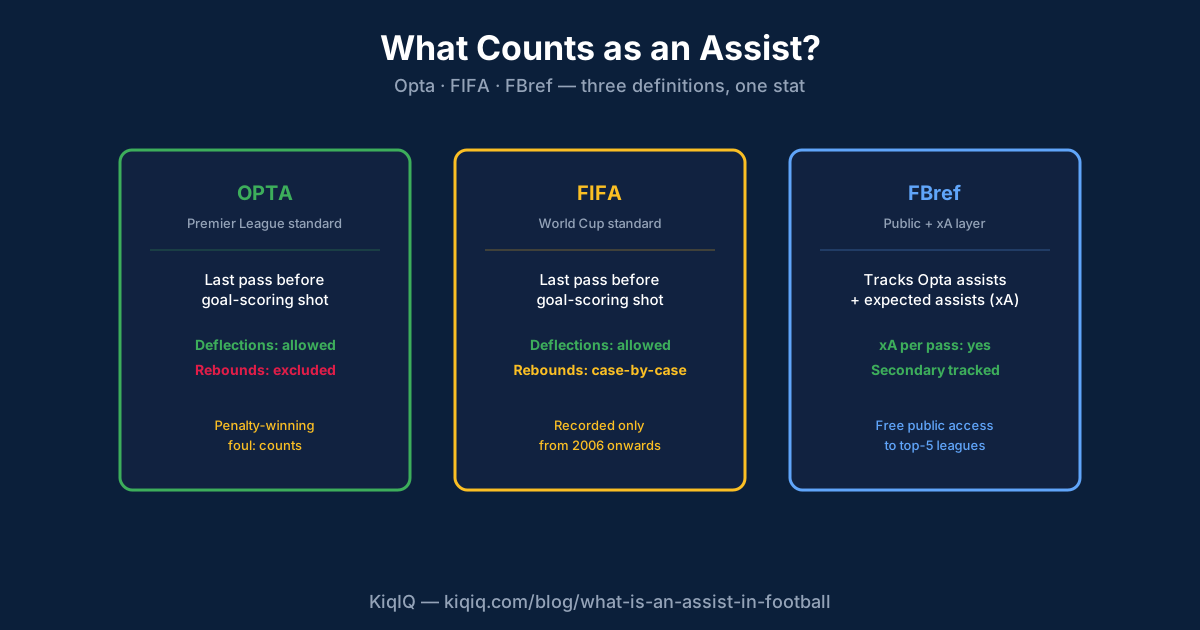
Opta Sports, now part of Stats Perform, supplies the assist data used by the Premier League, La Liga, Serie A, Ligue 1 and most major broadcasters. The Opta rule is that an assist is awarded to the player whose final pass or action led directly to a goal-scoring shot, even if the shot was deflected by an opposition player on its way to goal. The rule explicitly excludes situations where the shot was saved and then put in on the rebound: in those cases, the original passer does not receive an assist.
A penalty kick assist is awarded to the player who was fouled to win the penalty, but only if they themselves did not take the penalty. A free-kick assist is awarded to the player who won the foul, again on the same not-the-taker condition. An own-goal scored without a clear final pass from the attacking team carries no assist; an own-goal forced by a cross or shot that the defender mishit into their own net is debated case by case, but the Opta default is to award no assist on own goals.
Opta's definition is the working standard across the Premier League, La Liga, Serie A and FBref. The short version: final pass before a shot that becomes a goal, deflections allowed, rebounds excluded.
Where FIFA and the Premier League differ
FIFA's assist definition, used for World Cup and continental tournaments, broadly tracks the Opta rule but has historically been slightly more generous on rebounds. The FIFA Technical Study Group has on occasion credited an assist on a saved shot that fell to a teammate, where the original passer was clearly the architect of the chance, although recent World Cups have aligned more closely with the strict Opta last-action rule.
The Premier League official records use Opta data and follow the Opta definition exactly. The league has retrospectively re-awarded assists when an Opta review changed the call, most famously around Andy Cole's 1993-94 record where assist credits were revisited after the league's data review project in 2015. The historical record is therefore not entirely fixed: pre-1992 numbers are reconstructed rather than measured.
| Provider | Used by | Deflections | Rebounds | Secondary assists |
|---|---|---|---|---|
| Opta (Stats Perform) | Premier League, La Liga, Serie A, Ligue 1 | Allowed | Excluded | Tracked privately, not official |
| FIFA | World Cup, continental tournaments | Allowed | Case by case, historically more generous | Not in the official record |
| FBref | Public data plus expected assists (xA) | Follows Opta | Follows Opta | Shown alongside xA |
Secondary assists and the second-pass debate
A secondary assist (sometimes "hockey assist") is the pass before the assist: the second-to-last action by the goal-scoring team before the ball entered the net. The NBA and NHL track secondary assists as a standard stat, but football has resisted them in the official record. Opta does collect secondary-assist data privately and supplies it to subscribing clubs, but neither the Premier League nor FIFA records secondary assists on the official player ledger.
The argument for tracking them is straightforward: many goals are built on the pass before the pass, and rewarding only the final action under-credits deep-lying playmakers like Toni Kroos, Frenkie de Jong or Rodri who set up the chance two passes earlier. The argument against is parsimony: assists already capture the action with the clearest causal link to the goal, and stretching the definition backwards introduces subjective calls about which earlier pass really mattered.
- Primary assist. The final pass or action before the goal-scoring shot. Counted in the official record.
- Secondary assist. The pass before the assist. Tracked privately by Opta and FBref but not in official records.
- Penalty-winning assist. Awarded to the player fouled for a penalty, if they did not take the penalty themselves.
- Own-goal assist. Generally not awarded. Some data providers credit an assist if the own-goal was forced by a clear cross or shot.
Expected assists (xA): the predictive layer
Expected assists, or xA, sit on top of the binary assist count and measure the probability that a pass would lead to a goal, based on the location and quality of the shot it created. Opta and FBref both publish xA as a complement to raw assists, with FBref allowing free public access to season-level xA tables for the top European leagues. xA is calculated by scoring each completed pass that produced a shot against an xG model: a low cross into a six-yard box that creates a 0.40 xG chance is worth 0.40 xA to the passer, regardless of whether the receiver finished it.
The practical use of xA is to identify creators whose teammates over- or under-finish their chances. Kevin De Bruyne has consistently posted xA totals at or above his raw assist totals across the past five Premier League seasons, suggesting his finishers are roughly converting at expectation. Players whose raw assists run well ahead of their xA tend to be working with elite finishers (or running hot); players whose xA runs well ahead of their assists are creators whose receivers are missing chances.
Why the assist record is messier than it looks
The all-time Premier League assist record was passed by Ryan Giggs in 2010 and has since been claimed by Cesc Fabregas, with Kevin De Bruyne running close behind on a much shorter career. The reconstructed numbers for the pre-Opta era (before 1992 in England, earlier in Spain) are not directly comparable because the modern definition was not used at the time. The Premier League itself describes pre-2006 assist numbers as "best-effort" rather than definitive, with the 2006-07 season the first where Opta's methodology was applied consistently in real time.
For international football, the gap is even wider. FIFA only began recording assists at major tournaments from the 2006 World Cup onwards, and even then with looser deflection rules than the Opta standard. Comparing modern Champions League assist tallies with older European Cup numbers is therefore mostly an exercise in nostalgia: the underlying definition shifted under the data, and the older numbers are reconstructions rather than measurements.
Try it
Assist or no assist?
One edge case, one call. Make it before you scroll.
A winger slides a through ball to the striker. The striker shoots, the goalkeeper parries, and the same striker follows up to score the rebound. Does the winger get the assist?
Quick question
A pass is deflected by a defender and still reaches the scorer. Who gets the assist?
Frequently asked questions
- What is an assist in football?
- An assist is the final pass or final action by a teammate that directly leads to a goal. The Opta definition, used by the Premier League and most major leagues, credits the player whose pass led to the goal-scoring shot, with deflections off opponents allowed but rebounds from a saved shot excluded. Penalty-winning fouls also count if the fouled player did not take the penalty.
- Does a deflected pass count as an assist?
- Yes, under the Opta definition. If a pass is deflected by an opposition player and still reaches the eventual goal-scorer, the original passer is credited with the assist. The exception is if the deflection effectively becomes the shot (the ball goes from defender directly into the net), in which case the goal is logged as a deflected shot or own goal with no assist.
- Are secondary assists tracked in football?
- Not in the official record. Opta and FBref do collect secondary-assist data privately and supply it to subscribing clubs, but neither the Premier League nor FIFA recognises secondary assists in the official player ledger. The NBA and NHL track them as standard; football has chosen to keep the assist count to the final action only.
- What is the difference between assists and xA?
- Assists are the binary count of final passes that produced goals. Expected assists (xA) score each completed pass that produced a shot against an xG model: a pass that created a 0.40 xG chance is worth 0.40 xA to the passer, regardless of whether the shot was finished. xA isolates creator skill from finisher skill.
- Who has the most Premier League assists of all time?
- Ryan Giggs held the record at retirement in 2014 with 162 assists, since passed by Cesc Fabregas, with Kevin De Bruyne running close behind on a shorter career. The Premier League uses Opta data and applies the modern assist definition consistently from 2006-07 onwards; pre-2006 numbers are reconstructed and not perfectly comparable.
References
- Opta event data definitions: assists and xA · Stats Perform / Opta
- Premier League: stats methodology and assists definition · Premier League
- FBref: assists and expected assists explained · FBref / Sports Reference
- The Athletic: the case for tracking secondary assists · The Athletic
- FIFA Technical Study Group: assist criteria at the World Cup · FIFA
Key terms in this article
Ask KiqIQ a follow-up
Get a live, data-driven answer powered by our live data feeds + KiqIQ's Poisson model. Try one of these prompts or write your own.
Part of pillar
Fundamentals
See every article in this knowledge pillar →
Related
Reviewed by a KiqIQ editor before publication. Spotted an error? Email editor@kiqiq.com. We follow our Corrections Policy.