
What Is a Cap in Football? The Origin, Meaning, and Records
A cap in football is one international appearance for a national team. We explain the term's origin in 1860s English football, the modern meaning, and the all-time cap leaders.
 Tap to enlarge
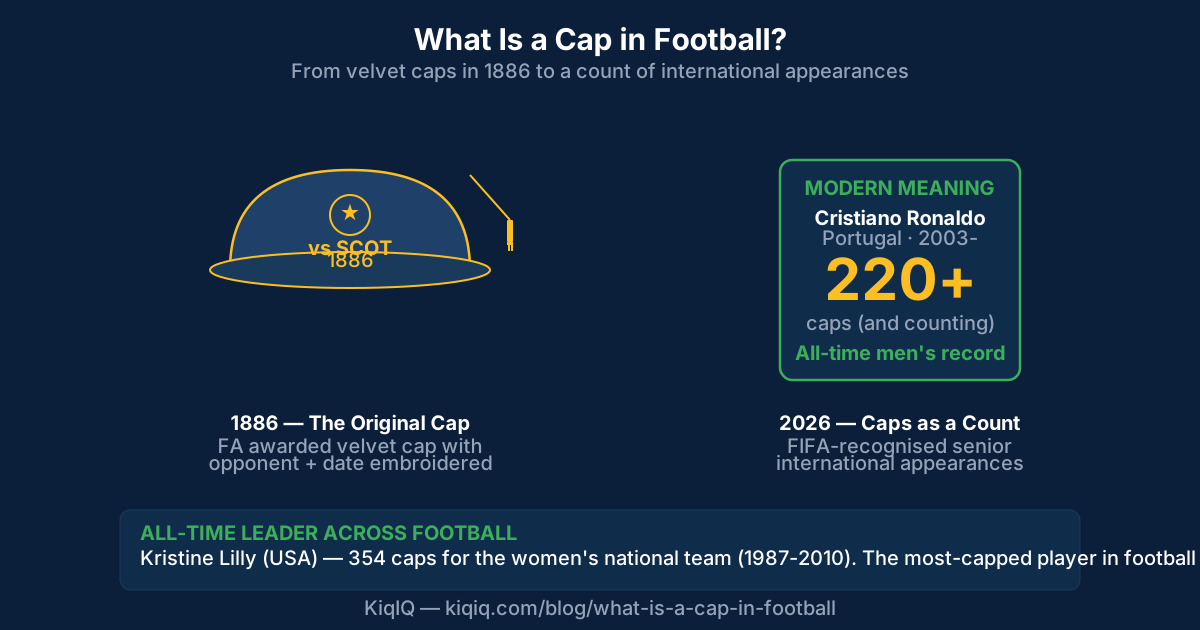
A cap in football is one appearance for a senior national team in an officially recognised international match. The term comes from 1880s English football, when the FA literally awarded players a velvet cap with a tassel after each international appearance. The tradition of giving caps as physical objects continues today (England players still receive a cap for major appearances), but the word has come to mean a count — "Cristiano Ronaldo has 220+ caps" means 220+ international appearances.
The origin of the cap
In 1886, the FA established the rule that all England international players would be awarded a cap as a reward for representing their country. The choice of object was deliberate: caps had been worn by university and public-school sports teams for decades as a mark of belonging. Awarding international players a cap symbolised admission to a national team in the same way.
Early caps were dark blue velvet with the player's opponent and date embroidered on the front in silver thread, plus a tassel. They were heavy, distinctive, and prized possessions. Some players accumulated dozens.
Quick question
Why is an international appearance called a cap?
How the term evolved
For roughly the first century, "cap" referred to the physical object. As football professionalised and globalised, the word evolved into a metric — "winning a cap" came to mean appearing in an international, with or without an actual cap being awarded.
Most football associations still award physical caps for major milestones. England awards a cap for every senior appearance. Some FAs award them only for first appearance, or for milestone appearances (50th, 100th, 200th).
"Cap" as a count is now standard global football terminology. "Cristiano Ronaldo has X caps" means X international appearances, regardless of whether a physical cap was issued for each.
What counts as a cap
FIFA's definition: an appearance in a senior international match that meets at least one of these criteria:
- A FIFA World Cup qualifier or finals match.
- A continental confederation tournament (Euros, Copa America, AFCON, Asian Cup, OFC Nations Cup, Gold Cup).
- A friendly between two FIFA member national teams.
- A FIFA-recognised tournament (Confederations Cup historically, Olympic finals for women, Nations League matches).
What does NOT count as a cap
Several appearances are commonly mistaken for caps but do not count under FIFA standards:
- Under-21 / youth international appearances.
- B-team / second-team international appearances (separately recorded as "B-caps").
- Olympic men's tournament appearances (which are U-23 with three over-age players — separate count).
- Unofficial friendlies (a national-team coach's warm-up match against a club side, for example).
The most-capped players in football history
All-time men's international cap leaders (career-end counts where applicable, current as of 2025-26):
- Cristiano Ronaldo (Portugal) — 220+ caps and rising. The all-time leader, surpassing Bader Al-Mutawa in 2023.
- Bader Al-Mutawa (Kuwait) — 196 caps. The previous men's record-holder.
- Soh Chin Ann (Malaysia) — 195 caps (career 1969-1984). Held the record for over 30 years.
- Mohamed Al-Deayea (Saudi Arabia) — 178 caps. Goalkeeper, four World Cups.
- Hossam Hassan (Egypt) — 178 caps. Striker, 1985-2006.
- Sergio Ramos (Spain) — 180 caps as of retirement in 2025.
The most-capped women players
The women's game has many of the most-capped players in the sport overall:
- Kristine Lilly (USA) — 354 caps (1987-2010). Most-capped player in football history across genders.
- Christie Pearce/Rampone (USA) — 311 caps.
- Carli Lloyd (USA) — 316 caps.
- Christine Sinclair (Canada) — 331 caps.
- Birgit Prinz (Germany) — 214 caps.
Cap presentation traditions
Many associations have specific cap traditions:
- England. Players receive a navy velvet cap for each appearance, embroidered with opponent and date. New caps presented at training-ground ceremonies.
- Brazil. First-cap recipients are honoured by team-mates at the post-match changing room — a rite of passage.
- Germany. First-cap recipients receive a special silver cap with their initials engraved.
- United States. Players receive a stars-and-stripes cap for milestone appearances (1st, 50th, 100th, 150th).
Frequently asked questions
- What is a cap in football?
- A cap is one appearance for a senior national team in an officially recognised international match. The term originated in 1886 when the FA began awarding actual velvet caps to England players. Today, the word means a count — "Cristiano Ronaldo has 220+ caps" means 220+ international appearances.
- Who has the most caps in football history?
- For men, Cristiano Ronaldo of Portugal holds the all-time record with 220+ caps and counting. He surpassed Kuwait's Bader Al-Mutawa (196 caps) in 2023. Across all of football, Kristine Lilly of the USA holds the overall record with 354 caps for the women's national team (1987-2010).
- Do under-21 appearances count as caps?
- No. Under-21 and youth international appearances are tracked separately and don't count toward senior caps. Olympic men's tournament appearances also don't count (the men's Olympic competition is U-23 with three over-age players). B-team appearances are recorded as "B-caps" — a separate count from the senior total.
- Are caps still physical objects?
- Yes — many football associations still award physical caps. England issues a navy velvet cap with the opponent and date embroidered for every senior appearance. Germany awards a special silver cap for first appearances. Brazil has a changing-room rite of passage for first-cap players. The physical tradition continues alongside the metric meaning.
References
- The Origin of the Football Cap · The FA
- FIFA International Match Standards · FIFA
- Most-Capped Players in Football History · Wikipedia (verified)
- Kristine Lilly · All-Time Cap Leader · FIFA
Ask KiqIQ a follow-up
Get a live, data-driven answer powered by our live data feeds + KiqIQ's Poisson model. Try one of these prompts or write your own.
Part of pillar
Fundamentals
See every article in this knowledge pillar →
Related
Reviewed by a KiqIQ editor before publication. Spotted an error? Email editor@kiqiq.com. We follow our Corrections Policy.