
ACL Injuries in Football: Why the Women's Game Sees More
ACL ruptures occur at roughly 2-3 times the rate in women's football compared with men's. The mechanism, the prevention evidence, and what a 9-12 month return-to-play actually involves.
 Tap to enlarge
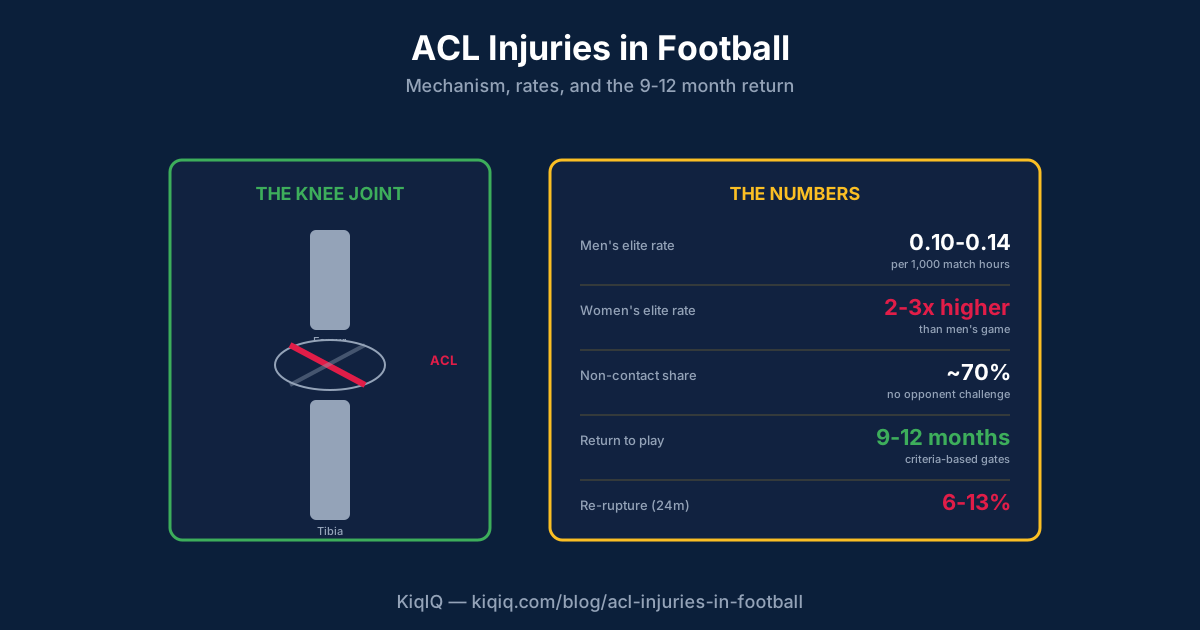
Anterior cruciate ligament (ACL) ruptures are the most severe common knee injury in football. The UEFA Elite Club Injury Study reports rates of roughly 0.10-0.14 ACL injuries per 1,000 hours of match exposure in elite men's football, with the women's game running at 2-3 times that figure. Roughly 70% of ACL ruptures in football are non-contact: a planted foot, a sudden change of direction, and a knee that collapses into valgus without an opposition challenge. Return to play after reconstruction typically takes 9-12 months and re-rupture rates in the first two years post-surgery sit at 6-13%.
What the ACL actually does
The anterior cruciate ligament is one of four major stabilisers in the knee, running diagonally from the back of the femur to the front of the tibia. Its job is to resist the tibia sliding forward relative to the femur and to limit internal rotation of the tibia. In a footballer pivoting on a planted foot, the ACL is the structure stopping the lower leg from rotating out of line with the thigh and the hip.
A complete ACL rupture, the typical football injury, leaves the knee mechanically unstable: the joint can still bend and straighten, but rotational movements and sudden decelerations cause the knee to give way. Without surgical reconstruction, a footballer with a complete ACL rupture cannot return to high-level cutting sports. Around 80-90% of professional footballers with complete tears opt for surgical reconstruction within 6-12 weeks of injury, after the initial swelling has resolved.
Roughly 70% of football ACL ruptures are non-contact. The injury happens to the player, not because of a challenge by an opponent: a planted foot, a sudden cut, a knee that collapses into valgus.
Why the women's rate is 2-3 times the men's
The UEFA Women's Champions League injury study and the FIFA Medical Network both report ACL rupture rates in elite women's football at 2-3 times the male rate. The reasons are multifactorial. Anatomical differences contribute: women have wider pelvises relative to femur length, producing a larger Q-angle that biomechanically predisposes the knee to valgus under load. The femoral notch through which the ACL passes is also narrower on average in female athletes, leaving less room for the ligament to absorb torsion.
Hormonal cycles add a second layer. The Walden et al. work in the British Journal of Sports Medicine (2024 review) finds elevated ACL injury risk during the pre-ovulatory phase of the menstrual cycle, when oestrogen peaks transiently reduce collagen stiffness. Several professional women's clubs (Chelsea, Manchester City, Lyon) now track menstrual cycles in their load-management software and adjust training loads around the pre-ovulatory window. The training and surfacing environment is a third layer: until the recent professionalisation of the women's game, female footballers played fewer matches on lower-quality pitches with less S&C support, and the catch-up in playing volume has run ahead of the catch-up in injury-prevention infrastructure.
The non-contact mechanism is also more common in women's football than men's. Approximately 75-80% of female ACL ruptures are non-contact compared with 65-70% in the male game, which points squarely at neuromuscular control of the knee during deceleration and cutting as the modifiable risk factor.
Prevention: the FIFA 11+ and neuromuscular training
The single best-evidenced prevention programme is the FIFA 11+, a 20-minute warm-up of running, plyometric and core-stability drills developed by the F-MARC group and trialled across multiple cohorts. The Soligard et al. randomised trial in Norwegian youth women's football (BMJ, 2008) showed a 32% reduction in overall lower-limb injuries and a 50% reduction in severe injuries (including ACL) in teams that completed the 11+ at least twice a week. Subsequent meta-analyses by Sadigursky et al. (2017) and Thorborg et al. (2017) both confirmed a 35-45% reduction in ACL injuries specifically.
The active ingredient in the 11+ appears to be neuromuscular control of the knee during deceleration: drills that teach the player to land with the knee tracking over the toe and the hip flexed, rather than collapsing into valgus. Six to eight weeks of consistent 11+ usage produces measurable improvements in landing mechanics on force-plate testing, which is the proxy for ACL risk that clinicians track in academy settings. The challenge in implementation is consistency: the 11+ works at 2+ sessions per week and effectively fails to reduce injuries at 1 session per week or less.
- FIFA 11+ warm-up. 20 minutes, twice a week minimum. 35-45% ACL injury reduction across meta-analyses.
- Eccentric quad and hamstring strength. Nordic curls and slow eccentric squats build the protective musculature.
- Plyometric landing drills. Box drops, depth jumps with hip-flexion and knee-over-toe coaching cues.
- Cycle-aware load management. Adjust intensity in the pre-ovulatory phase; trialled at Chelsea, Manchester City and Lyon.
Quick question
What is the best-evidenced way to reduce ACL injury risk in football?
Surgical reconstruction: hamstring graft vs patellar tendon
The two dominant graft choices for ACL reconstruction in elite footballers are the hamstring tendon autograft (semitendinosus, often combined with gracilis) and the bone-patellar-tendon-bone (BPTB) autograft. The 2023 Lancet review of ACL reconstruction outcomes (Webster and Hewett, summarising 18 trials) found broadly similar long-term re-rupture rates across the two graft types, but with subtly different trade-offs. BPTB grafts return slightly more rotational stability at the cost of higher anterior knee pain and kneeling discomfort post-operation. Hamstring grafts spare the patellar tendon but produce small but persistent reductions in peak hamstring strength.
Quadriceps tendon autograft has emerged as a third option in the past five years, with the early evidence suggesting comparable stability outcomes to BPTB without the same anterior knee pain profile. For professional footballers under 30, the surgical decision is typically discussed jointly between the player, the club's medical team and a specialist knee surgeon, with the position the player plays (and the strength profile they rely on) sometimes tilting the call.
Re-rupture rates in the first 24 months post-reconstruction sit at 6-13% across published cohorts of returning athletes, with younger age (under 20) and earlier return to play (under 9 months) both pushing the rate to the higher end. Contralateral ACL injury (the same player rupturing the other knee) occurs in another 6-8% of cases in the same window, which makes the post-return prevention work as important as the surgery itself.
Return-to-play: nine to twelve months, and the criteria that matter
The clinical baseline for return to play after ACL reconstruction in elite football is 9-12 months, with several recent studies in the British Journal of Sports Medicine arguing that 9 months is too soon for most players. Grindem et al. (BJSM 2016) found that each additional month before return up to 9 months reduced re-injury rates by 51%, with returning before 9 months associated with a 4-fold higher re-rupture risk than returning after.
Modern return-to-play criteria, published by the Aspetar group and adopted across many Premier League and Bundesliga medical departments, are functional rather than time-based. The player must demonstrate at least 90% of the contralateral limb's strength on isokinetic testing, complete a battery of hop tests (single-leg, triple, crossover) at 90%+ of the uninjured side, and pass on-pitch testing including unanticipated cutting, change-of-direction and sprint mechanics. The time threshold (9 months) is a minimum gate; the functional thresholds are the actual gate.
Even with criteria-based return, performance recovery often lags clinical recovery. Niederer et al. (2018) and other follow-up work found that returning footballers typically take a further 6-12 months to recover their pre-injury sprint metrics, top-speed running output and acceleration profile. The first two seasons back from ACL reconstruction tend to look like a different player on tracking data, even when the clinical return-to-play tests are passed.
Frequently asked questions
- How common are ACL injuries in football?
- The UEFA Elite Club Injury Study reports rates of roughly 0.10-0.14 ACL injuries per 1,000 match hours in elite men's football. Rates in elite women's football run at 2-3 times that figure. Across a 38-match season, a typical 25-player squad will see 0-2 ACL ruptures in the men's game and 1-3 in the women's game.
- Why are ACL injuries more common in women's football?
- Three factors. First, anatomical: wider Q-angles and narrower femoral notches predispose the female knee to valgus loading. Second, hormonal: oestrogen peaks in the pre-ovulatory phase transiently reduce collagen stiffness. Third, training: the women's game is catching up on playing volume faster than on injury-prevention infrastructure, and the non-contact mechanism is more common in the female game.
- Can ACL injuries be prevented?
- Partially. The FIFA 11+ warm-up, delivered at least twice a week, reduces ACL injuries by 35-45% across meta-analyses. The active ingredient is neuromuscular control of the knee during landing and cutting. Eccentric leg-strength work (Nordic curls, slow eccentric squats) and plyometric landing drills add to the protective effect. Cycle-aware load management is an emerging adjunct in the women's game.
- How long is the recovery from ACL surgery?
- The clinical baseline for return to football is 9-12 months. Grindem et al. (2016) found that each additional month before return up to 9 months reduced re-injury rates by 51%, with returns before 9 months associated with 4-fold higher re-rupture risk. Modern criteria add functional gates (limb-strength symmetry, hop-test symmetry, on-pitch cutting tests) on top of the time threshold.
- What is the re-injury rate after ACL reconstruction?
- Re-rupture of the reconstructed knee occurs in 6-13% of returning athletes in the first 24 months, with younger age and earlier return both pushing the rate higher. Contralateral ACL injury (rupture of the other knee) occurs in a further 6-8% in the same window. The first two seasons back are also typically a tracking-data step down from pre-injury performance.
References
- UEFA Elite Club Injury Study annual report · UEFA / Ekstrand et al.
- FIFA Medical Network: ACL injury prevention · FIFA F-MARC
- Soligard et al.: FIFA 11+ randomised trial in youth women's football · British Medical Journal (Dec 2008)
- Grindem et al.: return to play criteria after ACL reconstruction · British Journal of Sports Medicine (Jul 2016)
- Webster and Hewett: graft choice and re-rupture rates in ACL reconstruction · The Lancet (Jan 2023)
- Aspetar clinical practice guidelines on ACL return to sport · Aspetar Sports Medicine Journal
Ask KiqIQ a follow-up
Get a live, data-driven answer powered by our live data feeds + KiqIQ's Poisson model. Try one of these prompts or write your own.
Part of pillar
Performance Science
See every article in this knowledge pillar →
Related
Reviewed by a KiqIQ editor before publication. Spotted an error? Email editor@kiqiq.com. We follow our Corrections Policy.