
Common Ankle Injuries in Football: Types, Mechanism, and Return-to-Play
Football is the highest ankle-injury sport in the world. The four most common injuries (lateral sprain, high ankle / syndesmosis, peroneal tendon, anterior impingement) explained for coaches and players.
 Tap to enlarge
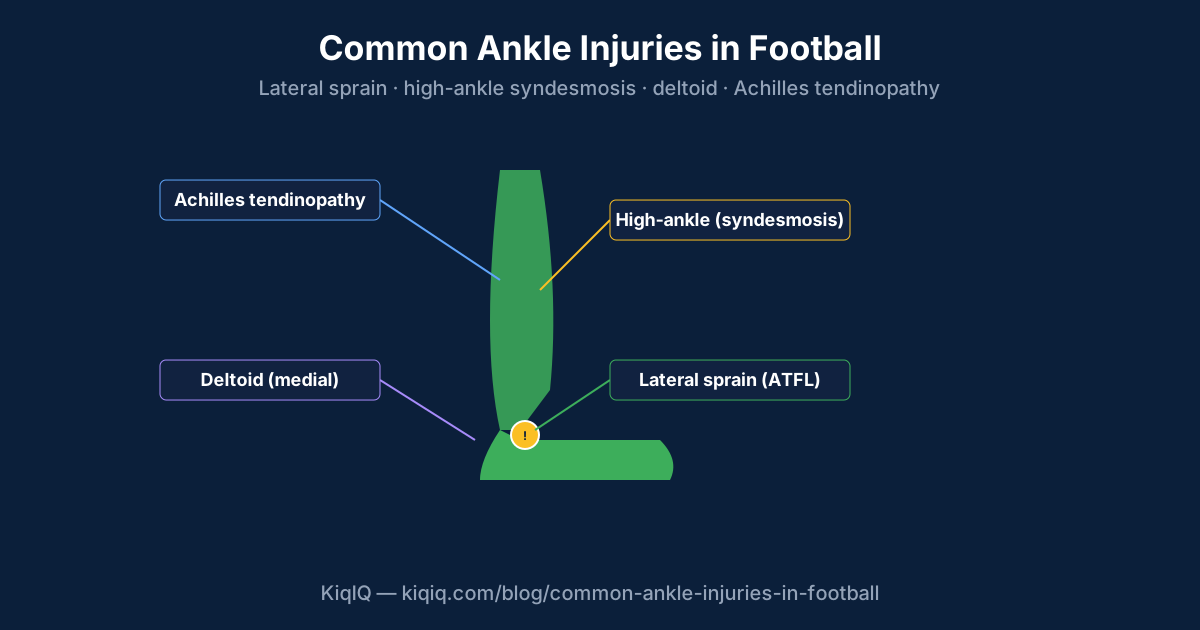
Football has the highest ankle-injury incidence of any global sport. The four most common ankle injuries (lateral ankle sprain, high ankle / syndesmosis sprain, peroneal tendon injury, and anterior impingement) each have a distinct mechanism, rehab timeline, and return-to-play criteria. Lateral sprains heal in 2-6 weeks; syndesmotic injuries can sideline players for 6-12 weeks. This is a coach/player-facing explainer, not medical advice. Diagnosis and rehab decisions belong with a qualified clinician.
Why ankle injuries dominate football
Football combines almost every biomechanical pattern that puts the ankle at risk. Repeated cutting and change-of-direction movements load the lateral ligaments. Studs catching on the surface during planting create rotational forces the joint isn't evolved to absorb. Aerial contests put the ankle at the mercy of how the player lands. Tackles transmit force through the foot at angles the joint can't escape from. Across professional, amateur, and youth football, the ankle is consistently the most-injured anatomical site after the thigh.
UEFA's Elite Club Injury Study has tracked the pattern over more than two decades: ankle injuries account for roughly 12-15% of all match injuries in the elite men's game, with the lateral ankle sprain alone the single most common diagnosis. The numbers in the women's game and at academy level are broadly similar, though some sub-types (notably ACL and anterior impingement) skew slightly differently between cohorts. The single-volume clinical reference on the territory is *Ankle Football: Sports Traumatology*, which covers anatomy, mechanisms, surgical and conservative management, and rehabilitation across the major football ankle injuries, written for clinicians but accessible to a serious coach or strength-and-conditioning practitioner who wants to understand how the medical team is thinking.
Quick question
Which is the classic football ankle injury?
Lateral ankle sprain: the classic football injury
A lateral ankle sprain involves damage to the ligaments on the outside of the ankle, primarily the anterior talofibular ligament (ATFL) and, in more severe cases, the calcaneofibular ligament (CFL) and posterior talofibular ligament (PTFL). The mechanism is almost always an inversion event: the foot rolls inward, often after landing on an uneven surface, an opponent's foot, or during a sharp cut where the planted foot can't track the body's direction change.
Severity is graded I-III. Grade I is a ligament stretch with mild swelling and minimal pain on weight-bearing; return to play is typically 1-2 weeks. Grade II is a partial tear with moderate swelling, bruising, and clear loss of joint stability; return is 2-6 weeks. Grade III is a complete ligament tear with significant instability; return is 6-12 weeks and may require surgical opinion if conservative rehab fails. The biggest risk factor for a future lateral sprain is a previous lateral sprain, recurrence rates of 40-70% within 12 months are documented in the literature, which is why proprioceptive rehab matters as much as ligament healing.
- Mechanism: inversion (foot rolls inward), most often after a cut or landing.
- Diagnosis signs: lateral ankle swelling, pain on inversion stress test, tenderness over ATFL.
- Rehab timeline: Grade I: 1-2 weeks; Grade II: 2-6 weeks; Grade III: 6-12 weeks.
- Return-to-play criteria: full pain-free range, single-leg balance ≥30s, hopping symmetry within 10% of uninjured side.
- Recurrence risk: 40-70% within 12 months without structured proprioceptive rehab.
High ankle / syndesmosis injury: the longer lay-off
The syndesmosis is the fibrous connection between the tibia and fibula just above the ankle joint. A high ankle sprain (also called a syndesmotic sprain) involves damage to this ligamentous bridge, typically caused by external rotation of the foot relative to the lower leg. The classic mechanism in football is a player getting their foot planted while being tackled from the side, forcing the foot outward against the locked planted ankle.
High ankle sprains are often initially misdiagnosed as lateral sprains because the early swelling and pain pattern can look similar. The distinguishing features are tenderness above the ankle joint line (over the syndesmosis), positive squeeze test (pain when the lower-leg bones are compressed together at mid-calf), and significantly slower recovery than the swelling alone would suggest. Rehab timelines run 4-8 weeks for stable syndesmotic injuries and 8-12+ weeks for unstable injuries (those with frank diastasis between the tibia and fibula on imaging). Unstable syndesmotic injuries often require surgical fixation (a screw or tightrope stabilisation) before rehab begins.
Peroneal tendon injury
The peroneal tendons run down the outside of the lower leg, wrap around the back of the lateral ankle bone (the lateral malleolus), and insert into the foot. They're responsible for foot eversion and contribute significantly to lateral ankle stability. Acute peroneal injury (typically a strain, tear, or subluxation of the tendon from its bony groove) can occur in the same inversion event that produces a lateral ankle sprain, and the two often coexist.
Chronic peroneal tendinopathy is more common than acute peroneal rupture in football. The presenting symptom is pain behind and below the lateral malleolus, particularly when pushing off in cutting or sprinting. Rehab focuses on eccentric loading of the peroneal complex, calf and intrinsic-foot strengthening, and a gradual return to dynamic lateral movement. Timelines for tendinopathy are 4-12 weeks; acute peroneal subluxation often requires surgical opinion. The injury is frequently missed in routine clinical exams because it sits anatomically close to where lateral ankle sprain pain presents, a tendon-specific diagnosis matters because the rehab is different.
Anterior ankle impingement, the footballer's ankle
Anterior ankle impingement (sometimes still called "footballer's ankle" in older clinical writing) refers to pinching of soft tissue or bony spurs at the front of the ankle joint during dorsiflexion (toes-up). It develops over time as repeated forceful dorsiflexion (the position the ankle is in at the bottom of a kicking action) causes bony adaptation: small osteophytes form on the front of the tibia and talus that physically restrict the joint at end-range. Pain at the front of the ankle on forced dorsiflexion is the classic symptom; loss of dorsiflexion range during squatting or kicking is the functional sign.
Conservative management focuses on calf flexibility, joint mobilisation, and avoidance of provocative end-range positions. Arthroscopic debridement of the osteophytes is the surgical option when conservative care fails or when the impingement is producing recurrent symptoms in-season. Return-to-play after surgical debridement is typically 8-12 weeks. Posterior impingement (a related condition affecting the back of the ankle during plantarflexion, common in dancers but seen in goalkeepers) is the less-frequent counterpart to the anterior version.
Mechanisms of injury: when and why ankles fail in football
Five game-situation mechanisms account for the majority of football ankle injuries:
- Cutting and change of direction: planted foot can't track the body's direction shift; lateral ligaments take the load. Most lateral sprains.
- Landing from aerial contests: landing on an opponent's foot, on uneven ground, or with the foot not square underneath the body. Inversion mechanism, lateral sprains common.
- Direct tackle contact: opponent's body forces the foot into an extreme position the player can't control. Often syndesmotic.
- Studs catching: particularly on long-bladed studs on dry firm ground; the foot stays planted while the body rotates. High rotational load through the joint.
- Cumulative kicking load: repeated forceful dorsiflexion at the bottom of striking actions over years. Anterior impingement develops gradually.
Mechanism matters because the rehab differs. A coach reporting "ankle injury" without describing how it happened gives the medical team an incomplete picture. Was it a cut, a tackle, a landing, a stud-catch? The answer to that question is part of the diagnosis.
Return-to-play criteria: when is the ankle actually ready?
Return-to-play decisions for ankle injuries should not be made on calendar dates alone. The literature increasingly supports criterion-based return: a checklist of objective markers the player must clear before resuming full training and matches. The standard battery includes full pain-free range of motion (compared to the uninjured side), full strength on isolated muscle testing (eversion, inversion, dorsiflexion, plantarflexion), single-leg balance for 30+ seconds with eyes closed, hopping symmetry within 10% between sides on triple hop and side hop tests, and full sport-specific skill demonstration (cutting at 90° and 180° at full speed without compensation).
Where calendar timelines are useful is as a sanity check on the criterion-based plan. A lateral sprain that's ready for full return inside two weeks is either Grade I or being rushed; a sprain that's not ready at six weeks for a Grade II warrants imaging to rule out an associated injury. The combination of "right timeline AND right criteria" is the safe ground; either alone can mis-fire.
Prevention: proprioception, strength, and footwear
Ankle-injury prevention works. The strongest evidence base is for proprioceptive training (single-leg balance drills, wobble-board work, dynamic balance protocols), which has been shown in multiple peer-reviewed studies to reduce ankle-sprain incidence by 30-50% in football populations. Programmes need to be applied prophylactically (before the season, integrated into warm-ups) rather than only after an injury.
Strength of the peroneal complex (eccentric eversion exercises), calf complex, and intrinsic foot muscles supports the ankle's active stabilisation. Taping and bracing have a documented effect on reducing re-injury risk in players with prior ankle sprain history; clinical support is strongest as part of a returning-player protocol rather than for the whole squad. Footwear matters too: stud configuration appropriate to the surface (firm-ground studs on dry firm pitches catch and contribute to rotational injury), shoes that fit the player's foot shape, and replacement at appropriate intervals all contribute to risk reduction.
Further reading and clinical references
For players, coaches, and physio assistants who want a deeper grounding than a general explainer, the clinical-textbook literature on the football ankle is well-developed. Pair the single-volume traumatology references with the BJSM (British Journal of Sports Medicine) open-access papers on ankle injury in football for the most current research-level findings.
Practical reminder: this article is a structural explainer, not medical advice. Any acute ankle injury that produces significant swelling, an inability to weight-bear within a few hours, audible pop or crack at the time of injury, or unusual pain location warrants in-person clinical assessment before any return-to-training plan is built. The fastest way to turn a 3-week injury into a 3-month injury is to misdiagnose it and rehab the wrong thing.
Frequently asked questions
- What is the most common ankle injury in football?
- The lateral ankle sprain, an inversion-mechanism injury to the ligaments on the outside of the ankle, primarily the anterior talofibular ligament (ATFL). It accounts for the majority of ankle diagnoses in professional, amateur, and youth football. Grade I sprains recover in 1-2 weeks; Grade II in 2-6 weeks; Grade III in 6-12 weeks with possible surgical opinion if conservative rehab fails.
- What is the difference between a lateral ankle sprain and a high ankle sprain?
- A lateral ankle sprain damages the ligaments on the outside of the ankle from an inversion (foot rolling inward) mechanism. A high ankle sprain (syndesmotic injury) damages the ligamentous bridge between the tibia and fibula above the ankle joint, usually from external rotation. High ankle sprains have a longer rehab timeline (4-12+ weeks vs 1-6 weeks) and are often initially misdiagnosed as lateral sprains.
- How long does a football ankle injury take to heal?
- It depends on the diagnosis and severity. Grade I lateral sprain: 1-2 weeks. Grade II lateral sprain: 2-6 weeks. Grade III lateral sprain: 6-12 weeks. Stable syndesmosis: 4-8 weeks. Unstable syndesmosis: 8-12+ weeks (often with surgical fixation). Peroneal tendinopathy: 4-12 weeks. Anterior impingement: 8-12 weeks if surgical debridement required. Calendar timelines are a sanity-check; objective return-to-play criteria should drive the actual decision.
- How can football players prevent ankle injuries?
- Proprioceptive training (single-leg balance, wobble-board, dynamic balance protocols) has the strongest evidence, 30-50% reduction in ankle-sprain incidence in football populations when integrated into warm-ups. Pair with peroneal and calf strength work, appropriate footwear and stud choice for the surface, and prophylactic taping or bracing for players returning from prior injury. Address proprioception before the first sprain rather than only after.
References
Ask KiqIQ a follow-up
Get a live, data-driven answer powered by our live data feeds + KiqIQ's Poisson model. Try one of these prompts or write your own.
Part of pillar
Performance Science
See every article in this knowledge pillar →
Related
Reviewed by a KiqIQ editor before publication. Spotted an error? Email editor@kiqiq.com. We follow our Corrections Policy.