
West Bromwich Albion Shirt History: The Throstles, the Navy-and-White Stripes
West Bromwich Albion shirt history: the throstle (song thrush) heritage, the navy-and-white stripes from the 19th century, the manufacturer rotation, and modern away-kit experimentation.
 Tap to enlarge
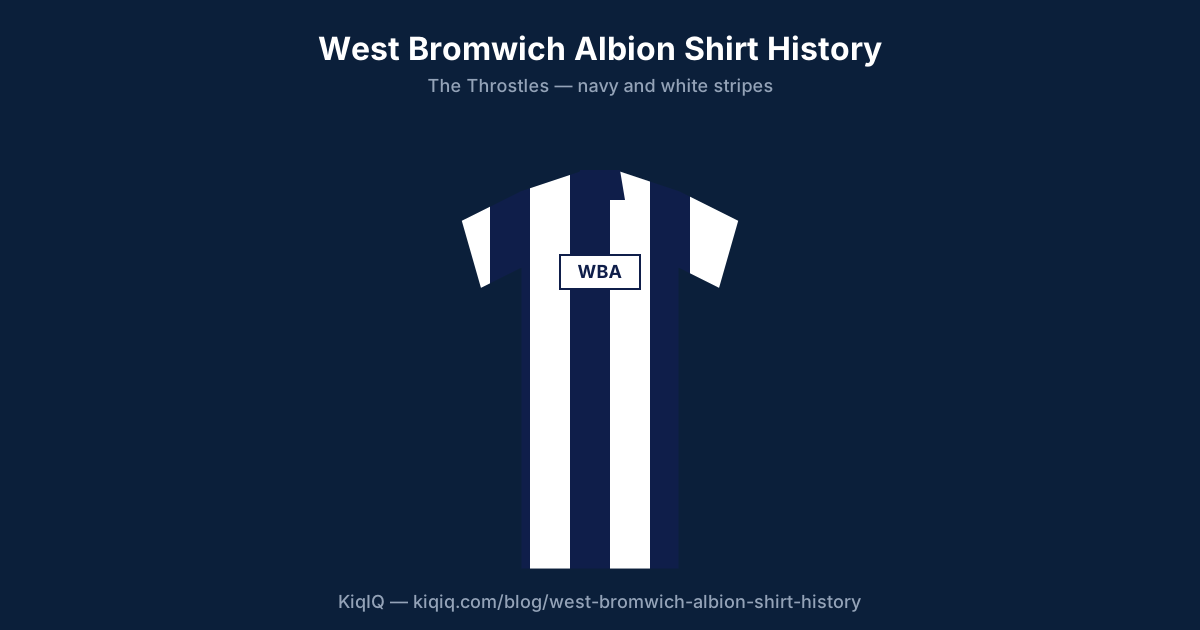
West Bromwich Albion's home shirt has been navy-and-white vertical stripes for almost the entire history of the club. Founded in 1878 and one of the twelve founder members of the Football League in 1888, Albion's kit identity is among the oldest continuously-used designs in English football. The throstle (song thrush) crest, the Black Country heritage, and the stripe pattern have anchored the visual identity through every era of professional football since the 1880s.
An 1878 founding and the stripe heritage
West Bromwich Strollers was founded in 1878 in the Black Country town of West Bromwich, renamed West Bromwich Albion in 1880, and became one of the twelve founder members of the Football League at its inaugural 1888-89 season. The navy-and-white vertical-stripe home design was settled in the club's earliest seasons and has been the heritage anchor of the kit ever since. The exact width of the stripes has varied across manufacturer eras, but the basic structure (vertical, navy-and-white, full-width across the front) has been the constant.
A current example is a 2022-23 West Bromwich Albion away shirt, illustrating how the away-kit slot operates as the design-experimental space alongside the conserved navy-and-white home identity.
The throstle and Black Country identity
The throstle (an old name for the song thrush, Turdus philomelos) is the club's heritage emblem and one of the most-distinctive crests in English football. The connection comes from a song thrush that was kept in a cage at the Plough and Harrow public house on Sandwell Road, near the early Albion training ground, in the late 1800s. The thrush became associated with Albion via the players' regular post-training visits to the pub, and the bird was formally adopted into the club's identity in the late 19th century.
Across the modern era the throstle has appeared on the crest in several stylised forms, sometimes sitting alone, sometimes paired with a hawthorn bush (a nod to The Hawthorns, the club's home ground since 1900). The current crest preserves the heritage reference while modernising the line work. The Hawthorns itself takes its name from the hawthorn bushes that grew on the original ground site, and the bird-and-bush motif is one of the most-direct stadium-to-crest connections in English football.
Quick question
What is West Bromwich Albion's home shirt?
The 1968 FA Cup win and the manufacturer-template era
Albion's most-celebrated modern silverware is the 1968 FA Cup, won 1-0 against Everton at Wembley with Jeff Astle scoring an extra-time winner. The shirts of the period (still in the pre-manufacturer-template era of British football, with kit produced via traditional supplier arrangements) carry a simpler design language: navy-and-white stripes, plain white shorts, the club badge embroidered without the manufacturer co-branding that defined later decades. Original 1960s match shirts surface only rarely on the collector market.
From the 1970s onwards Albion cycled through the standard British kit manufacturers of each era: Umbro, Admiral, Adidas, Diadora, Patrick, and others through the modern period. The manufacturer cycle produced a recognisable internal taxonomy in the collector market, with each era's templates carrying distinctive collar, sleeve, and chest detailing. The late-1970s and early-1980s Admiral templates are particularly recognised within English lower-league collecting.
Albion are one of the twelve founder members of the Football League (1888-89) and the navy-and-white stripe home design dates to the same era. The kit identity is among the oldest continuously-used designs in English football.
The Premier League years and modern away-kit experimentation
Albion's Premier League seasons across the 2000s and 2010s coincided with a more commercially-significant kit programme, with shirts produced by Adidas and other major manufacturers under heavier media exposure than the lower-league periods. The home navy-and-white stripes remained heritage-protected through this period; the away kits became the design experimentation space, with seasons running variants in yellow, all-white, black, light blue, and other colour combinations.
Across the 2020s, with Albion bouncing between the Premier League and the Championship, the kit programme has continued with a sequence of away kits ranging across paler and bolder palettes. The 2022-23 away kit is representative of the format: a clear visual departure from the home stripes, designed to be wearable as casual kit, with the throstle crest as the consistent identity anchor across the home/away/third range.
The collector market and the long-history continuity
Albion shirts sit in a similar collector category to other founder-member clubs with stable colour schemes (Aston Villa, Wolverhampton Wanderers, Stoke City, Notts County): the design continuity makes individual season-shirt collection feasible across a long arc, with manufacturer cycles and sponsor turnover doing the season-by-season visual distinction work. A collector chasing 'a shirt from each Albion decade since the 1970s' has a clear, recognisable progression to follow.
Sponsor history is a meaningful part of the collector taxonomy. The various Albion sponsors across the 1980s, 1990s, and 2000s (regional Black Country businesses, then national brands as the club entered and re-entered the Premier League) provide a date stamp for individual shirts. The 1968 pre-sponsor era, the early-sponsor templates of the 1980s, and the major-brand sponsorships of the Premier League years are recognised internal periods within Albion shirt collecting.
- 1878 founding: West Bromwich Strollers, renamed Albion 1880.
- 1888 Football League founder member: One of the twelve original Football League clubs.
- Throstle crest: Tied to a thrush kept at the Plough and Harrow pub near the early training ground.
- The Hawthorns since 1900: Stadium name and crest hawthorn motif both reference the bushes on the original ground.
- 1968 FA Cup win: Jeff Astle, 1-0 against Everton at Wembley.
- Modern manufacturer rotation: Umbro, Admiral, Adidas, Diadora, Patrick, and others across the decades.
Frequently asked questions
- What colours does West Bromwich Albion play in?
- West Bromwich Albion play in navy-and-white vertical stripes at home, an identity used continuously since the club's early seasons after the 1878 founding. Away kits have varied across yellow, all-white, black, light blue, and other variants across the manufacturer eras. The home stripe layout is heritage-protected in practice: every modern manufacturer has retained it across Albion's Premier League and Championship cycles.
- Why are West Brom called the Throstles?
- The throstle is an old name for the song thrush. Albion's connection to the bird comes from a thrush kept in a cage at the Plough and Harrow public house on Sandwell Road, near the early club training ground, in the late 19th century. The bird became associated with the players who regularly visited the pub, and the throstle was formally adopted into the club's identity in the late 1800s. The current crest preserves the throstle reference alongside a hawthorn-bush motif.
- When was West Bromwich Albion founded?
- West Bromwich Strollers was founded in 1878 and renamed West Bromwich Albion in 1880. The club became one of the twelve founder members of the Football League at its inaugural 1888-89 season. Albion has played at The Hawthorns since 1900, with the stadium name referencing the hawthorn bushes that grew on the original ground site. The navy-and-white stripe home identity dates to the same late-19th-century era.
- When did West Brom win the FA Cup?
- West Bromwich Albion last won the FA Cup in 1968, beating Everton 1-0 in the final at Wembley with Jeff Astle scoring an extra-time winner. Albion have also won the FA Cup in 1888, 1892, 1931, and 1954, making them one of the most-successful clubs in the competition's history. The 1968 shirts (still in the pre-manufacturer-template era) carry a simpler design language and are rare items on the modern collector market.
References
- West Bromwich Albion, official club history · West Bromwich Albion FC
- Football Shirt Culture Magazine, English football archive · Football Shirt Culture
- Classic Football Shirts, West Brom editorial archive · Classic Football Shirts
- Historical Football Kits, West Brom archive · Historical Football Kits
- West Bromwich Albion 2022-23 away shirt, Mystery Shirt Club (affiliate) · Mystery Shirt Club
Key terms in this article
Ask KiqIQ a follow-up
Get a live, data-driven answer powered by our live data feeds + KiqIQ's Poisson model. Try one of these prompts or write your own.
Related
Reviewed by a KiqIQ editor before publication. Spotted an error? Email editor@kiqiq.com. We follow our Corrections Policy.