
Load Management for Amateur Football: How to Avoid Injuries Without Sports Science Kit
Practical load-management heuristics for amateur footballers and once-a-week coaches. ACWR in plain English, training-week structure, recovery markers and fatigue signs to watch without GPS or RPE apps.
 Tap to enlarge
Most performance content available to football coaches assumes pro-level instrumentation: GPS pods on every player, daily session-RPE apps, a dedicated strength and conditioning department, lactate threshold testing in pre-season. The amateur context strips all of that away. A once-a-week Sunday-league coach with no kit beyond a stopwatch still needs to manage load if they want their squad to finish the season. The good news is that the underlying principles, including the Acute-to-Chronic Workload Ratio framework first formalised by Tim Gabbett, translate into eye-and-ear heuristics any coach can apply without instrumentation.
What ACWR actually says in plain English
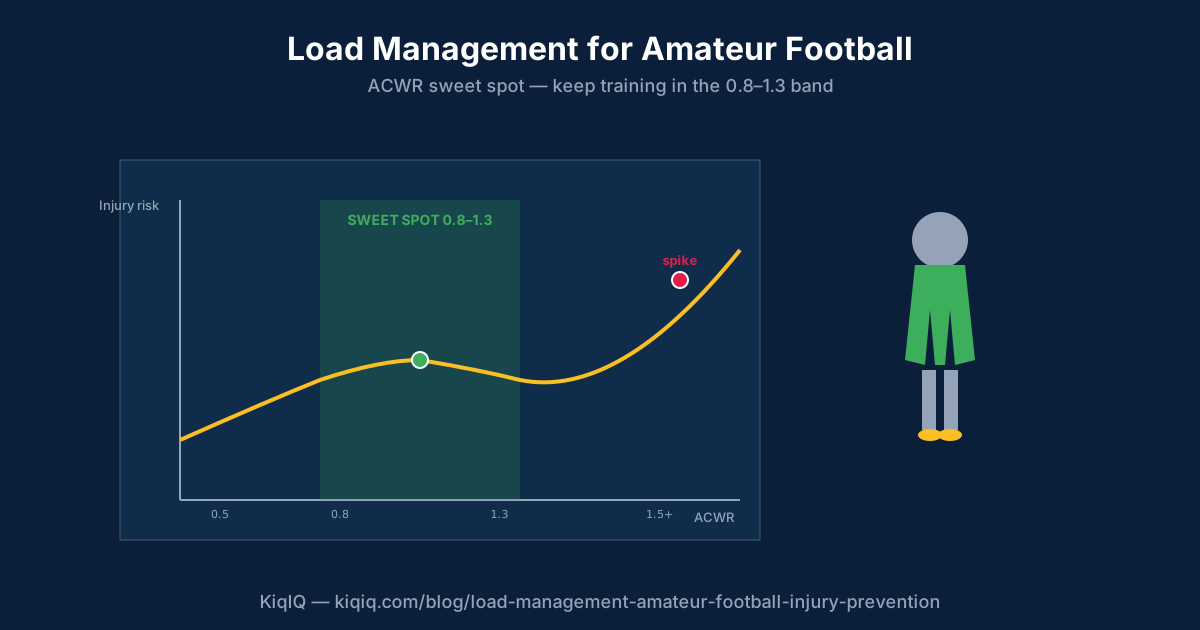
The Acute-to-Chronic Workload Ratio compares a player's recent training load (typically the last seven days) to their longer-term training load (typically the last 28 days). The classic Tim Gabbett framework, published across multiple papers in the British Journal of Sports Medicine, framed an ACWR between 0.8 and 1.3 as a "sweet spot" with low injury risk, and ratios above 1.5 as a "danger zone" where the risk of soft-tissue injury rises sharply (Gabbett, 2016).
In plain English: if the last week has been substantially heavier than the player's recent month-long average, the player is running hot relative to their conditioning baseline. The body has not had time to adapt to the spike, and the probability of a non-contact injury (hamstring tear, calf strain, ankle sprain) goes up. The reverse is also true: if a player has been doing nothing for three weeks and then plays a full 90-minute Sunday match, the body is unprepared for the spike, and the same elevated injury risk applies.
The framework has been challenged in subsequent research. A 2024 Bundesliga study found the chronic-load component, particularly when standardised to a player's individual lactate-threshold velocity, is the stronger predictor than the ratio itself. The amateur takeaway is unchanged: smooth out the spikes, keep the chronic baseline reasonable, and avoid the boom-bust cycle of three weeks off followed by a 90-minute fixture.
ACWR in one sentence: if last week is much heavier than the last month's average, the body is unprepared for the spike, and non-contact injury risk goes up.
A four-block training week without instrumentation
The training-week structure used at professional level translates directly to amateur scheduling, even if the volumes are lower. The standard pattern is heavy-medium-light-rest, with the heavy session 72 hours from the match and the light session 24-48 hours before kick-off. For a Sunday match, that means a heavy session on Wednesday or Thursday, a medium session on Friday, a light session on Saturday, and rest on Monday and Tuesday after the match.
The principle behind the pattern is that hard sessions need 48-72 hours of recovery before competition, and the body should not be loaded inside the 24 hours before a match. The exact day-of-week structure depends on what your players can attend; the relative spacing matters more than the calendar position. A team that only trains once a week should treat that session as a "medium" load 3-4 days before the match, never a "heavy" load 24 hours before.
- Heavy. High-intensity small-sided games, sprint work, set-piece intensity. 72 hours before match.
- Medium. Pattern play, possession drills, moderate-intensity finishing. 48 hours before.
- Light. Technical work, set-piece walk-throughs, no high-speed efforts. 24 hours before.
- Rest. 24-48 hours post-match. Active recovery (walking, cycling) preferred over total inactivity.
Quick question
You coach an amateur side with no GPS and no S&C department. What still works?
Recovery markers any coach can spot without kit
The pro-level monitoring stack uses morning heart-rate variability, jump-mat readings, urine specific gravity and a daily wellness questionnaire. None of that is available at amateur level. The eye-and-ear substitutes are surprisingly effective because the underlying signals are large enough to be visible without instruments.
Watch the warm-up. A player who arrives ten minutes late, jogs at a noticeably reduced effort during the warm-up laps, complains of stiffness in the same area as the previous session, or shows up with strapping that was not there last week is signalling accumulated fatigue or carrying a niggle. The British Journal of Sports Medicine has published on the validity of simple self-report markers in non-elite cohorts (Saw, Main and Gastin, 2016): they correlate well with objective load measures even when the player has had no training in formal self-reporting.
Listen during the cool-down. Players who walk away from a session unusually quiet, decline a post-session drink, or mention sleep disruption from "achy legs" are signalling more than they would in writing. The FA grassroots coaching guidance has long recommended a brief check-in conversation at the end of every session as the cheapest fatigue-monitoring tool available to a once-a-week coach.
Symptoms that should make a player drop out of the session
Three categories of in-session symptom should trigger a player drop-out, regardless of fitness level or how important the upcoming match is. The first is sharp, localised pain that is asymmetric (one calf and not the other, one hamstring and not the other). Asymmetric pain is the body signalling a structural problem rather than general fatigue. The second is a sudden loss of explosive output, where a player who normally produces sharp first steps is visibly half a yard slower over a 10-metre sprint. The third is any sign of dizziness, nausea or disorientation, which can indicate dehydration, low blood sugar or in rare cases more serious cardiovascular issues.
The conservative rule that works at amateur level: when in doubt, drop the player out of the session, ask them to walk for five minutes, and reassess. The cost of stopping early is a missed half-hour of training. The cost of pushing through is typically two to six weeks out with a soft-tissue injury, which sets the player's chronic baseline back to zero and makes the next return-to-play even riskier.
How a once-a-week coach can spot accumulating fatigue
The pattern that catches most amateur coaches off guard is the slow accumulation rather than the obvious spike. A player who has played four fixtures in three weeks (a midweek cup tie, two league matches, and a casual five-a-side they did not mention) arrives at training looking tired, performs at 90% of their usual level, and is waved through as "having an off day". The next match they tear a hamstring inside fifteen minutes.
Three habits intercept that pattern. The first is asking about external load at the start of every session: "what football have you played since I last saw you?". Players will not volunteer the casual five-a-side or the work team's lunchtime match unless asked. The second is comparing the player against their own baseline rather than against the rest of the squad: a 25-year-old recreational player who normally arrives chatty and arrives quiet has changed, and the change is the signal. The third is rotating intensity within the squad rather than running every session at the same load: in a 16-player amateur squad, three or four players carrying niggles can be managed into lower-intensity drills without anyone losing face.
For sides where injury history is becoming visible across the season, the longer-form ACWR primer at /blog/acwr-endurance-injury-football covers the chronic-load research findings from the Bundesliga in more depth, and /blog/stretches-for-football covers the mobility work that pairs with load management to extend the durability window.
What changes when you actually do have basic kit
Sub-pro environments increasingly have access to entry-level kit: a £20 GPS phone-strap app, a session-RPE form in a free questionnaire tool, a basic wellness score collected in a group chat. These add precision but do not change the underlying mechanics. Tim Gabbett's own work emphasises that the value of monitoring lies in the consistency of measurement, not the sophistication of the metric. A team that has tracked perceived exertion on a 1-to-10 scale for ten consecutive weeks has more useful information than a team that started using GPS yesterday.
For coaches considering an upgrade, the priority order is: a simple post-session RPE collection (free), then attendance and minute tracking across all competitive matches and training, then objective load measurement (GPS or accelerometer) if budget allows. The compound effect of the first two is larger than most amateur coaches expect, and the cost is one Google Form and ten seconds at the end of each session.
Frequently asked questions
- What is ACWR and does it work for amateur footballers?
- The Acute-to-Chronic Workload Ratio compares the most recent seven days of training load to the most recent 28 days. The Gabbett "sweet spot" of 0.8 to 1.3 was developed in elite cohorts but the underlying principle, that sudden spikes raise injury risk, applies at every level. Amateur coaches can apply the principle without instrumentation by smoothing out the heavy-week / light-week pattern.
- How should an amateur team structure its training week?
- Heavy session 72 hours before the match, medium 48 hours before, light 24 hours before, rest immediately after. For a Sunday fixture, that places the heavy session on Wednesday or Thursday. Once-a-week sides should treat their single session as a medium-load day 3-4 days from the match, never as a heavy session inside 48 hours.
- What recovery markers can a coach without GPS use?
- Three eye-and-ear markers: how the player moves in the warm-up (late arrival, reduced effort, complaints of stiffness are signals), what they say in the cool-down (unusually quiet, sleep disruption, declined drink), and asymmetric niggles that recur in the same body area across sessions. Brief end-of-session check-in conversations correlate well with formal wellness scores in non-elite cohorts.
- When should a player drop out of a session?
- Three triggers should always pull a player out: sharp asymmetric pain on one side only, sudden loss of explosive output relative to that player's normal level, or any dizziness, nausea or disorientation. The conservative rule is to drop out, walk for five minutes and reassess. The cost of pausing is small; the cost of pushing through is typically two to six weeks out.
- What is the biggest mistake amateur players make with load management?
- The slow accumulation that no single session reveals. A player who plays a midweek cup match, a league match, a casual five-a-side and a work team's lunchtime kickabout in the same week is at high injury risk by Sunday, even if no individual session was unusually hard. Asking "what football have you played since I last saw you?" at every session intercepts the pattern that catches most amateur coaches off guard.
References
- Gabbett (2016): The training-injury prevention paradox · British Journal of Sports Medicine (mar 2016)
- Saw, Main and Gastin (2016): Monitoring the athlete training response via subjective self-reported measures · British Journal of Sports Medicine (mar 2016)
- Marshall et al. (2024): ACWRHMLD vs underlying acute and chronic components and injuries · Applied Sciences (MDPI) (oct 2024)
- FA grassroots coaching guidance · The Football Association
- Bowen et al.: Injury risk and training load in elite youth football · British Journal of Sports Medicine
Key terms in this article
Ask KiqIQ a follow-up
Get a live, data-driven answer powered by our live data feeds + KiqIQ's Poisson model. Try one of these prompts or write your own.
Part of pillar
Performance Science
See every article in this knowledge pillar →
Related
Reviewed by a KiqIQ editor before publication. Spotted an error? Email editor@kiqiq.com. We follow our Corrections Policy.