
Inverted Winger Explained: Why Right-Footed Left-Wingers Dominate Modern Football
An inverted winger is a wide attacker playing on the opposite flank to their strong foot. We explain the geometry, the famous practitioners, and why the role has overtaken the orthodox touchline winger.
 Tap to enlarge
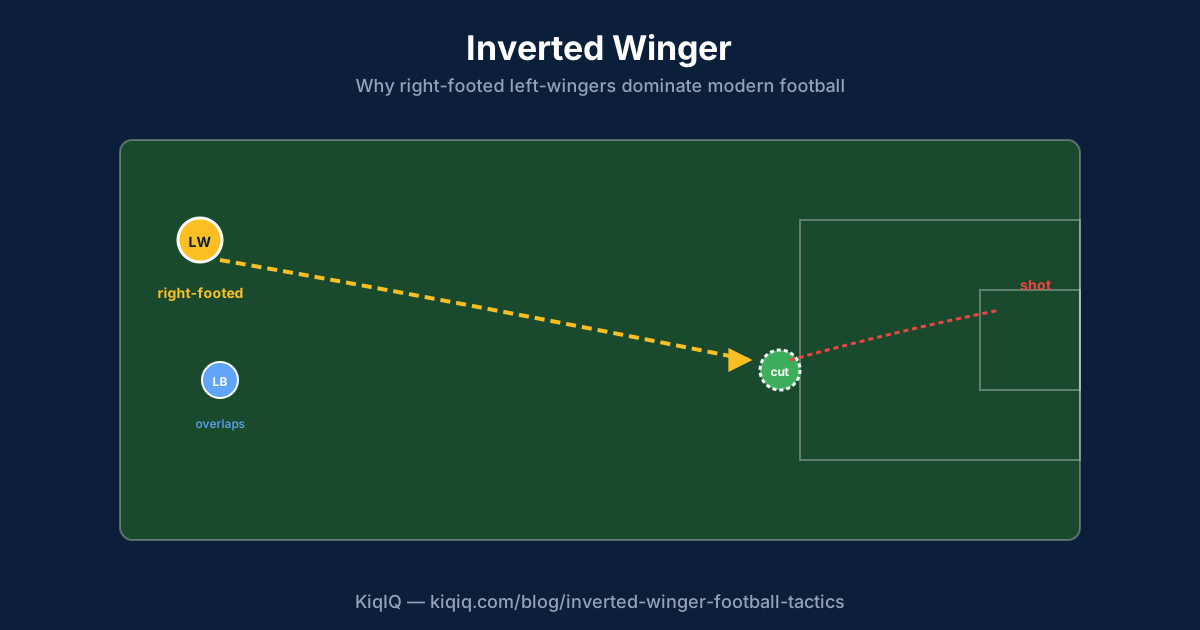
An inverted winger is a wide attacker whose strong foot is opposite to the flank they occupy: a right-footed player on the left wing, a left-footed player on the right. The setup looks counter-intuitive until you see what it does to the geometry of the final third. The strong foot is angled into the pitch rather than into the touchline, which means cutting inside opens a shooting line, a through-ball lane to the centre-forward, and a curling cross to the back post that an orthodox winger cannot produce. Arjen Robben, Mohamed Salah, Lionel Messi and Bukayo Saka are the canonical reference cases.
What the geometry actually does
A right-footed player standing on the left touchline has two options when they receive the ball facing the opposition goal. They can go down the line on the weaker left foot, then attempt a cross from a tight angle with the wrong foot, or they can cut inside onto the strong right foot. The geometry of the pitch makes the second option the higher-value choice in roughly seven of every ten in-possession scenarios, which is why inverted wingers exist.
Cutting inside onto the strong foot opens four specific outputs that the orthodox winger struggles to produce. First, a shot with the strong foot bending toward the far corner, the Robben signature finish. Second, a through ball with the inside of the strong foot into the channel between centre-back and full-back. Third, a curling cross to the back post that arcs away from the goalkeeper. Fourth, a one-two with the central midfielder rolling into the half-space. The orthodox winger, by contrast, is restricted to byline cross-and-cutback patterns and beating the full-back on the outside, both of which are higher-effort and lower-conversion.
The single sentence: the inverted winger's strong foot points into the pitch, not into the touchline. Every output flows from that one geometric fact.
Try it
Orthodox or inverted?
Same flank, same player, opposite strong foot. Watch what changes about the options available.
Strong foot on the outside
A left-footed player on the left. The strong foot is angled towards the touchline, so the natural action is to go outside and cross.
- Best delivery: the outswinging cross from the byline.
- Beats the full-back on the outside, where there is no cover behind.
- No shooting angle from wide, because the body is opening away from goal.
The inverted winger trades byline penetration for three central options. That trade is why the role took over, and why sides still keep one orthodox winger to stretch the pitch.
The canonical practitioners and what they actually do
Arjen Robben is the closest the role has had to a single defining figure. The right-footed Dutchman spent twelve years at Bayern Munich playing on the right, cutting inside onto the left of a defender, and finishing or threading the ball into the box. The pattern was so consistent that opposition defenders knew exactly what was coming and could not stop it, because the body shape and the first touch were unstoppable when executed at pace. Robben's 2014 World Cup goals against Spain and Mexico are textbook examples.
Mohamed Salah at Liverpool is the modern continuation. A left-footed right-winger, Salah cuts inside from the right touchline onto the left foot, and his shot map across Klopp's tenure shows roughly 80% of his shots taken from the right half-space or central zone, almost none from the right touchline (StatsBomb, Salah shot maps 2017-2024). Bukayo Saka at Arsenal is the inverted-left-foot variant on the right wing, with Mikel Arteta's side building structural overloads around Saka in the right half-space rather than asking him to beat his man on the outside. Messi's entire Barcelona career was a study in the same idea, with the left-footed Argentine starting on the right wing and drifting into central zones to shoot, pass and dribble.
Why the role overtook the orthodox winger
The shift began around 2008 with two parallel changes. Defensively, sides started defending in compact mid-blocks rather than chasing wide attackers, which meant the orthodox winger's touchline isolation became harder to exploit. Offensively, the rise of the inverted full-back created an attacking full-back who would overlap on the outside, allowing the winger to drift inside without losing width. Once both shifts happened at once, the orthodox winger lost both their primary defensive matchup and their attacking job description.
The xG data confirms what the eye sees. The Athletic's analysis of Premier League winger data from 2018-2024 found that inverted wingers averaged roughly 0.15 non-penalty xG per 90 against 0.08 for orthodox touchline wingers, with the gap driven almost entirely by central shooting locations the inverted role unlocks (The Athletic, Premier League winger analysis). Crossing volume dropped league-wide across the same period as sides moved away from the cross-and-cutback patterns the orthodox winger was built for.
Where the orthodox winger still wins
The role has not died entirely. Three specific cases keep the orthodox winger relevant. First, sides with a dominant aerial target striker (Mateta at Crystal Palace, Watkins at Aston Villa, prime Lukaku) benefit from a touchline crosser who can deliver early balls to the back post. Second, transition-heavy systems where the winger's job is to receive in space and beat the full-back one-versus-one favour the orthodox foot for the byline run. Third, in narrow systems with overlapping full-backs, the winger may invert structurally while still being right-footed-on-the-right because the inversion is provided by the full-back rather than the winger.
Antonio Conte's use of Victor Moses as a right-wing-back at Chelsea in 2016-17 and Stefan Kuntz's German under-21 sides are recent examples of orthodox-foot wide players succeeding because of system fit rather than individual brilliance. The honest read for 2026 is that the inverted winger is the default in roughly 70-80% of top-flight sides, with orthodox wingers used selectively against specific match-ups.
- Inverted winger. Strong foot opposite to flank. Cuts inside to shoot, thread through balls, curl crosses to far post.
- Orthodox winger. Strong foot matches flank. Beats full-back on the outside, delivers conventional crosses from the byline.
- Famous inverted players. Robben, Salah, Messi, Saka, Mané at Liverpool, Sterling, Rashford.
- Tactical pre-conditions. Overlapping full-back to provide width; central striker who can finish back-post curlers; midfielder willing to rotate into the half-space.
How to spot an inverted winger and what to look for
The fastest visual cue is the receiving body shape. An inverted winger receives the ball with the strong foot ready to push the ball infield, and their first touch will angle inside rather than along the touchline. The shot map tells the same story: an inverted winger's shots cluster in the half-space or central zone, with very few from the touchline corner of the box. The cross map is the inverse: inverted wingers will produce far fewer crosses than orthodox wingers from the same minutes, but a higher share of their crosses will be back-post bending deliveries.
Beyond the individual cues, watch the structural support. An inverted winger needs an overlapping full-back to provide the touchline width, a striker who can occupy the centre-back so the curling shot has space to land, and a near-side midfielder willing to rotate into the half-space when the winger comes inside. Sides that play inverted wingers without that structural support produce isolated dribbling moments rather than co-ordinated attacks, which is usually the diagnostic for a system not built for the player rather than a player not built for the system.
Frequently asked questions
- What is an inverted winger in football?
- An inverted winger is a wide attacker whose strong foot is opposite to the flank they occupy: a right-footed player on the left wing, a left-footed player on the right. The setup angles the strong foot into the pitch, which opens shooting lines, through-ball lanes and curling crosses to the back post that an orthodox winger cannot easily produce.
- Who was the first famous inverted winger?
- The role has older roots, but Arjen Robben at Bayern Munich (2009-2019) is the modern reference. Earlier examples include Robert Pires at Arsenal, Cristiano Ronaldo at Manchester United from 2006, and Lionel Messi at Barcelona from 2008. The pattern became league-wide between 2012 and 2018 as orthodox crossing wingers fell out of favour.
- Why does Mohamed Salah play on the right wing if he is left-footed?
- Because he is an inverted winger. Playing on the right with his strong left foot means every time he cuts inside he opens a shooting line with the inside of his foot bending the ball toward the far corner, or a through ball into the channel. Roughly 80% of his Liverpool shots are taken from the right half-space or central zone, almost none from the right touchline.
- What is the difference between an inverted winger and an inside forward?
- They overlap but are not identical. An inverted winger starts wide and cuts inside, with the touchline as their reference line. An inside forward starts in the half-space and operates more centrally, with the central channel as their reference. The same player can shift between the two depending on whether the side is in build-up or in the final third.
- Do inverted wingers still need an overlapping full-back?
- Almost always, yes. If the winger comes inside without a full-back providing the touchline width, the opposition full-back has nothing to mark and can step inside to crowd the half-space. The structural pairing of inverted winger plus overlapping full-back is the modern default. Without it, the inverted winger's threat collapses to individual dribbling moments.
References
- The Athletic: Premier League winger analysis 2018-2024 · The Athletic
- StatsBomb: Salah shot maps and inverted winger profiles · StatsBomb
- Coaches' Voice: tactical breakdowns of inverted wide attackers · The Coaches' Voice
- Spielverlagerung: positional play and wide-attacker geometry · Spielverlagerung
- The Analyst (Opta): crossing trends in European top leagues · The Analyst (Opta)
Key terms in this article
Ask KiqIQ a follow-up
Get a live, data-driven answer powered by our live data feeds + KiqIQ's Poisson model. Try one of these prompts or write your own.
Part of pillar
Tactical Intelligence
See every article in this knowledge pillar →
Related
Reviewed by a KiqIQ editor before publication. Spotted an error? Email editor@kiqiq.com. We follow our Corrections Policy.