
IMU vs GPS in Football: How Each Tracking System Works
GPS measures position via satellites; IMUs (inertial measurement units) measure acceleration / orientation via on-body sensors. Most modern football pods combine both. We explain.
 Tap to enlarge
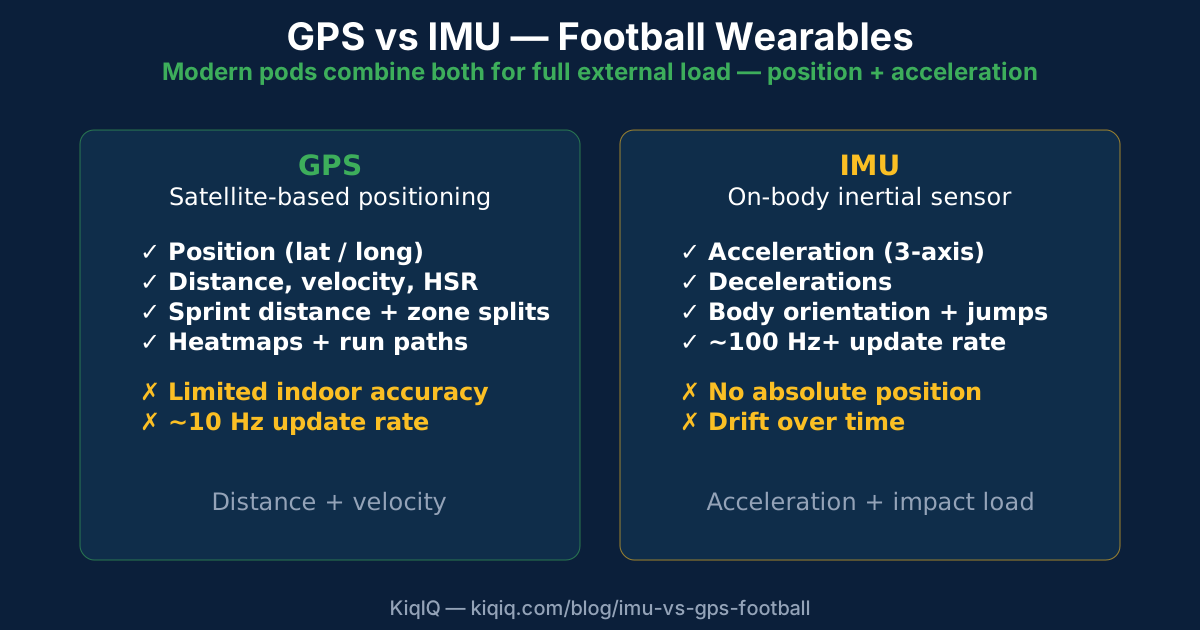
GPS (Global Positioning System) measures a player's position on the pitch via satellite triangulation — typically at 10 Hz. IMU (Inertial Measurement Unit) measures acceleration, orientation, and rotation via on-body sensors (accelerometer + gyroscope + magnetometer) — typically at 100-400 Hz. Modern football pods combine both: GPS for distance and velocity, IMU for jumps, COD, accelerations, and Player Load.
GPS — what it measures well
- Distance covered. Total distance, HSR distance, sprint distance.
- Velocity. Maximum speed, time spent in velocity zones.
- Position on pitch. Heatmaps, average positions.
- Sample rate. 10 Hz typical (10 readings per second).
- Limitations. Indoor venues block GPS; small movements (jumps, COD) under-counted.
IMU — what it measures well
- Accelerations / decelerations. Captures non-linear movement IMU misses.
- Jumps + landings. Vertical accelerations.
- Changes of direction. Lateral accelerations during turns.
- Player Load. Vector magnitude derived from tri-axial accelerometer.
- Sample rate. 100-400 Hz (much higher than GPS).
- Limitations. No position info — can't produce a heatmap or distance metric independently.
Modern combined pods
- Catapult, STATSports, GPSports, PlayerData. All major football wearable vendors combine GPS + IMU.
- GPS provides distance / position. IMU provides intensity / movement-quality detail.
- Single pod, two data streams. Output combined into one dashboard.
- Indoor / futsal use. IMU works without GPS; useful when GPS signal is unavailable.
Try it
GPS or IMU?
Two sensors in the same vest, answering different questions.
Where the player is
Satellite triangulation, typically at 10 Hz, giving position on the pitch and everything derived from it.
- Distance, speed and high-speed running.
- Degrades indoors and under stadium roofs.
- Too slow to resolve very short, sharp actions on its own.
Modern pods carry both, which is why one vest can tell you a player covered 11km and that most of the mechanical cost came from stopping rather than running.
Frequently asked questions
- What is the difference between IMU and GPS in football?
- GPS measures a player's position on the pitch via satellite triangulation, capturing distance, velocity, and heatmaps. IMU measures acceleration, orientation, and rotation via on-body sensors, capturing jumps, COD, accelerations, and Player Load. Modern football pods combine both for full external-load monitoring.
- What does an IMU measure that GPS cannot?
- Jumps, changes of direction (lateral acceleration with no horizontal distance), accelerations / decelerations, and Player Load (vector magnitude). GPS captures movement across the pitch but undercounts intensity when movement is non-linear or vertical. IMU operates at 100-400 Hz vs GPS at 10 Hz, capturing finer movement detail.
- Do football pods use GPS or IMU?
- Both. Catapult, STATSports, GPSports, PlayerData, and other major football wearable vendors combine GPS and IMU sensors in a single pod. GPS provides distance / position; IMU provides intensity / movement-quality detail. Combined data feeds into one dashboard for full external-load monitoring.
References
- Catapult · IMU vs GPS · Catapult / IMeasureU
- Kinexon · Tracking Systems · Kinexon
- Tandfonline · IMU Comparison · Tandfonline
Ask KiqIQ a follow-up
Get a live, data-driven answer powered by our live data feeds + KiqIQ's Poisson model. Try one of these prompts or write your own.
Part of pillar
Performance Science
See every article in this knowledge pillar →
Related
Reviewed by a KiqIQ editor before publication. Spotted an error? Email editor@kiqiq.com. We follow our Corrections Policy.