
Hamstring Injuries in Football: Why They Keep Coming Back
Hamstring strains are the single most common muscle injury in elite football, and the most likely to recur. The evidence on mechanism, Nordic-curl prevention, and return-to-play criteria, explained for coaches and players.
 Tap to enlarge
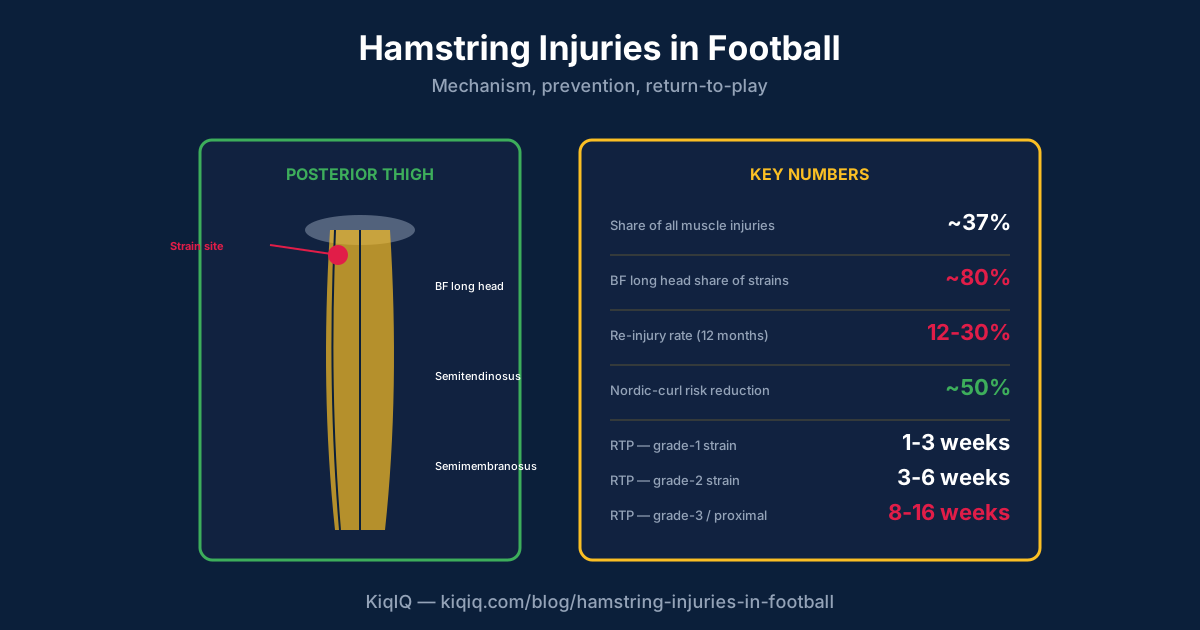
Hamstring strains are the single most common muscle injury in elite football and have been getting more common for two decades, not less. The UEFA Elite Club Injury Study has tracked a roughly 4% year-on-year rise in hamstring incidence since 2001. Recurrence rates sit between 12% and 18% within two months of return, the highest of any common football injury. The evidence on what prevents them (eccentric loading, particularly the Nordic hamstring curl) is unusually strong; the evidence that clubs apply it consistently is not. This piece is a coach- and player-facing explainer, not medical advice.
How common is it, and why is the trend going the wrong way?
The UEFA Elite Club Injury Study has tracked injury patterns across European top-flight squads since 2001. Across the most recent reporting cycles, hamstring injuries account for around 24% of all muscle injuries and roughly 12% of all time-loss injuries in elite men's football. The mean per-squad cost is approximately 90 days lost per season to hamstring problems alone, with five to six separate hamstring incidents per squad in a typical season. The pattern in the women's elite game is broadly similar in incidence per 1,000 match hours.
The trend matters more than the absolute number. Ekstrand and colleagues, publishing repeatedly in the British Journal of Sports Medicine, have documented a steady rise in hamstring incidence at about 4% per year across the study window. Several plausible drivers compound: matches are faster (more high-speed running per 90), schedules are denser (less recovery between exposures), squad rotation patterns concentrate load on the same players, and pitches are more uniform (firm, fast, less variation in surface braking). The biomechanical demand on the hamstrings has gone up faster than the prevention work has caught up.
The hamstring injury rate in elite football has risen roughly 4% per year for two decades. Faster matches, denser fixture lists, more high-speed running per 90.
Anatomy and mechanism: which muscle, and how it tears
The hamstring complex is three muscles on the back of the thigh: the biceps femoris (which itself has a long head and a short head), the semitendinosus, and the semimembranosus. All three cross the hip and the knee. Their job in football is twofold: extend the hip during the propulsive phase of sprinting, and decelerate the swinging leg as it reaches forward during the late-swing phase before foot strike. The deceleration job is eccentric: the muscle is lengthening under high load. That is when most strains happen.
Roughly 80% of football hamstring strains affect the biceps femoris long head, and most occur during high-speed running, particularly in the final stride or two before the foot plants. The classical mechanism is captured on broadcast cameras hundreds of times a season: a player accelerating into open space, body upright, suddenly pulls up clutching the back of the thigh. The injury is a partial tear at the myotendinous junction (where muscle meets tendon), almost always at the proximal end near the ischial tuberosity. A smaller subset of hamstring injuries are stretch-type strains, often involving the semimembranosus, caused by extreme hip flexion with the knee extended, classically kicking actions or sliding tackles.
- Sprint-type strain: late-swing phase of high-speed running, biceps femoris long head, proximal myotendinous junction. Sharp acute pain, the player stops.
- Stretch-type strain: extreme hip flexion with knee extension (high kick, slide tackle, gymnastic landing). Often semimembranosus, often closer to the ischial tuberosity, slower recovery on average.
- Grade I: mild strain, minor fibre disruption, normal walking, 1-2 weeks lost.
- Grade II: partial tear, clear weakness on testing, antalgic gait, 3-6 weeks lost.
- Grade III: complete tear or proximal avulsion, severe weakness, often surgical, 12+ weeks.
Quick question
What has happened to hamstring injury rates in elite football over the last two decades?
Why they recur: the 16% problem
Recurrence is what defines the hamstring as a problem injury in football. The UEFA cohort puts re-injury within two months of return at 12-18% across recent reporting cycles. By the end of the season in which the original strain occurred, the recurrence figure climbs further. Recurrent injuries also tend to be more severe than the index injury and to keep the player out longer the second time around.
Three drivers explain most of the recurrence pattern. First, return-to-play decisions are made on time elapsed rather than function recovered: the player feels fine in straight-line jogging, the calendar says three weeks, and they return to full training without ever testing maximal eccentric strength on the injured side. Second, the residual strength deficit is real and persistent: imaging-confirmed strains leave a measurable eccentric-strength deficit on the injured leg for months, sometimes a season, after the player feels symptom-free. Third, the prevention work that closes that deficit (high-volume eccentric loading) is uncomfortable enough that compliance drops the moment supervised rehab ends. The combination of premature return plus drift away from eccentric work is the recurrence engine.
The Nordic hamstring curl: the most-evidenced intervention in football
The Nordic hamstring curl is a bodyweight eccentric exercise: the player kneels, ankles pinned, and lowers the torso forward under control, resisting gravity with the hamstrings until the muscles can no longer hold the lengthening contraction, at which point the player catches the fall with the hands. It loads the hamstrings precisely in the eccentric range where sprint-type injuries occur. The evidence base for it is unusually strong by sports-medicine standards.
Petersen and colleagues, in a 2011 Danish Superliga randomised controlled trial published in the American Journal of Sports Medicine, found a 65-70% reduction in overall hamstring injuries and a similar reduction in recurrence in the intervention group. Van Dyk and colleagues followed with a 2019 BJSM meta-analysis pooling several trials and confirming the effect in football populations: roughly a 51% reduction in hamstring injury incidence when the protocol was applied consistently. The relevant word is consistently. Compliance studies show many clubs adopt the exercise nominally and then drop the volume after pre-season; the meta-analytic effect assumes the recommended dose of progressively increasing reps across the week, sustained through the competitive season.
Meta-analysis (van Dyk, BJSM 2019): consistently-applied Nordic hamstring protocols reduce hamstring injury incidence by approximately 51%. The dose-response evidence is unusually strong; the compliance evidence is not.
Beyond the Nordic: the supporting prevention stack
Nordic curls are the headline intervention but not the only useful one. The FIFA 11+ warm-up programme, validated in multiple amateur-level trials, includes Nordic-style work alongside dynamic stabilisation drills and has been shown to reduce overall lower-limb injury rates by around 30% when applied as a complete protocol two to three times a week. The Askling L-protocol, developed at the Swedish national-team level, uses three high-eccentric-load exercises (the extender, the diver, and the glider) targeting both flexibility and eccentric strength; the evidence base is smaller than for the Nordic curl but it has clinical traction in elite return-to-play settings.
High-speed running exposure also matters as a prevention variable. Counterintuitively, the players who do the least sprinting in training are not the safest. The hamstring needs regular exposure to near-maximal eccentric loading to maintain capacity; players returning from injury or fixture congestion who skip high-speed running entirely lose conditioning at the velocities they will eventually have to compete at. Buchheit and colleagues have argued for a structured weekly minimum exposure to >90% maximum sprint speed in the microcycle, on the basis that the alternative (no sprint exposure all week, then a competitive 90 with multiple maximal sprints) is the configuration most likely to produce a strain.
Return-to-play: criteria, not calendars
Calendar-based return ("it has been three weeks, that's a Grade II window, back to training") is the largest single contributor to recurrence. The current consensus across elite-club medical departments has moved towards criterion-based return: objective markers that the player must clear before resuming full training and matches, with the calendar used only as a sanity check on the rehab arc.
A typical criterion battery includes: pain-free maximal isometric strength testing within 5% between sides, eccentric-strength symmetry (often measured on a Nordbord device) within 10% between sides, full pain-free range on active knee-extension testing, completion of an on-field sprint progression at progressively higher percentages of maximum speed without symptoms, and a final unrestricted sprint session at >95% maximum velocity at least 24 hours before reintroduction to team training. Imaging is generally not the deciding variable for return: structural healing on MRI lags behind functional readiness, and players who look "healed" on scan may still have a meaningful eccentric-strength deficit. The functional tests detect that deficit; the scan does not.
Modifiable risk factors a coaching staff can actually act on
Several risk factors are non-modifiable: age (incidence climbs steadily after 25), previous hamstring injury (the single strongest predictor of a future one), and ethnicity (epidemiological signal in some studies, mechanism unclear). The modifiable factors are where the coaching and S&C staff have leverage:
- Eccentric hamstring strength, measured at the start of pre-season and re-tested at intervals. Low or asymmetric baseline scores are predictive; the test pays for itself.
- Acute and chronic high-speed running exposure, monitored against the player's recent history. Sudden spikes in high-speed running volume (a sub-pattern of acute:chronic workload) precede a disproportionate share of strains.
- Fatigue and accumulated match minutes, tracked across the cluster of three-game weeks. Hamstring strain rates rise sharply in players exceeding 60 competitive minutes per game across consecutive fixtures with under 72 hours' recovery.
- Warm-up quality, particularly the inclusion of a dedicated eccentric primer and progressive high-speed running before match kick-off rather than only generic dynamic mobility.
- Pitch and weather conditions, recognising that hard pitches with low braking and cold ambient temperatures both shift hamstring strain risk upwards.
Previous hamstring injury is the strongest single predictor of a future one. A player returning from a strain who has not closed their eccentric-strength deficit is, statistically, the highest-risk player on the squad.
What the data does not say
Stretching as a stand-alone hamstring-injury preventer has weak evidence. Static stretching pre-match has not been shown to reduce hamstring strains and in some trials has slightly impaired short-burst power output for the next 15-30 minutes. Dynamic mobility as part of a structured warm-up is supported; passive static holds done in isolation are not. Foam-rolling, massage, and post-match cool-downs all have a place in subjective recovery, but the evidence base for any of them as a hamstring-injury prevention tool is thinner than the marketing implies.
The same applies to imaging-led return decisions. A clean MRI scan does not in itself constitute readiness to play. Players who return on a clean scan but with a residual eccentric-strength deficit re-injure at materially higher rates than players who return on functional criteria. The scan is one input. Strength symmetry is another. Sprint exposure is another. Treating any one of them as a single-point decision rule is the consistent failure mode.
For the player and the coach: the actionable summary
For a serious player at any level: do the Nordic hamstring work, year-round, at the recommended dose, and not just in pre-season. Expose yourself to near-maximal sprint efforts at least once a week even when the schedule is congested. Do not return from a hamstring strain until you can demonstrate symmetrical eccentric strength on testing, not just because the calendar says you should be ready.
For the coaching staff: include eccentric hamstring work in the weekly microcycle as a non-negotiable, not a pre-season block. Track high-speed running exposure week-on-week and flag spikes. Treat return-to-play as a criterion-clearance process rather than a calendar event. And when a player insists they are fit, ask for the strength-test numbers and the sprint-progression completion record before agreeing. The fastest way to turn a four-week injury into a four-month injury is to return on perception and miss the eccentric deficit underneath.
Further reading and clinical references
The British Journal of Sports Medicine open-access archive holds the bulk of the elite-football hamstring literature, including the rolling UEFA Elite Club Injury Study reports and the major Nordic-curl trials and meta-analyses. The FIFA Medical site documents the 11+ programme in full, with downloadable session plans suitable for grassroots and amateur use. As with all injury writing on this site, this piece is a structural explainer, not medical advice. Acute hamstring pain, particularly any incident involving an audible pop, a visible bruise, or inability to walk without limping, warrants in-person clinical assessment before any return-to-training plan is built.
Frequently asked questions
- Why are hamstring injuries so common in football?
- Football combines repeated high-speed running, frequent decelerations, and changes of direction, all of which load the hamstrings eccentrically (the muscle lengthens under tension). The biceps femoris long head is particularly exposed during the late-swing phase of sprinting. UEFA Elite Club Injury Study data shows the incidence has risen roughly 4% per year for two decades as match intensity, fixture density, and high-speed running per 90 have all increased.
- How long does a hamstring injury take to heal in football?
- It depends on grade and type. Grade I (mild strain): 1-2 weeks. Grade II (partial tear): 3-6 weeks. Grade III (complete tear or proximal avulsion): 12+ weeks, often surgical. Sprint-type strains involving the biceps femoris long head recover faster on average than stretch-type strains involving the semimembranosus. Calendar timelines are sanity-checks; objective criteria (strength symmetry, sprint progression) should drive the actual return decision.
- Do Nordic hamstring curls really reduce injuries?
- Yes, when applied at the recommended dose and sustained through the season. The Petersen 2011 trial in the Danish Superliga found roughly a 65-70% reduction in hamstring injuries. The 2019 BJSM meta-analysis by van Dyk and colleagues confirmed about a 51% reduction across pooled football studies. The compliance evidence is the weakness, not the efficacy evidence: clubs that drop the volume after pre-season lose the protective effect.
- Why do hamstring injuries keep recurring?
- Recurrence rates sit at 12-18% within two months of return in elite football. The main drivers are calendar-based rather than criterion-based return-to-play decisions, persistent eccentric-strength deficit on the injured leg that lingers after symptoms resolve, and compliance falling on eccentric prevention work once supervised rehab ends. A returning player with an unclosed strength deficit is statistically the highest-risk player on the squad.
- Should I stretch to prevent hamstring strains?
- Static stretching as a stand-alone preventer has weak evidence and pre-match static holds can briefly reduce power output. Dynamic mobility inside a structured warm-up is supported. The intervention with the strongest evidence by a wide margin is eccentric strength work (Nordic hamstring curls and similar), not flexibility work. Stretching is not harmful; it is just not the right tool for preventing the strain.
References
- Ekstrand et al., UEFA Elite Club Injury Study: hamstring injury trends 2001-onwards · British Journal of Sports Medicine
- Petersen et al., Preventive effect of eccentric training on acute hamstring injuries in mens soccer (Danish Superliga RCT) · American Journal of Sports Medicine
- van Dyk et al., Nordic hamstring exercise meta-analysis: reduction in hamstring injury rates · British Journal of Sports Medicine
- Bahr et al., Hamstring injury risk factors and return-to-sport criteria consensus · British Journal of Sports Medicine
- FIFA 11+ injury-prevention programme · protocol and session resources · FIFA Medical
- Buchheit et al., High-speed running and sprint exposure in professional football · Journal of Sports Sciences
Key terms in this article
Ask KiqIQ a follow-up
Get a live, data-driven answer powered by our live data feeds + KiqIQ's Poisson model. Try one of these prompts or write your own.
Part of pillar
Performance Science
See every article in this knowledge pillar →
Related
Reviewed by a KiqIQ editor before publication. Spotted an error? Email editor@kiqiq.com. We follow our Corrections Policy.